
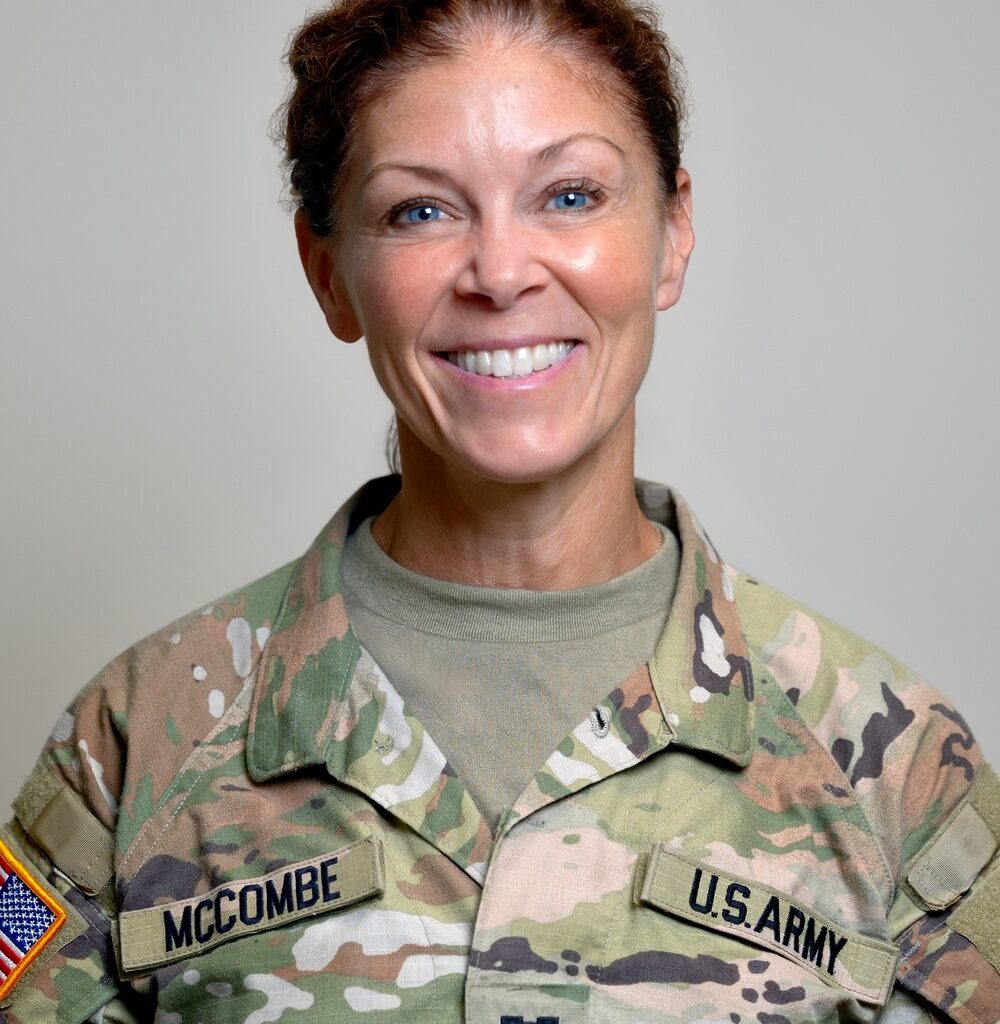
Story and photo by Sgt. 1st Class Terry Rajsombath
CRANSTON, R.I. – Land navigation requires Soldiers and Airmen to stop, check their bearing, and sometimes reorientate themselves to ensure they’re moving in the right direction. It’s a skill that demands awareness, patience, and willingness to change course when obstacles obstruct the path. For Capt. Michelle McCombe, Behavioral Health Officer, with the 43rd Military Police Brigade, the same principles apply to life.
In her civilian career, McCombe works as the Life Skills Instructor at the Naval Academy Preparatory School, located at Naval Station Newport. The school prepares prior-enlisted Sailors, Marines, and high school graduates for the academic and military rigors of the U.S. Naval Academy, which produces future officers of the U.S. Navy. Among her duties, McCombe counsels students considering a drop on request (DOR), a formal process of leaving the program.
“Part of my job is to be a thinking partner – a sound board – to help them make the best decision for them,” said McCombe.
She said the goal is to make them stop at their metaphorical checkpoint and reassess their route, their terrain, and ultimately, their destination.
McCombe guides students by role-playing as the person who strongly encouraged them to pursue a commission as a Naval officer. She asks them to explain their decision as if they were speaking directly to that supporter—the mentor, parent, or leader who believed in their potential from the start. The exercise helps them pause, check their bearings, and decide whether they’re still on the right path.
“If that student looked uncomfortable or was scrambling over their words, I’d ask, ‘How did that feel?’” said McCombe. “If they knew that the school is not the right place, they’d be excited to no longer pursue something that they knew they didn’t want. You should be thinking, ‘I tried. It was a great opportunity, but oh my goodness, I realized it was not for me.’”
McCombe said the difference in mindset often determines whether a person grows from the experience or carries it as a burden.
“When people reassess, they feel liberated and proud that they figured it out,” said McCombe. “When people quit, there’s guilt and shame. They’re embarrassed to say why they stopped pursuing something.”
By walking through this exercise, McCombe helps students reassess and reevaluate, clarifying whether they are setting a new course in the right direction or simply quitting under pressure.
McCombe believes there’s an important distinction between quitting and reassessing.
“In land nav, you’re always checking your points to confirm you’re on the right path,” said McCombe. “But sometimes you realize that point A isn’t where you actually need to go anymore. Maybe point B now makes more sense for your goals or resources. It’s not quitting—it’s strategic reorientation.”
So, whether you’re navigating in the field or through the journey of life, be sure to reassess and reevaluate your objectives so you don’t end up at the wrong destination. And if you’re off course, have the courage to reorientate and set your path toward where you truly belong in life.