
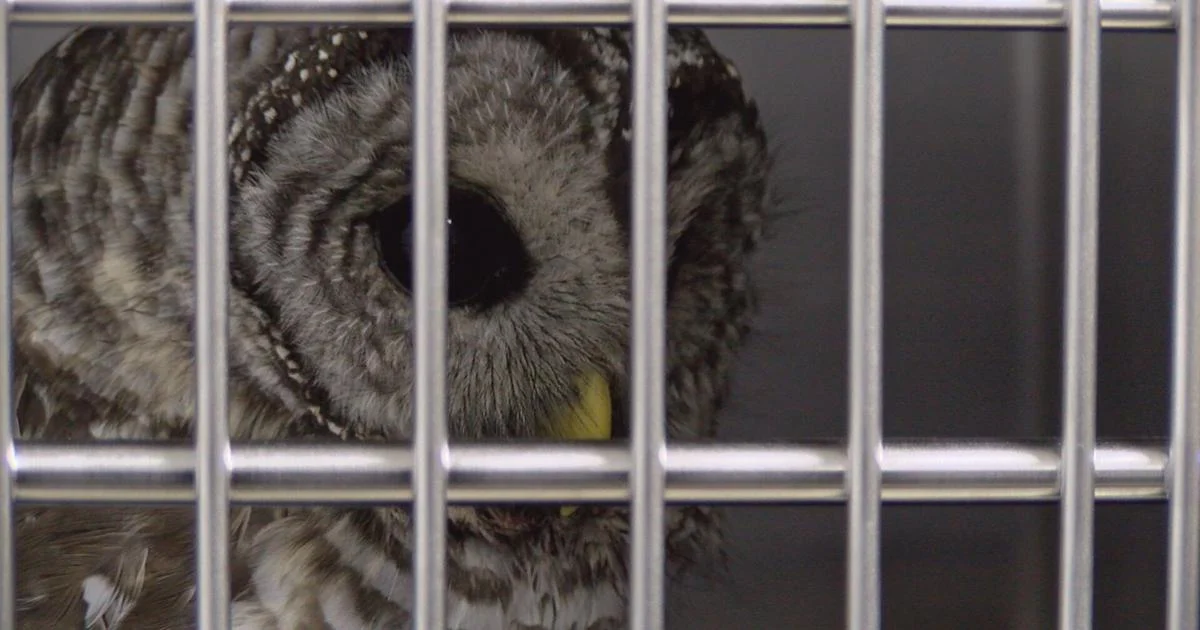
RHINELANDER (WJFW) — A Northwoods resident formed a connection with an injured barred owl last week after helping to save it in Nokomis.
The owl—who was likely hit by a car—is currently recovering with the help of the Rhinelander-based wildlife rehabilitation center, Wild Instincts. Though the future of the bird is up in the air.
Kara Kroupa, the Northwoods resident, found the owl on a normal day.

“I was driving to work like normal, on a normal work day,” Kroupa said. “It had just snowed so there were chunks of snow on the road because they had plowed and whatever else. I went by this chunk of snow and all of a sudden it moved and I’m like ‘that’s not right.’”
She knew she had to do something to save it.
“It almost purred,” she said. “It kind of felt like a connection. It’s a part of life in the Northwoods and I’m attached to it.”
She got help from some Nokomis employees who were able to shelter the owl until Wild Instincts could pick it up and care for the animal.
“Basically, it’s just a matter of getting on pain meds and anti-inflammatories right away,” said Mark Naniot, director of rehabilitation for Wild Instincts. “Getting it in a situation where its warmer, has oxygen and fluids and kind of let the bird rest up for a while and get the bleeding to stop and then we can do a more thorough examination and x-rays.”
After treatment, the was owl healthy enough to stand on its own. Kroupa has been calling the rehabilitation center every day for an update.
“It’s like calling and checking on a loved one in the hospital,” Kroupa said.
But it still has one big obstacle standing in the way of its release: it’s currently blind.
“If you get it soon enough and you can reduce that swelling, a lot times the vision comes back and everything is fine,” Naniot said. “If you don’t get it soon enough or the swelling is too severe or there’s actually damage to that optic nerve, it’s a situation where that does not grow back.”
Blind birds can’t survive in the wild and can’t live in captivity by federal regulation.
“Rehab centers have a success rate of about 50%,” Naniot said. “So that means if you have 1,000 animals come in, 500 get released and 500 of them don’t.”
The owl has been blind for 6 days and after 12 days, it’s likely it’s vision won’t ever return and the bird will be euthanized.
But Kroupa is holding out hope.
“I’m very hopeful,” she said. “They’re just so attentive and so good at what they do there that I’m hoping that for some miracle that this bird comes out of it.”
If the owl’s vision does return, it has no injuries preventing from a full return to the wild.
Wild Instincts, has seen situations like this owl before and recommend people not leave food on the side of the road to prevent more animal injuries like this one. If you want to help Wild Instincts take care of this owl and other animals, you can donate to them through their website.