
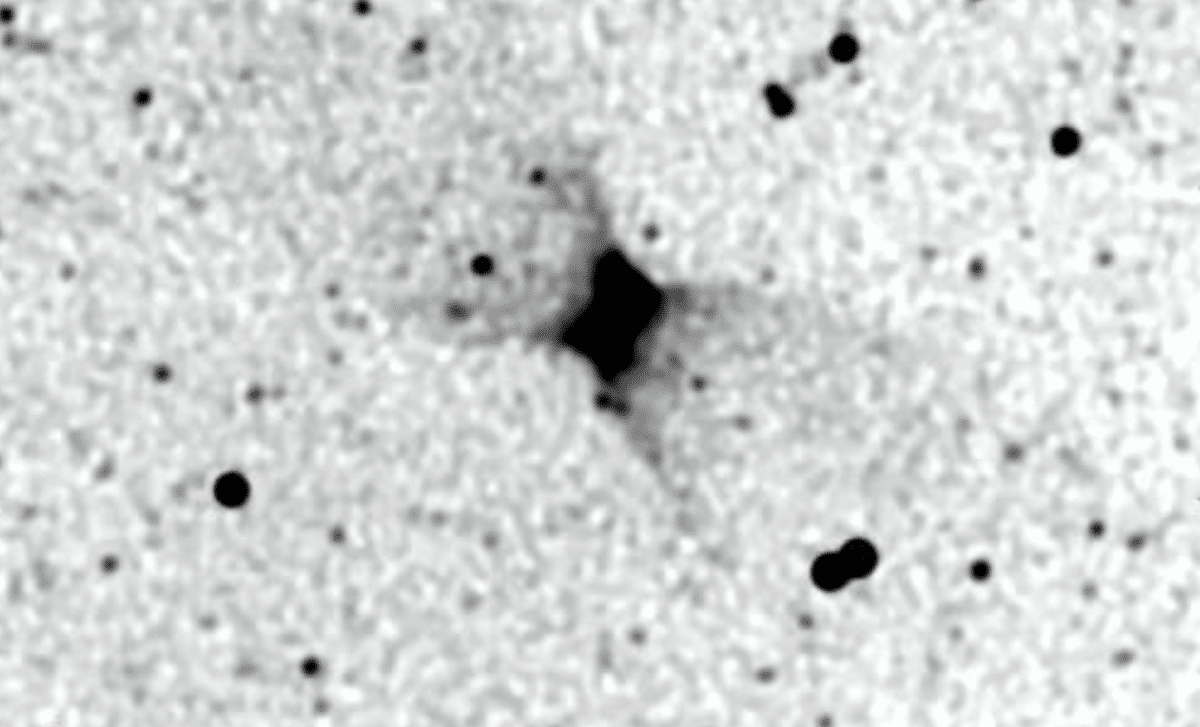
Using Australia’s ASKAP radio telescope, astronomers have detected a massive bipolar outflow of cosmic material erupting from the disk of galaxy ESO 130-G012, offering new clues about galaxy evolution and black hole activity. The discovery, led by researchers from Western Sydney University and published on arXiv on December 17, 2025, was made as part of the Evolutionary Map of the Universe (EMU) project.
A Giant Structure Hidden in Plain Sight
The galaxy ESO 130-G012, located roughly 55 million light years away, might seem unremarkable at first glance: an edge-on spiral with about 11 billion solar masses of stars and a modest star formation rate of 0.2 solar masses per year. But when observed through the lens of the Australian Square Kilometre Array Pathfinder (ASKAP) at 944 MHz, this ordinary-looking galaxy revealed something extraordinary, an enormous bipolar outflow extending far into the galaxy’s halo.
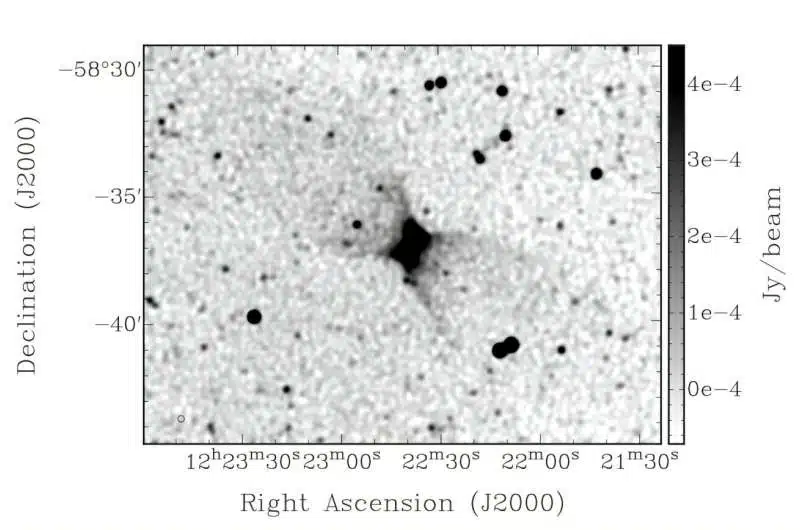 ASKAP EMU 944 MHz radio continuum image of the spectacular outflow from the edge-on galaxy ESO 130-G012. Credit: Koribalski et al., 2025.
According to the authors, the ASKAP data showed a structure that spans at least 6 arcminutes (∼30 kiloparsecs) above and below the stellar plane. “While inspecting deep ASKAP EMU 944 MHz radio continuum images, we discovered a bipolar outflow extending at least 6′ (∼30 kpc) above and below the edge-on stellar disk of ESO 130-G012,” the researchers write. The structure appears symmetric, bursting outward from both sides of the disk like a cosmic hourglass.
The Hourglass Geometry And Its Components
The bipolar outflow forms a dramatic hourglass-shaped structure, stretching up to 160,000 light years into the surrounding halo on either side of the galaxy. The base of the hourglass, what the astronomers refer to as the “waist”, measures about 33,000 light years across, centered around the star-forming disk. The morphology of this phenomenon appears highly ordered, with multiple radio components layered around the core.
According to the paper, the ASKAP radio continuum images reveal not just the outflow, but an intricate structure composed of several parts: a central radio core, knots linked to an inner stellar ring, a thin stellar disk, and a box-shaped thick disk. Emanating from the edges of this box-shaped structure are X-shaped radio wings, forming the wide, open funnels of the outflow. These X-shaped features are typically seen in galaxies hosting active galactic nuclei (AGN), adding to the complexity of interpreting this case.
The bipolar flow appears to begin with a vertical rise from the disk, followed by lateral broadening as it moves outward, creating a characteristic funnel shape with an opening angle of about 30 degrees on both sides of the galactic plane.
What Drives The Outflow?
One of the key questions raised by this discovery is: what exactly is powering this enormous outflow? The study, published on arXiv, suggests that star formation, stellar winds, and cosmic ray pressure across the full width of the stellar disk could be responsible. Given the relatively moderate star formation rate, this would imply that even low-intensity star-forming regions can, under the right conditions, create large-scale galactic winds.
At the same time, the authors acknowledge the possibility of an active galactic nucleus (AGN) or a past central starburst contributing to the flow. The galaxy’s central black hole, estimated to be 50 million times the mass of the Sun, may have once been far more active than it appears today. Its dormant state now doesn’t rule out a past that was far more dynamic.
“Our discovery of a large-scale radio continuum outflow from the disk of ESO 130-G012 makes it a promising target to further explore its disk-halo interface and model the outflow formation,” the scientists conclude.