
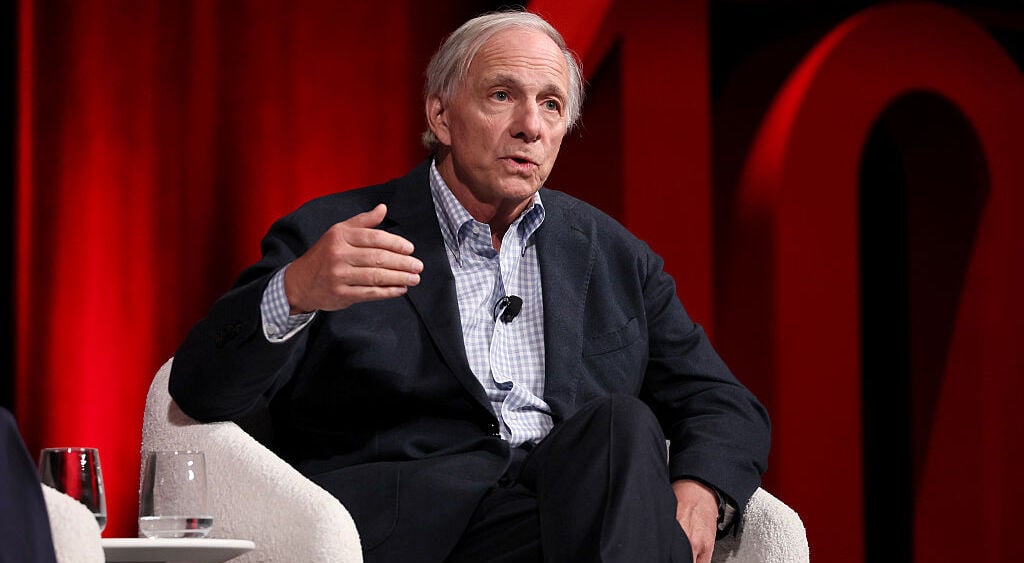
 Jemal Countess/Getty Images
Moneywise and Yahoo Finance LLC may earn commission or revenue through links in the content below.
Hedge-fund billionaire Ray Dalio has a stark warning for America — one that centers on its mounting debt crisis, with national debt standing at a record-high $38.4 trillion (1).
In an interview with CNBC in early 2025, Dalio painted a grim picture of the nation’s financial trajectory, saying it was on course to “a debt death spiral (2).”
“A debt death spiral is that part of the cycle when the debtor needs to borrow money in order to pay debt service, and it accelerates,” he cautioned. “And then everybody sees that, and they don’t want to hold the debt.”
Highlighting the dire situation, he notes that the U.S. federal government now spends almost $1 trillion a year in interest payments to service the national debt.
A report from Fortune in early December related that the Treasury had already paid out $11 billion per week in the fiscal year 2026 to service the nation’s debts, representing 15% of federal spending for the year (3).
To make matters worse, the country continues to run deficits, spending more than it receives. The U.S. Department of the Treasury reports that the federal government ran a $1.83 trillion deficit in fiscal 2024 when it spent $6.75 trillion but only took in $4.92 trillion in revenue.
The Congressional Budget Office (CBO) projects that the federal budget deficit will reach $1.9 trillion by the end of 2025 (4).
When a borrower carries an overwhelming amount of debt, lenders begin to worry about repayment, increasing the risk of default. But according to Dalio, the U.S. is unlikely to default. The bigger threat? Depreciation of our currency.
“There won’t be a default — the central bank will come in, and we’ll print the money and buy it,” he says. “And that’s where there’s the depreciation of money.” Americans are all too familiar with the central bank’s quantitative easing (printing money) during the pandemic — and the resulting loss of purchasing power.
Inflation surged to a 40-year high in June 2022, with the consumer price index (CPI) soaring 9.10% year over year (5). The cost of essentials like food and housing remains stubbornly high.
Read more: Warren Buffett used 8 solid, repeatable money rules to turn $9,800 into a $150B fortune. Start using them today to get rich (and stay rich)’
To recession-proof your investments, Dalio emphasized the power of diversification and the role of one time-tested asset.
“People don’t have, typically, an adequate amount of gold in their portfolio,” he noted. “When bad times come, gold is a very effective diversifier.”
Gold is considered a go-to safe haven. It can’t be printed like fiat money, and because it’s not tied to any single currency or economy, investors flock to it during periods of economic turmoil or geopolitical uncertainty, driving up its value.
So, how much of the precious metal should an investor own? Dalio advises that investors hold 10 to 15% of their portfolios in gold.
In uncertain economic times, investors tend to flock to the precious yellow metal to shockproof their portfolios against market shifts.
Since gold can’t be printed at will like fiat currency, it stores value better during a downturn. Plus, with a gold IRA, you can invest in gold and other precious metals in physical form while also providing the significant tax advantages of an IRA.
If you’re not sure where to start, you can check out some of Moneywise’s top picks for gold IRAs to compare your options for free. Just keep in mind that gold is often best used as one part of a well-diversified portfolio.
With debt on the rise and a somewhat shaky stock market in 2025, it’s natural that investors are looking for other ways to preserve their wealth for 2026. One investment to consider for diversifying your portfolio is real estate. Even if you aren’t ready to jump into home ownership (financially or otherwise), there are platforms like Arrived that let you buy stakes in rental properties, earn dividends and skip the responsibilities of property management.
Backed by world-class investors like Jeff Bezos, Arrived’s easy-to-use platform offers SEC-qualified investments such as rental homes and vacation rentals for as little as $100. Their flexible investment options allow both accredited and non-accredited investors to benefit from this inflation-hedging asset class with ease.
Start by browsing vetted properties, then simply select a property and choose the number of shares to buy.
Investing in necessity-based real estate is another way to hedge your bet with real estate.
Commercial real estate has long been touted as a wise investment for adding stability to your portfolio, outperforming the S&P 500 over a 25-year period.
First National Realty Partners (FNRP) provides accredited investors access to institutional-quality commercial real estate investments. Requiring a minimum investment of $50,000, FNRP lets you benefit from investing in commercial properties without the hassle of being a landlord.
As a private equity firm, FNRP acts as the deal leader and offers white-glove service to investors, providing expertise and doing the time-intensive legwork for you. The team has developed relationships with the nation’s largest essential-needs brands, including Kroger, Walmart and Whole Foods — providing insights into the best properties both on and off-market.
Engage with experts, explore available deals and easily make an allocation, all on FNRP’s secure platform.
But if real estate, gold and other alternative assets don’t fit your portfolio, you could instead consider the dark horse of alternative assets: art.
Like many of the assets in this vertical, art tends to be inflation-resistant and, in some cases, generates competitive returns when weighed against the S&P 500.
Traditionally, this market has been locked behind a network of brokers, dealers, appraisers and experts. But now with Masterworks, you can access the growth potential of art.
Masterworks helps both non-accredited and accredited investors purchase fractional shares of artwork by iconic artists like Banksy, Picasso and Jean-Michel Basquiat. These pieces are referred to as “blue-chip” art, meaning that they’re expected to appreciate in value the same way as blue-chip stocks.
What’s more, Masterworks investors have realized representative annualized net returns like +17.6%, +17.8% and +21.5% among assets held for longer than one year.
Note that Past performance is not indicative of future returns. Investing involves risk. See Reg A disclosures at Masterworks.com/cd.
We rely only on vetted sources and credible third-party reporting. For details, see our editorial ethics and guidelines.
Congress Joint Economic Committee (1); @CNBC (2); Fortune (3); Congressional Budget Office (4); Federal Reserve Bank of St. Louis (5);
This article provides information only and should not be construed as advice. It is provided without warranty of any kind.