
Tom Tassoni’s winter break has been filled with fevers, coughing, soup and Gatorade — times five.
Flu-like symptoms hit the Oak Lawn dad’s 4-year-old daughter about a week before Christmas and soon spread to him, his wife and their two toddlers. They’re just now starting to emerge from the fog of sickness.
“It was a rough Christmas,” Tassoni said. “We’ve just kind of been laid up.”
Across the Chicago area and the country, people have increasingly been coming down with the flu in recent weeks. Flu activity officially jumped to high levels in suburban Cook County, and emergency department visits and hospitalizations for the flu were high in Chicago for the week that ended Dec. 20, according to the county and city health departments.
Chicago-area hospitals say they’ve seen spikes in patients with the flu. Emergency room visits related to the flu nearly tripled in suburban Cook County during the week that ended Dec. 20, said Dr. Kiran Joshi, Cook County Department of Public Health chief operating officer.
Nationally, flu activity is high or very high in more than half of states, according to the Centers for Disease Control and Prevention. In Illinois, flu activity was moderate for the week that ended Dec. 20, according to the state health department.
While it’s not unusual for flu cases to increase this time of year, hospitals say they’re seeing large numbers of patients sooner this year than last year. It’s not yet clear whether the illness is peaking earlier this year, or if this flu season is going to be worse than the last one, doctors say.
“Last year, we also experienced a severe flu season in Cook County,” Joshi said. “While back-to-back severe seasons are uncommon, they can happen, particularly when vaccination rates are low.”
In addition to the flu spreading during holiday gatherings, this year’s flu vaccine also isn’t as good a match as had been hoped for a variant of the flu that’s now circulating.
The new variant, known as subclade K, began spreading rapidly after scientists had already chosen which strains to include in this season’s flu vaccine.
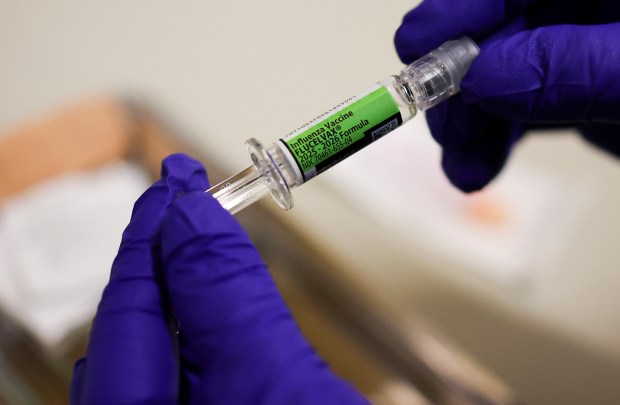 Medical assistant Loreal Velastegui holds a flu vaccine to be administered at the Esperanza Health Centers’ Brighton Park North Clinic, Dec. 31, 2025. (Eileen T. Meslar/Chicago Tribune)
“We’re facing a significant flu season this year,” said Dr. Jonathan Pinsky, infection control medical director for Endeavor Health Edward Hospital.
Last week, Endeavor saw about 900 patients with the flu in its emergency departments throughout the health system, Pinsky said. That means about 11% of visits to Endeavor’s emergency departments were for the flu, up from 1.5% about a month earlier, he said. An average of nearly 80 patients a day were hospitalized across Endeavor with the flu last week — numbers that Endeavor didn’t see last season until about February, Pinsky said.
Rush University System for Health is also seeing more patients with the flu than it did at this time last year, said Dr. David Nguyen, a pediatric infectious disease specialist at Rush.
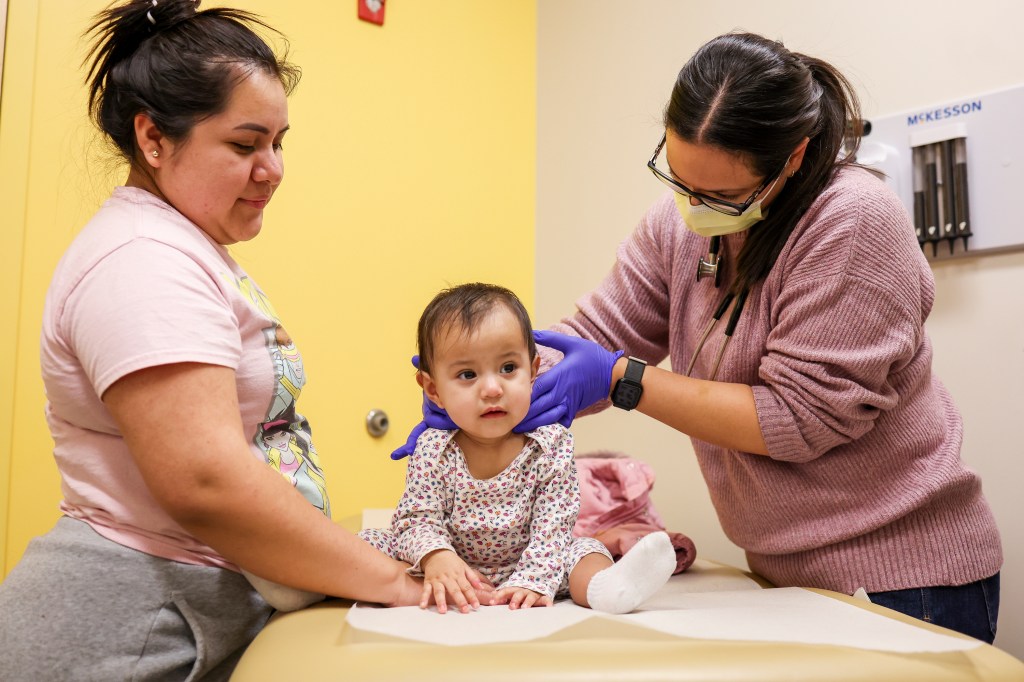
The illness can be particularly rough for young children. Throughout suburban Cook County, emergency department visits by kids for the flu are twice as high as they were at this time last year, Joshi said.
Throughout the Lurie Children’s Hospital system, about 350 children were diagnosed with the flu last week, up from about 90 two weeks earlier, said Dr. Larry Kociolek, an attending physician of pediatric infectious disease at Lurie.
Children younger than 5 are considered to be at higher risk for complications and severe cases of the flu, he said. As of Tuesday, 33 patients were hospitalized at Lurie with the flu or RSV, he said.
“I think people should be concerned. I don’t think influenza is ever something to scoff at,” Kociolek said. “I think people tend to think of the flu as something that’s just another cough and cold. Certainly, while most people won’t get that sick from influenza … the risk of hospitalization and complications is nontrivial.”
People should be vigilant about washing their hands, and those who are sick should try to stay home to avoid spreading the illness, doctors say.
Also, health care leaders say it’s not too late to get a flu vaccine.
Though the vaccine may not be a perfect match for subclade K, it may still help reduce the severity of the illness and cut the risk of hospitalization, doctors say. A study out of the United Kingdom, published in November, found the vaccine offered some protection against hospitalization and emergency department visits.
“There’s still an advantage even if you get it this late,” Nguyen said, “because the flu season will last for a few more months still.”
About 22% of Chicagoans had received flu vaccines as of Dec. 13, according to the Chicago Department of Public Health.
Six-year-old Bentley Appling got his annual flu shot at Rush University Children’s Hospital on Wednesday. After being hospitalized for a few days because of asthma complications, he was feeling better and getting ready to head home.
“Of course, life is unpredictable, people are unpredictable, so it gives me a little relief knowing … he’s well protected, and it will give him a boost for this crazy season we’re experiencing,” said his mother, Melissa Borrero.
The Cook County Department of Public Health continues to offer free flu vaccines in conjunction with Cook County Health and CountyCare at vaccination clinics most Saturdays at rotating locations, regardless of insurance or immigration status. Appointments are not necessary.