
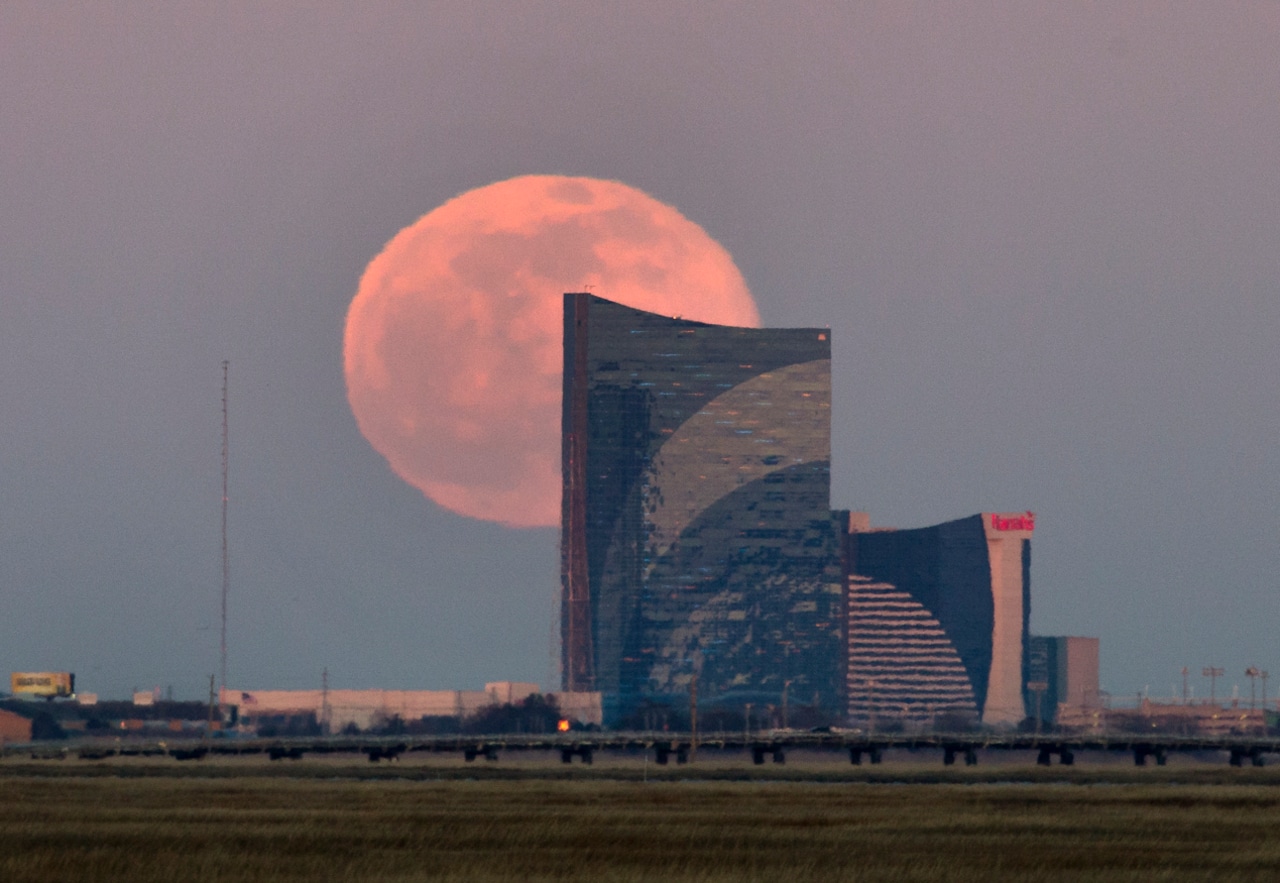
Skywatchers: Tonight’s your night.
The first full moon of 2026, sometimes known as the wolf moon, is rising tonight and putting on a bit of a show.
And this time, it’s extra special.
It’s not just a full moon, but a “supermoon,” meaning it’ll be closer to Earth in its orbit — and thus appear brighter and larger than usual.
What’s a wolf supermoon?
The wolf moon is the traditional name for January’s full moon, rooted in old seasonal naming traditions where people associated the first moon of winter with wolves howling on cold nights.
You’ll often see the catchy nickname credited to the Old Farmer’s Almanac, which popularized the use of traditional names for the monthly full moons, supposedly drawing from “early Native American, Colonial American and European folklore.”
A supermoon happens when a full moon coincides with perigee, the point in the moon’s orbit when it is closest to Earth, according to NASA.
The proximity triggers an optical trick known as the moon illusion. That can make the moon look up to 14% larger and 30% brighter than its smallest appearance in the year, the space agency says.
How do I see it?
The full phase where the moon is most illuminated happened early Saturday morning, but the moon will still look impressively full on Sunday night as it climbs into the sky.
Around sunset, fix your eyes on the eastern horizon — that’s where the moon first pops up, and when the moon illusion will be most dramatic.
Once it has risen, you can watch it move higher through the evening.
Any other viewing tips?
You don’t need a telescope or binoculars to enjoy the wolf supermoon, which will be bright, easy and safe to see with the naked eye.
For the best experience, find a spot with limited light pollution, away from city lights if possible.
If you’re into sky mapping, the gas giant Jupiter will be nearby in the sky in the constellation Gemini over the next couple of nights, according to National Geographic.
But make sure you bundle up: January nights are cold, and clear skies often mean even brisker temperatures.
What else is going on in the sky right now?
Just to sweeten the weekend, the Quadrantid meteor shower peaked on Saturday night and early Sunday morning too — although the moon’s brightness washed out many of the fainter meteors.
Still, if you catch a break in the glare and look toward darker parts of the sky late into the night or early morning, you might see a few lingering “fireball” streaks.
Will there be any other supermoons this year?
The year’s second supermoon will rise on November 25, hitting peak illumination the night before Thanksgiving.
The traditional name for November’s full moon is the beaver moon, as it’s when beavers tend to be busiest building their dams and readying themselves for winter.