
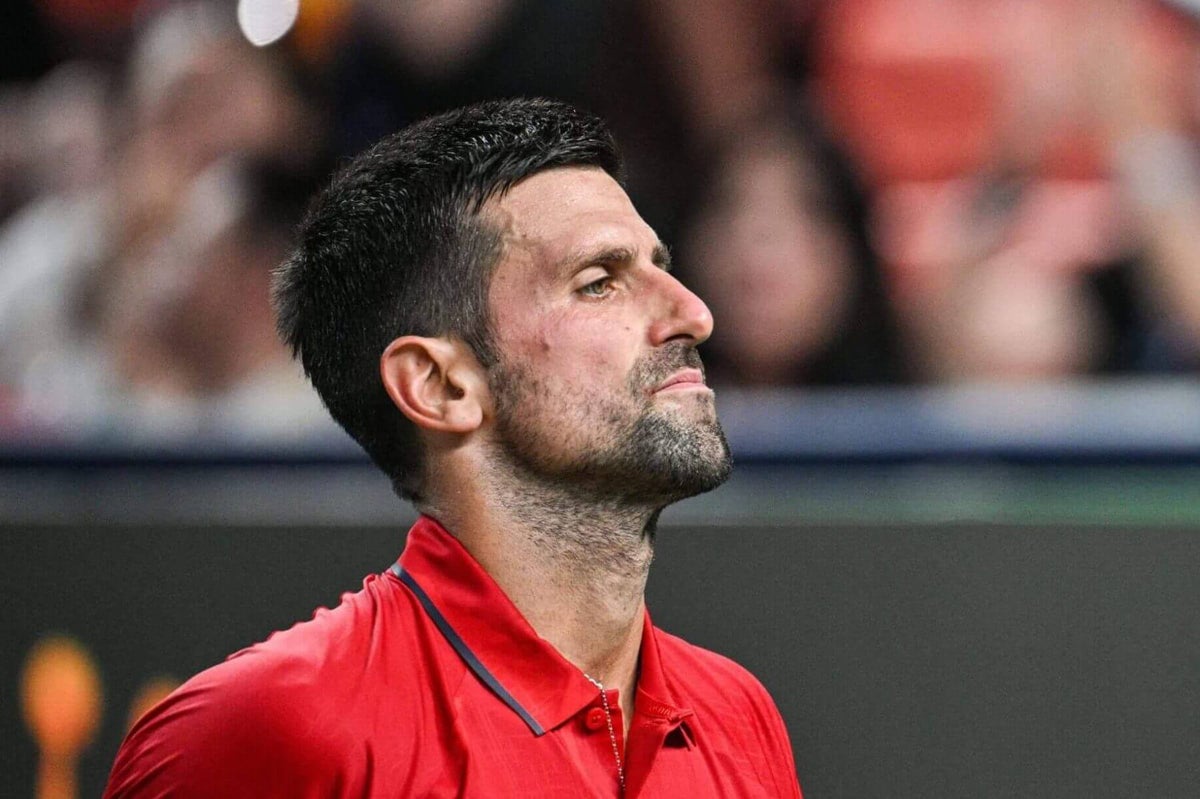
Novak Djokovic announced Sunday that he is stepping away from the Professional Tennis Players Association, which he co-founded five years ago.
“After careful consideration, I have decided to step away completely from the Professional Tennis Players Association,” Djokovic announced on social media.
“This decision comes after ongoing concerns regarding transparency, governance, and the way my voice and image have been represented.
“I am proud of the vision that Vasek (Pospisil) and I shared when founding the PTPA, giving players a stronger, independent voice – but it has become clear that my values and approach are no longer aligned with the current direction of the organization.”
Ahmad Nassar, the executive director of the PTPA, did not immediately respond to a message seeking comment. In a statement, the PTPA later appeared to suggest that Djokovic’s decision may have been linked to what it described as an effort to spread “inaccurate and misleading narratives” about the governance of the organization. It did not name any entities it believed to be the source of those rumors.
“Players created the PTPA to secure a stronger, more transparent voice in professional tennis. The PTPA is governed by players and operates with open communication, collaborative decisions, and regular engagement. We always welcome the opportunity to address issues with any player, and remain available to do so,” the PTPA said.
“As part of its mission, the PTPA initiated litigation against the tours and Grand Slams to advance reforms related to governance, transparency, and player rights. As a result, we have been targets of a coordinated defamation and witness intimidation campaign through the spreading of inaccurate and misleading narratives intended to discredit the PTPA, its staff, and its work. A federal court has already ruled this type of harassment improper and ordered it to cease.
“We are working closely with legal counsel, law enforcement and players to evaluate all available options to address the spread of misinformation. These attacks from non-player third parties will not distract us from our mission: pursuing meaningful reforms for all players.”
Djokovic’s move comes at the center of the PTPA’s most significant undertaking since its founding: a lawsuit against the six most powerful organizations in tennis.
The PTPA filed an antitrust suit against the ATP and WTA Tours in March, also naming the International Tennis Federation and the sport’s anti-doping authorities as defendants. Djokovic was not a named plaintiff in the lawsuit and said during a news conference at the Miami Open in March that he did not agree with all parts of it.
In May, a federal judge ruled that the ATP Tour could not retaliate against players who joined the suit. The ATP Tour had circulated a letter to be signed by its players, saying that any players that signed it did not support the lawsuit, nor the PTPA.
Judge Margaret Garnett ruled that the circulation of that letter, and a specific instance in which an ATP board member pressured two players to sign it, amounted to “coercive, deceptive, or potentially abusive” behavior. Those players were then-world No. 2 Alexander Zverev, of Germany, and Ben Shelton, then the world No. 13.
In September, the PTPA removed the latter two organizations and added the organizers of the Australian, French and U.S. Opens and Wimbledon, which it had previously labeled as “co-conspirators” with a “cartel” formed by the tours that restricted player opportunity, prize money and welfare.
In December, it said that it had reached an as-yet-undisclosed settlement with Tennis Australia. The other three Grand Slams and two tours have moved to dismiss the suit, while the ATP Tour has described it as “entirely without merit” and the WTA labeled it “baseless.” Nassar has said that the PTPA does not intend to litigate the suit all the way to a verdict and is seeking reform focused on prize money distribution and the tennis calendar.
Players, including Djokovic and others not associated with the suit, have been pushing for a higher proportion of revenue from the Grand Slams to go toward prize money. The figure is currently around 15 to 20 percent, where leagues like the NBA, NFL and MLB — which have collective bargaining agreements drawn up between players and leagues — award players closer to 50 percent of revenues.
Djokovic, 38, last year reached all four Grand Slam semifinals but did not win a major. He is seeking a 25th Grand Slam title this year, starting at the Australian Open Jan. 18.
How did Novak Djokovic and the PTPA get here?
When the 24-time Grand Slam champion announced the creation of the PTPA at the 2020 U.S. Open, with a dramatic picture of many of the top men in the game standing on a court together, but socially distanced, Djokovic stood in direct opposition to the ATP Tour.
He also stood in opposition to the other top players who were serving on or had served on its players’ advisory committee, notably Roger Federer, Rafael Nadal and Andy Murray.
Djokovic immediately resigned from that committee and said players could only achieve an equal say and a fair share of revenues for their sport through an independent organization. For a time, Djokovic even threw his support behind a PTPA effort to establish a so-called premium tour that would have included between roughly 15 and 20 of the biggest tournaments in the sport.
However, as the PTPA in recent years became increasingly militant toward the ATP Tour, Djokovic began to quietly distance himself from the organization. He and his associates were frustrated that each time the PTPA did something that might be viewed as antagonistic toward the close-knit world of the tennis establishment, Djokovic got lumped in with those efforts.
He signed deals with sports investors in Saudi Arabia to appear at events there in exchange for millions of dollars in fees. Saudi Arabia has in recent years become one of the biggest investors in tennis and will hold a new ATP Masters 1000 event — the tour’s flagship series — beginning as soon as 2028.
Djokovic’s frustration with his constant connection to the PTPA burst into public view when he decided not to become a named plaintiff in the PTPA’s antitrust actions. The PTPA had desperately wanted him to put his name to the document.
In one sense, Djokovic wanted it both ways — to be a leader of a player effort to gain greater independence and more money, but not if it meant being seen as the leading antagonist of the leaders of a sport that he would like to have celebrate the final seasons of his career.
Djokovic forecasted a split like this at the U.S. Open last summer, when he complained that players needed to do more to force change in the sport than merely complain in the media. He appeared to be sending a message to the new stars of the game. His time as a rabble-rouser seemed behind him.
“This is an ongoing story of the players, particularly top players,” Djokovic said. “They express their feelings, but then you really need to put in the time and the energy into conversations, meetings, which I know it’s very difficult. I have been there, trust me, many times. But it’s necessary because then, you know, you’re doing something not only for yourself but future generations, and you’re making the right moves, the right steps and contributing.”
At the time, he was speaking about the lack of backing he received in 2021, when he tried to push back against the ATP plan to lengthen many of its top-level tournaments by making them 12-day events, nearly as long as the four Grand Slams. Players were already competing in one of the longest seasons in sports.
“I have noticed that a lot of top players have been quite opposing the new change of the almost two-week events, the Masters level,” Djokovic said, two days before he began his latest quest to win what would be his 25th Grand Slam singles title. “I support the players. But (at) the end of the day, when the players needed to be active and when there was a time of negotiations and decision-making, players weren’t participating enough.”
Other groups of top players, including most of the ATP and WTA top 10, have recently sent letters to the four Grand Slams pushing for increased prize money. Though not in formal opposition to the PTPA, their efforts for reform have created conditions in which the tours and the majors, which share similar but competing views for the future of tennis, can play against each other.
The severing of the relationship between Djokovic and the PTPA is as big a win for the tours and Grand Slams against the PTPA as they have had all year.