
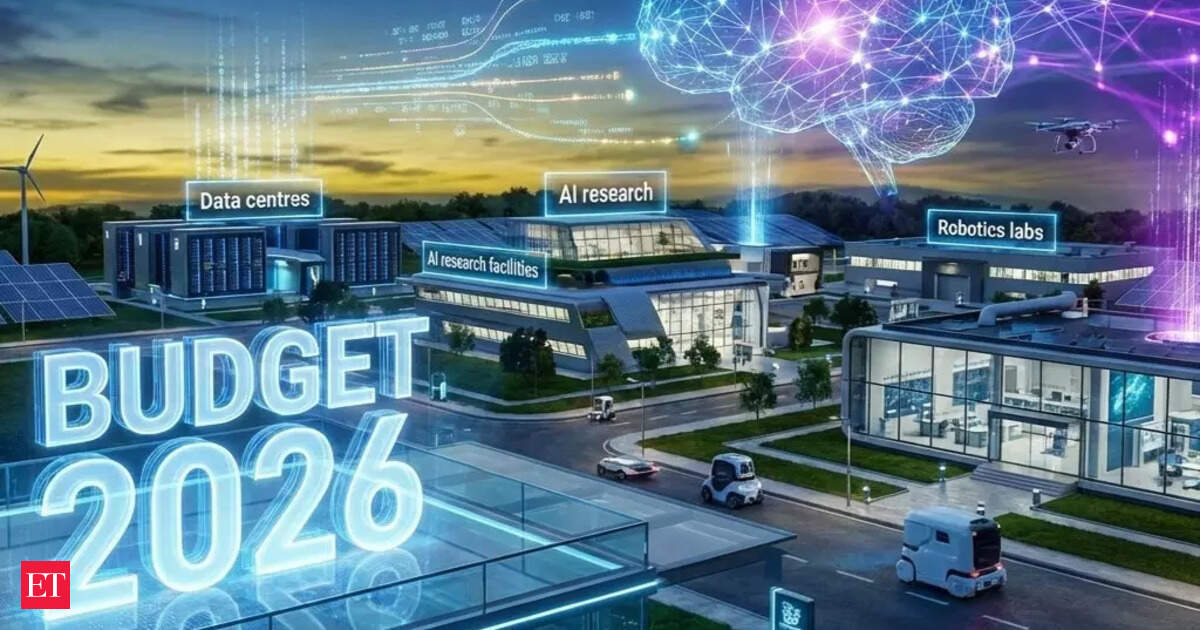
India Budget: As the government prepares the Union Budget 2026–27, the global economic environment is being defined by rapid technological disruption. The trend might find an echo in the upcoming budget.
As per an ET report based on sources, leading economists and experts made a case for targeted policy support for data centres, artificial intelligence and robotics at the pre-budget consultation chaired by Prime Minister Narendra Modi on Tuesday.
Click here to check the latest developments on India’s Budget
They stressed the need to accelerate the diversification of India’s services exports, arguing that higher-value digital, financial, and knowledge-based services could help cushion the economy against global trade volatility.
The upcoming Budget’s focus on these new-age sectors – if the government accepts this recommendation of experts – will show India’s intent to be at the front of the new-age tech such as AI and robotics. These sectors are no longer peripheral technologies. They are becoming foundational for future growth, productivity and competitiveness. A budget that meaningfully supports them would show India’s intent to shape, rather than merely adapt to, the next phase of the global digital economy.
 Live Events
Also Read: How 8 Budgets presented by FM Sitharaman reshaped India’s power game
Cushioning India against global trade volatility
India’s merchandise exports remain vulnerable to external shocks such as protectionism, slowing demand in advanced economies and geopolitical tensions. Services exports have historically provided a buffer, but the next phase of resilience will depend on moving up the value chain. High-value digital services, AI-driven solutions and knowledge-intensive platforms offer greater pricing power and lower exposure to cyclical downturns.Targeted support for data centres, AI and robotics can help India diversify its services exports beyond conventional IT outsourcing. As global firms seek scalable, secure and cost-effective digital infrastructure, India has the opportunity to position itself as a hub for cloud services, AI model training and automation-driven solutions. This diversification would reduce dependence on a narrow set of export markets and protect the economy from sudden global trade disruptions.
Also Read: Budget 2026 measures can upgrade India’s supply chain
Data centres as the backbone of the digital economy
Data centres are the physical backbone of the digital economy, enabling cloud computing, AI processing, fintech platforms, e-governance and emerging digital services. India’s data consumption is growing exponentially, driven by digital payments, streaming, e-commerce, and the rapid adoption of AI applications. However, domestic data centre capacity still lags potential demand.
Policy support through fiscal incentives, rationalised power tariffs, easier land access and faster approvals could accelerate investment in this capital-intensive sector. A strong domestic data centre ecosystem would also enhance data sovereignty, cybersecurity and compliance with evolving data protection norms. In the medium term, it would lower costs for Indian startups and enterprises, making advanced digital services more accessible and competitive.
Artificial intelligence as a productivity multiplier
Artificial intelligence is moving from experimentation to deployment across sectors such as healthcare, agriculture, manufacturing, finance and logistics. For India, AI is not merely about technological leadership but about solving scale-specific challenges, from improving crop yields and disease diagnosis to enhancing public service delivery.
Targeted budgetary support for AI research, domestic compute capacity and industry-academia collaboration can help bridge the gap between innovation and application. Without such support, India risks becoming a consumer of AI technologies developed elsewhere rather than a producer of globally relevant solutions. Strategic investment now would allow Indian firms to build proprietary models, platforms and intellectual property, strengthening long-term economic competitiveness.
While concerns around job displacement often accompany discussions on AI and robotics, it is also true that these technologies can generate new forms of employment if supported by the right policies. Data centres, AI ecosystems and robotics manufacturing create demand for engineers, technicians, data scientists and a wide range of ancillary services. Budgetary support can be designed to integrate skilling, reskilling and regional development, ensuring that the benefits of technological advancement are widely distributed.
Robotics and automation for industrial transformation
Robotics and automation are central to the next wave of manufacturing and industrial efficiency. As global production systems increasingly rely on smart factories and automated processes, India must adapt to remain competitive in global value chains. Robotics can help offset labour shortages in specific sectors, improve product quality and reduce operational inefficiencies.
Policy support for robotics, particularly for manufacturing, startups and applied research, can accelerate adoption while ensuring that India develops indigenous capabilities. When aligned with skilling initiatives, robotics can complement the workforce rather than displace it, enabling workers to move into higher-value roles in design, maintenance and system integration.
Putting India ahead in the global tech power race
The global race for leadership in AI, advanced computing and automation is intensifying, with major economies deploying large-scale fiscal and industrial policies. For India, inaction carries the risk of technological dependence and missed opportunities. A budget that prioritises these sectors would send a strong message to global investors, technology firms and supply chain partners about India’s long-term vision.
Such a policy stance would also reinforce India’s ambition to become a trusted global technology partner, particularly for emerging markets seeking affordable and scalable digital solutions. By aligning domestic capabilities with global demand, India can expand its influence in setting standards, shaping platforms and exporting next-generation services.
The recommendation by economists and sectoral experts to PM Modi — focusing on data centres, artificial intelligence, and robotics — reflects a clear understanding of India’s evolving economic needs. At this juncture, targeted policy support is not just about promoting specific sectors but about building resilience, enhancing productivity and securing India’s place in the global economic order.
If the Union Budget 2026-27 backs the new-age industry, it will be a step toward positioning India at the forefront of new-age technologies. Such a move would demonstrate foresight, ensuring that India’s growth story in the coming decades is driven by innovation, value creation and technological leadership.
Policy support for data centres, artificial intelligence, and robotics is vital for India at this particular juncture. India must anchor its growth strategy in high-value, technology-driven sectors that offer resilience and long-term competitiveness. At the same time, breakthroughs in AI, automation and digital infrastructure are reshaping production, services and geopolitics, and countries that fail to invest early will risk technological dependence and marginalisation in global new-age tech order. Timely policy backing can accelerate domestic capacity creation and attract more global investment. Acting now allows India to shape emerging technologies on its own terms, rather than adapting belatedly to standards and systems set elsewhere.