
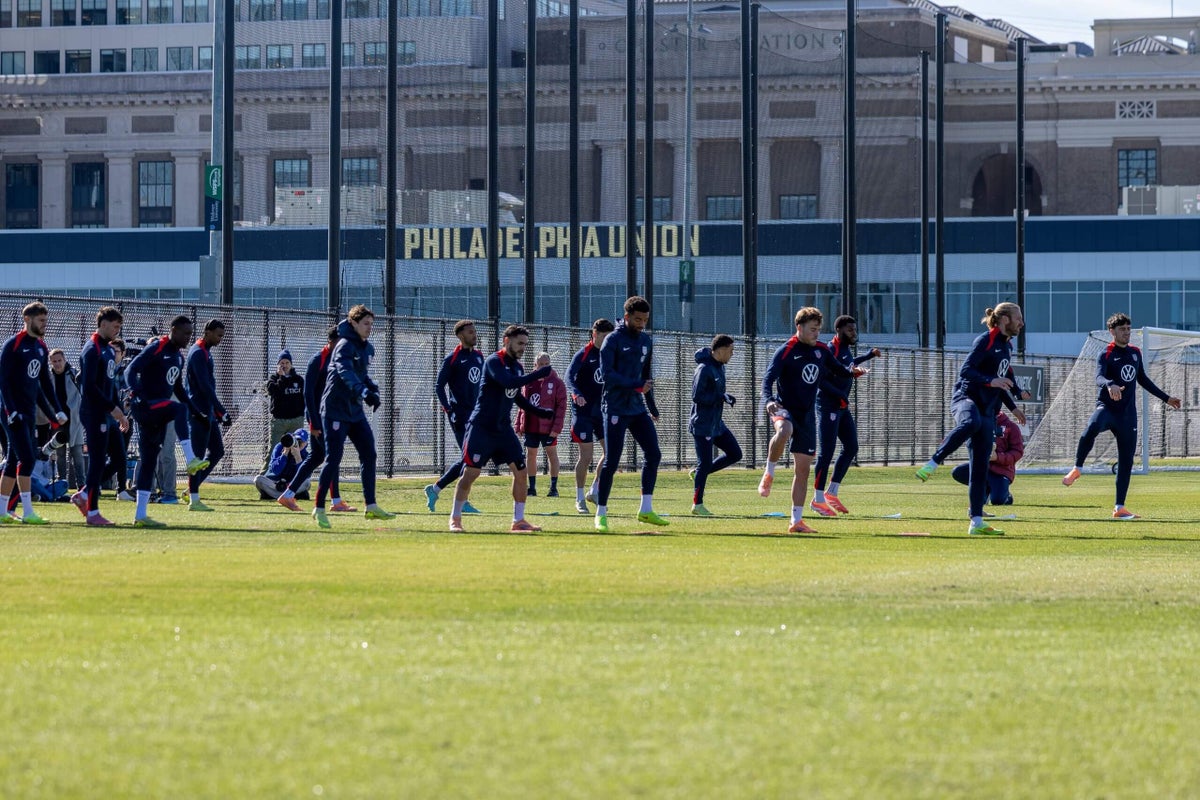
Entering 2026, the U.S. men’s national team is trending upward. After months of apathy and doubt, optimism is suddenly abundant. But that does not mean the USMNT is anything close to a finished product. With a home World Cup six months away, its roster and its starting 11 are far from settled.
Some of the biggest USMNT stories of early 2026, therefore, will be battles that play out remotely. The national team will gather only once between now and the naming of a World Cup roster in late May. Players, whether in MLS or abroad, will have to prove their worth at their clubs.
Some, surely, have already done that. Christian Pulisic, for example, leads the Italian Serie A in goals plus assists per 90 minutes (and across all of Europe’s Big Five leagues, he’s second to only Harry Kane). He will start for the U.S. on June 12 against Paraguay, if healthy.
But other spots — in the 11, in head coach Mauricio Pochettino’s rotation, and on the 26-man roster — are up for grabs. Questions remain unanswered. Who will start in midfield? Who will play right back, or right center back and wingback? Is there room on the roster, or even on the field, for Gio Reyna? And what about the strikers behind Folarin Balogun?
The following is a breakdown of those questions and others, and the key personnel dilemmas that remain unsolved as the World Cup nears.
Who’s starting in midfield?
The evolution of the national team over the past seven months had an enormous impact on what the position battles look like across the field, and it has reshaped how we think about the U.S. midfield entirely.
After operating through most of the last cycle and the first half of this cycle in a 4-3-3, the U.S. now plays in a hybrid 3-4-2-1/4-4-2 setup. That tweak means the U.S. will likely start with two attacking midfielders on the field along with two central midfielders. And the group of players being considered for those four spots grew after the Gold Cup and fall friendlies.
Pochettino is thus weighing two elements to the midfield: what’s the best pairing for midfielders in front of a back line that, when the U.S. has the ball, plays out of a back three; and who are the two best attacking midfielders to complement the wingback/wingers and No. 9.
Let’s tackle the deeper-lying position battle first.
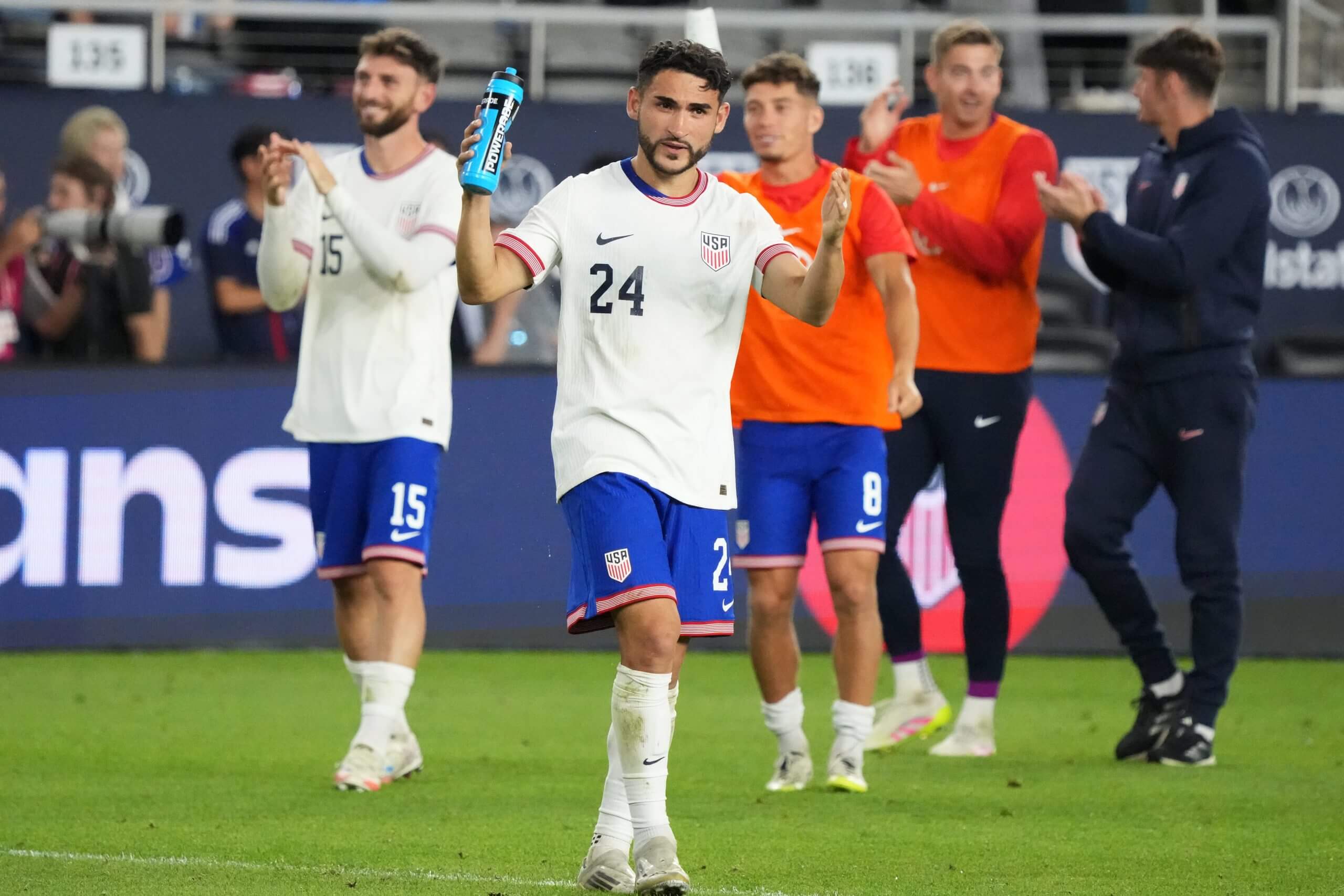
Cristian Roldan’s positive influence has given him a shot at the USMNT’s World Cup roster. (Koji Watanabe / Getty Images)
Tyler Adams feels like a natural starter as one of those two players, but while Adams was often seen as the No. 6 in the U.S.’s 4-3-3, with Weston McKennie and Yunus Musah playing in front of him, there is a real argument to be made that allowing Adams to roam and attack in midfield is the better use of his skill set. Thus, Pochettino could be looking at players such as Tanner Tessmann, Cristian Roldan, Aidan Morris, and Johnny Cardoso as fighting it out at the No. 6.
Adams, then, holds down the top spot on the depth chart in that box-to-box role, but Pochettino has also coaxed fantastic performances out of players such as Sebastian Berhalter, McKennie, Tessmann — and even Timmy Tillman — in that role.
McKennie is maybe the personification of how the math in midfield has changed. Whereas he was always seen as a natural midfield partner for Adams, tucked in behind Pulisic in a 4-2-3-1, or as a more advanced central midfielder in the 4-3-3, he now might be a better fit as one of the dual No. 10s in the 3-4-2-1 formation rather than playing behind the attacking line. Or even as a substitute for Adams in the box-to-box role.
And then, of course, there’s the question of Adams’ health. The Bournemouth midfielder left a 4-4 draw against Manchester United on Dec. 15 with a torn MCL and will miss up to three months. That would put Adams back on the field in March, so he should have time to recover ahead of the World Cup, but his injury is a reminder that the math in midfield can swing dramatically based on the health of any one player.
Our current depth chart for the two central midfield roles:
No. 6: Tessmann, Roldan, Morris, Cardoso
No. 8: Adams, McKennie, Berhalter, Tessmann
Is Gio on the field, or even the roster?
The question about the two attacking midfield roles has to begin with Gio Reyna’s health, form and availability.
Reyna, 23, was once considered the best American prospect ever. His early seasons at Dortmund made him look like the natural follow-up to Pulisic, but the last four seasons have been marred by injury. Reyna totaled just 2,925 minutes across all competitions with his club team since 2021-22 — an average of 731.25 per season. There are real concerns about whether he can stay healthy for a full season and also get back to his previous levels of production.
There is a glimmer of hope. Reyna started four consecutive games for Borussia Monchengladbach in December, the first time he’s completed that feat at club level since August 2021. His 372 minutes in the Bundesliga this year surpass his output for all of last season with Dortmund. Reyna has yet to score or assist for Gladbach, but he did pick up a goal and assist in his return with the U.S. in November.
That adds intrigue to the battle in attacking midfield.
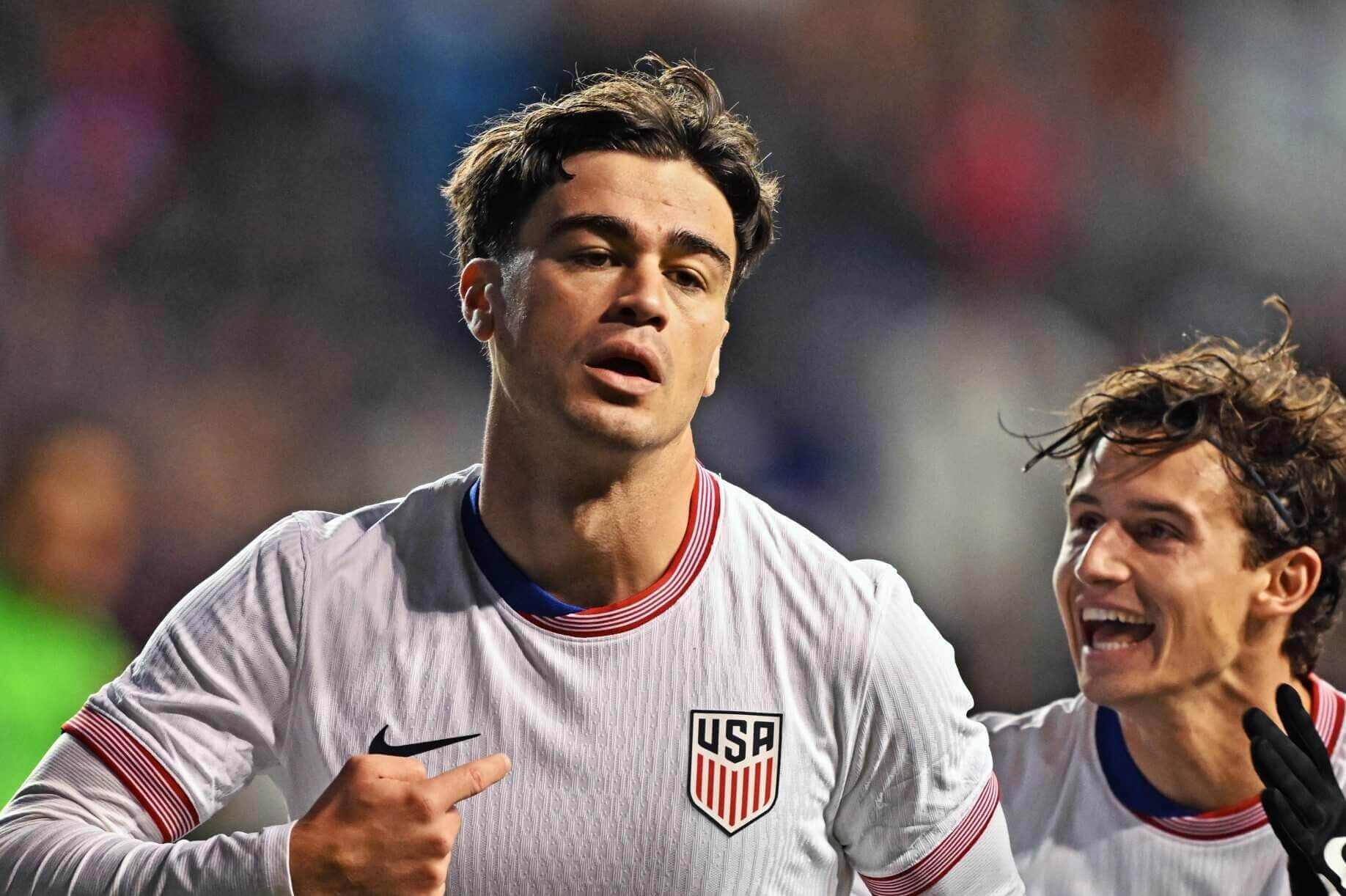
Gio Reyna remains a conundrum for the USMNT. (Drew Hallowell / Getty Images)
Pulisic is a locked-in starter for the U.S. The Milan man is turning in yet another fantastic season in Italy. Pulisic has eight goals and two assists in 12 league games for Milan this season, two goals behind Lautaro Martínez for the Serie A lead.
That makes for a three-way battle at the other spot. In the mix: Malik Tillman, one of the U.S.’s standouts in 2025; McKennie, who has been sharp for Juventus this year, with two Champions League goals; Reyna; Diego Luna, a Pochettino favorite; and Tim Weah, who is an option as a right back/right wingback/winger, but can also play inside.
How many midfielders will Pochettino bring to the World Cup? That could be impacted by the versatility of players elsewhere and the fact that the flexibility of the lineup puts an emphasis on players who can help in multiple spots.
The current depth chart:
No. 10A: Pulisic, McKennie, Luna
No. 10B: Tillman, Reyna, Weah
Who starts at right back? Scally, Dest, Weah or… Alex Freeman?
What even is a right back in this current system? It depends on who you ask and when you ask.
It is notable, however, that Sergiño Dest started alongside Alex Freeman in the 5-1 win over Uruguay, and while Freeman sometimes looked like a third center back, he was actually considered the right back while Dest was a winger.
That sums up the possibilities for Pochettino at the World Cup. In a system in which the U.S. builds out with three but often defends in a four, the outside backs have become sort of hybrid wingers/wingbacks/fullbacks, depending on the size and balance of the team.
Over the past few months, that means Max Arfsten has played as a left back/left wingback, while the right back — whether it was Dest, Tim Weah or Freeman — has been more of a winger than a defender.
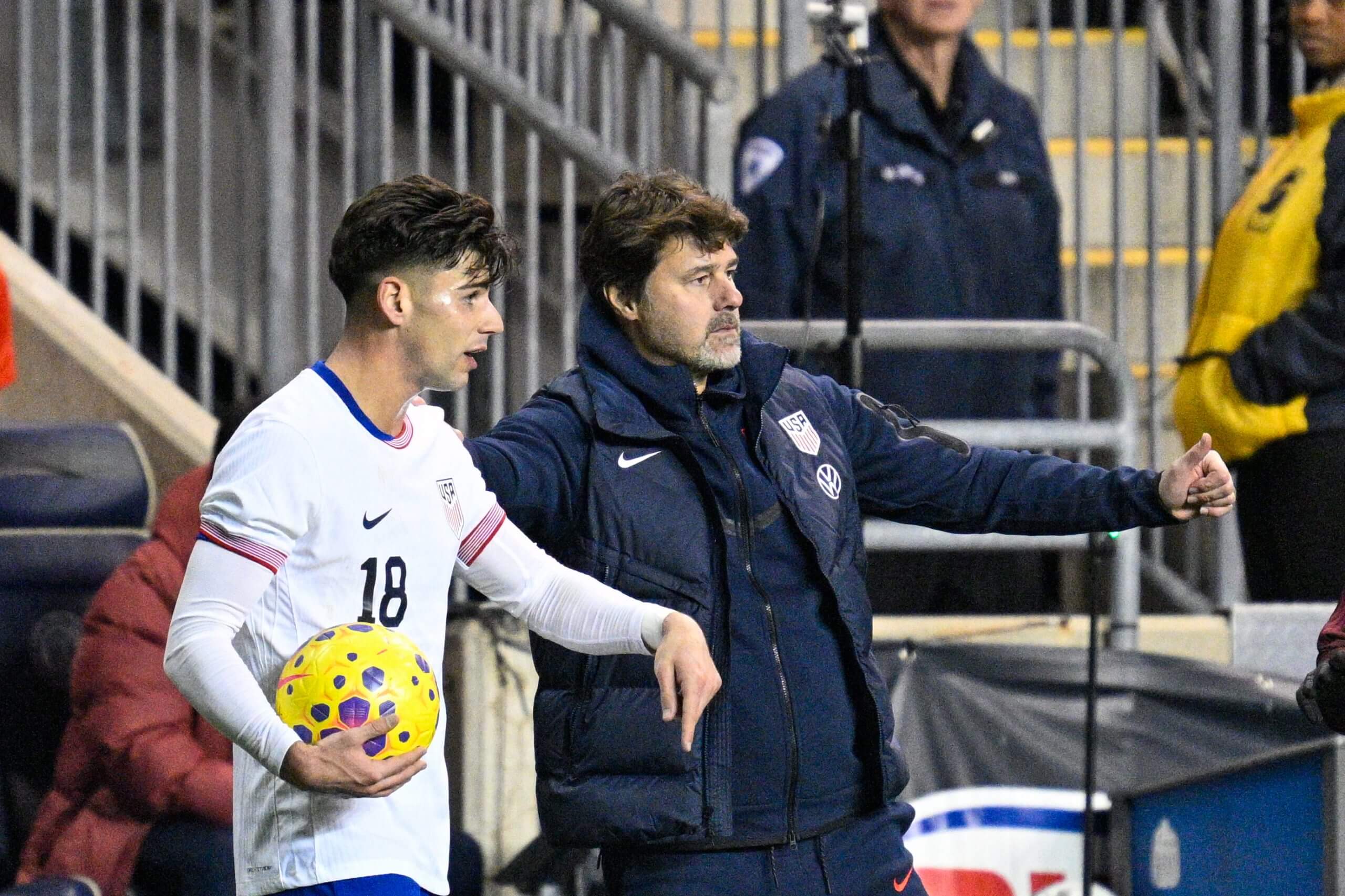
Max Arfsten has earned Mauricio Pochettino’s trust. (Terence Lewis / Icon Sportswire via Getty Images)
Will that look the same when and if Antonee Robinson is back healthy and in the U.S. lineup again? Or will he be asked to push higher up the field? That’s something we might learn in March. But the battle of the right backs has become an interesting study in the different ways the U.S. can beat you. Freeman’s ability to play as a hybrid third center back/right back is especially intriguing because it adds another attacking element for the U.S.
Pochettino might opt to start three center backs in the back line, as he has before with Chris Richards, Tim Ream and Miles Robinson or Mark McKenzie. He might opt instead to start a right back in that spot, as he has with Joe Scally and Freeman. If he opts for the latter, it gives the U.S. some different looks to unbalance the opponent.
Here’s how we think things stand right now in the pecking order:
Left back: Antonee Robinson, Arfsten, Tolkin
Left center back: Ream, Richards
Center back: Richards, McKenzie, Walker Zimmerman
Right back/right center back: Freeman, Scally, Miles Robinson
Right wingback/winger: Dest, Weah
Is Matt Freese definitely the No. 1 GK?
Goalkeeper has been a position of uncertainty ever since Matt Turner’s club minutes vanished in Europe. Freese got an opportunity in June, won the job, and has played every single minute of every match since. So, is the competition closed? Or could Turner win back his place if he re-finds his 2022 form in MLS this spring?
He still has more upside than Freese. He also has World Cup experience. The only scenario where the goalkeeper position isn’t viewed as something of a weakness for the USMNT in June is the one where Turner, now back with the New England Revolution, becomes the shot-stopping machine he was a few years back.
Freese, though, has proven himself to Pochettino. And like Turner, he’s sharp and well-liked by teammates. He’s clearly the frontrunner for the No. 1 shirt, but U.S. coaches will surely be watching both Matts (and other goalkeepers) once the MLS season begins in February.
Which strikers, and how many, will be at the World Cup?
Balogun has almost cemented himself as the USMNT’s starting striker, but beyond him, the depth chart remains in flux. Haji Wright has performed well for both Coventry City and the national team. Ricardo Pepi was performing well a year ago before his knee injury, and he has recaptured that goalscoring form with goals in four straight Eredivisie games and in three of his last four Champions League appearances (all off the bench).
Meanwhile, Patrick Agyemang (six goals in his debut season at Derby County in the EFL Championship) endeared himself to Pochettino at this summer’s Gold Cup and brings a physical presence that this striker group would otherwise lack. And yes, although Josh Sargent has likely fallen off the roster bubble, he — or another forward — could always play his way back into the mix.
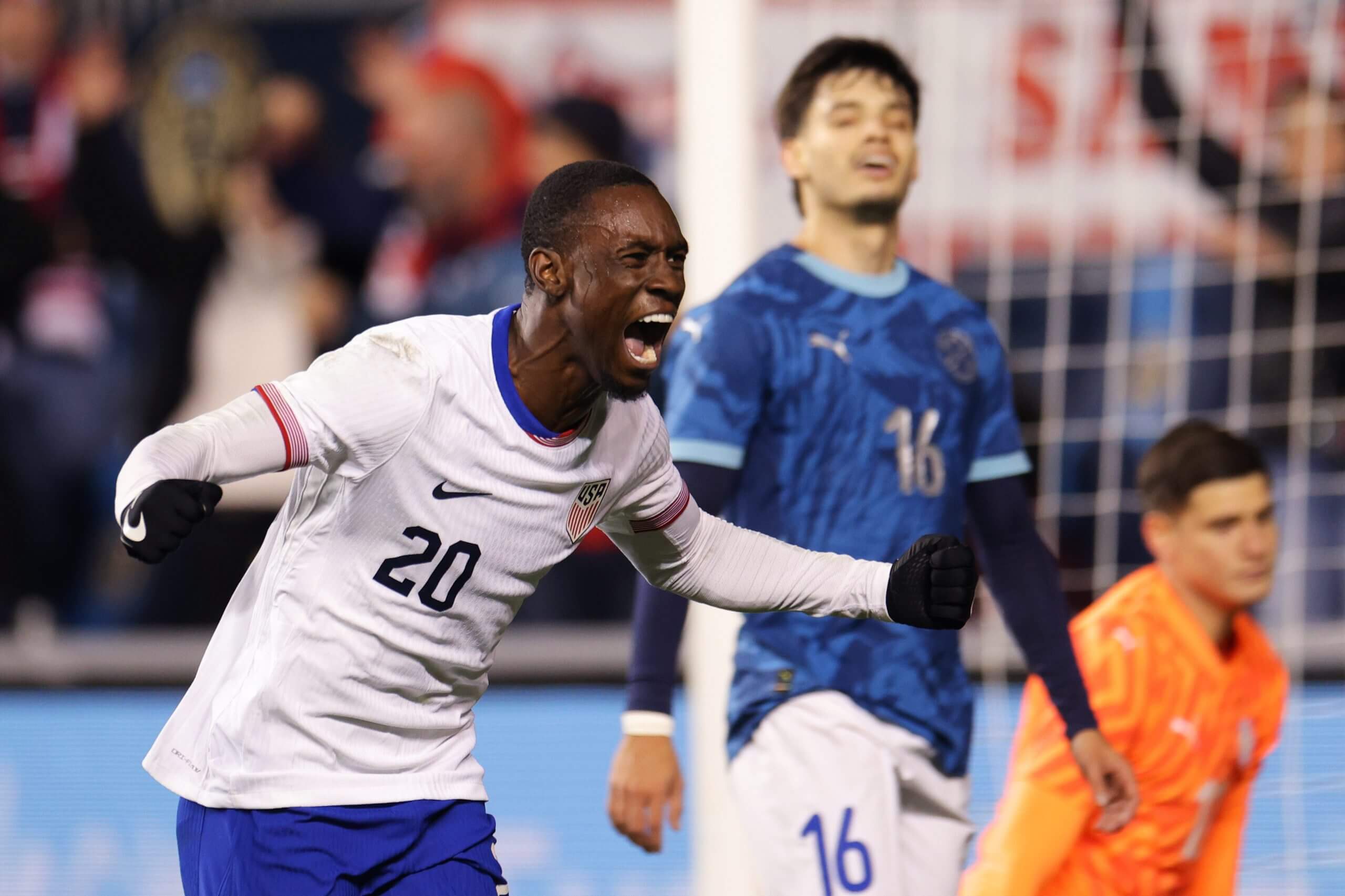
The race for USMNT striker spots behind Folarin Balogun is heating up. (John Dorton / ISI Photos / USSF / Getty Images)
The question for Pochettino, then, is twofold:
Who is Balogun’s backup/supersub? (Or backups, plural?)
If enough options emerge, is it worth taking four strikers? Or is there only room for three?
The answers, as always with strikers, depend on form. Pepi feels like the biggest wild card. Agyemang is probably on the outside looking in, but could fill a unique role — if he continues playing well enough for Derby County. Plenty remains up in the air.