
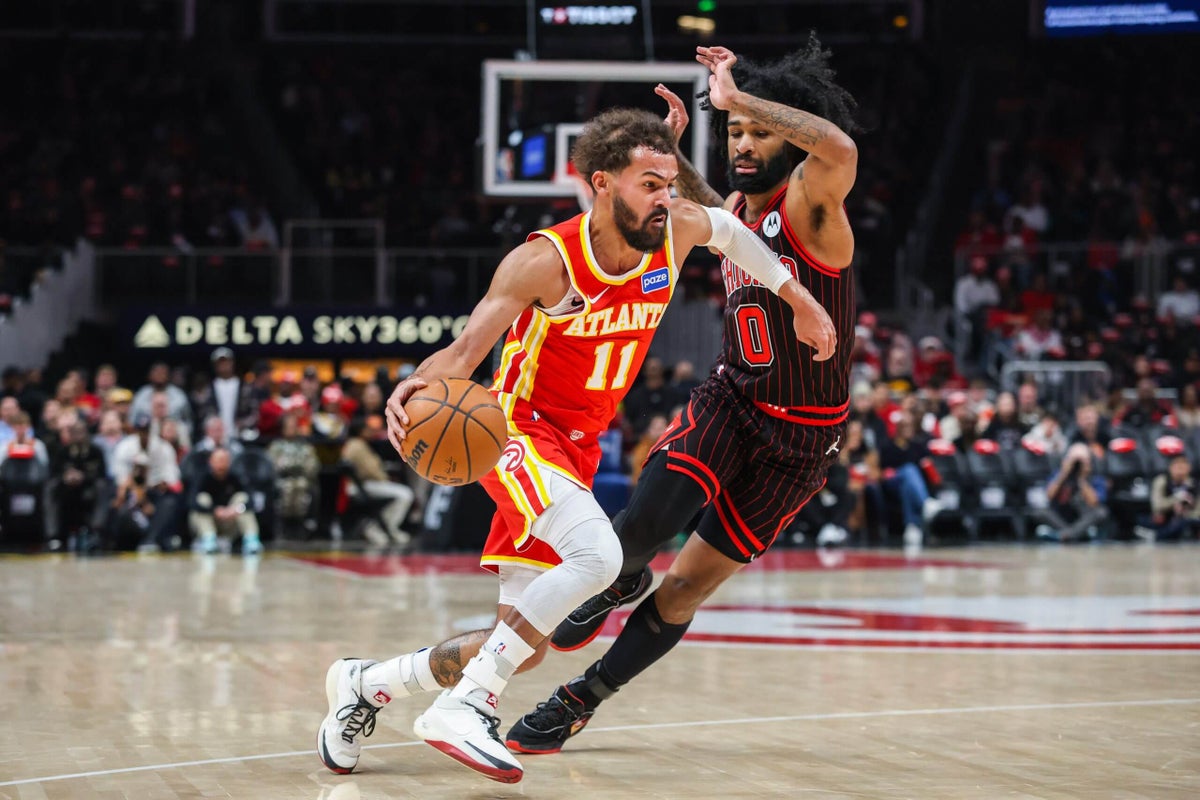
WASHINGTON — Trae Young does not fit the physical archetype favored by Monumental Basketball president Michael Winger and Washington Wizards general manager Will Dawkins.
Most of the players whom Winger and Dawkins have drafted or traded for over the last 31 months possess at least above-average positional size: Bub Carrington, Bilal Coulibaly, Kyshawn George, Tre Johnson, Will Riley and Alex Sarr, to name a few.
At 6-foot-2, Young does not qualify as someone with at least above-average positional size, even as a point guard. So why would the Wizards have interest in adding Young via a trade with the Atlanta Hawks, as a report Monday night on The Stein Line suggested?
A deal for Young would make at least some sense for the Wizards if it includes a future draft pick (or picks) and/or a promising young player who is under long-term contractual control.
Adding future draft picks and promising young players arguably has been a larger priority for Winger and Dawkins than adding positional size.
It should be noted that it’s unclear whether the Wizards actually are considering adding Young. Reached early Monday evening, a Wizards official said the team does not comment on trade rumors.
Draft capital and/or a young player seemingly would be in the offing for the Wizards, because the Wizards would be adding salary in any deal in which it would acquire Young’s contract. Young possesses a $49 million player option for the 2026-27 season, which would make him the team’s highest-paid player.
The Wizards could afford to accept that salary, however. The team currently projects to have approximately $80 million in cap space available for the 2026-27 season, in large part because CJ McCollum’s contract, worth $30.7 million this season, and Khris Middleton, worth $33.3 million this season, are set to expire.
McCollum likely would be the primary outgoing player in a deal, The Stein Line reported.
How Young would fit in on the court with the Wizards is more difficult to gauge. On one hand, he would provide additional gravity on the perimeter. In Atlanta, his impressive shooting range has forced defenders to guard him beyond the 3-point line, which, in turn, creates space for other Atlanta players to operate.
Opponents sometimes send a second defender at him, and Young excels at passing out of double-teams, leaving opponents scrambling in defensive rotations.
As long as the Hawks are patient, making subsequent passes, they can eventually generate open shots. Having more open shots would be a godsend for Johnson, who has made 50 percent of his wide-open 3-point attempts during his rookie season, and for Carrington, George and Sarr, who have made leaps with their long-range shooting as second-year players.
Young, 27, also excels as a pick-and-roll ballhandler, and Wizards bigs, led by Sarr, would feast on rolls to the hoop.
Under coach Brian Keefe, the Wizards have implemented an offense predicated on ball movement, pace in transition, pace in the half court and multiple ballhandlers.
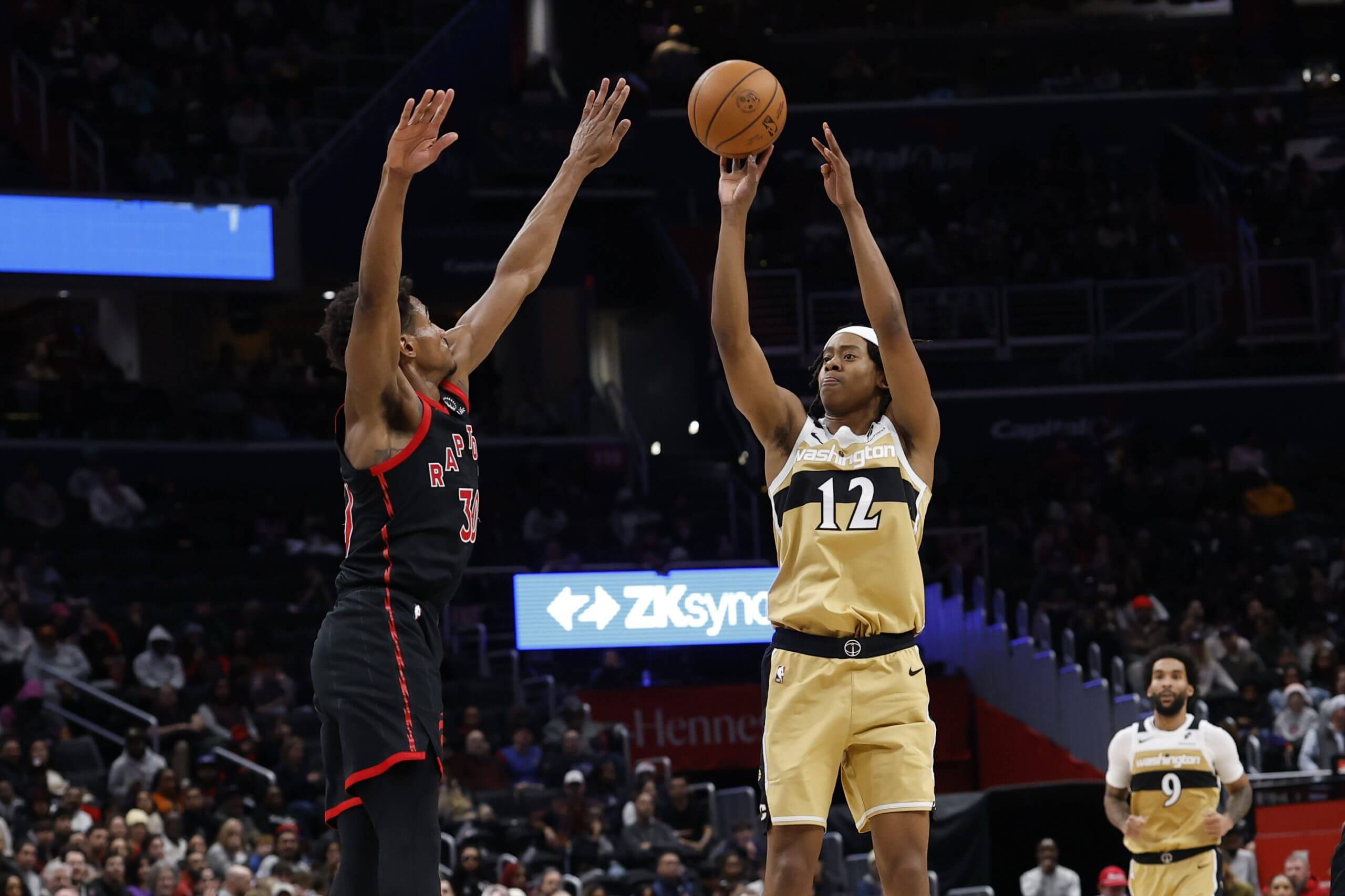
Washington Wizards rookie shooting guard Tre Johnson has made 41.2 percent of his 3-point attempts this season. Playing alongside Trae Young likely would mean that Johnson and other Wizards players would get more wide-open shots. (Geoff Burke / Imagn Images)
Passing is a hallmark to Young’s game. He has averaged more than 10 assists per game three times in his eight-year career, finishing last season as the NBA assist leader, at 11.6 per game.
The problem for the Wizards likely would be the same problem the Hawks have encountered: Young’s shortcomings on defense. He struggles at the point of attack. His lack of size is a detriment.
Washington, it would seem, cannot afford to add more subpar defenders. Despite Sarr’s growth as a rim protector, the Wizards entered Monday ranked 29th in the NBA in points allowed per possession. A porous perimeter defense has been the main culprit.
Even if Coulibaly, the Wizards’ top perimeter defender, can remain healthy — the third-year wing has played in only 20 of the Wizards’ 34 games this season — Young is the kind of player who is difficult to hide on defense, even if Coulibaly, George and Sarr continue to make strides as defenders.
McCollum has been a liability on defense. Washington has surrendered 3.8 more points per 100 possessions when McCollum is on the court than when McCollum is off. Perhaps swapping McCollum for Young would not create as severe a drop-off on defense as Young’s reputation indicates.
If the Wizards trade for Young — again, a substantial “if” — team officials might view that move as a one-year trial.
If it works out, great. If it fails, then the team would not have any long-term salary obligation to him after the 2026-27 season. His expiring $49 million salary in 2026-27 would be an asset in its own right, as McCollum’s and Middleton’s expiring salaries are assets now.
Young would give Washington a degree of star power that it currently lacks. The Wizards average 15,865 fans per home game, the second-lowest figure in the NBA this season, according to a tabulation by the Elias Sports Bureau. A little extra buzz in the building, and perhaps a lot of extra offense, would not be a bad thing.