
CROOK COUNTY, Ore. — Bird watching is not always a fair-weather activity. Some of the most scientifically important bird watching is done in the winter by volunteers who conduct surveys and report their findings to a national database.
“Red-tailed hawks like to perch about 30 feet above the ground. Well, we very conveniently put 30-foot perches every 150 to 200 feet when we put these power poles up. That created all kinds of perfect feeding habitat,” said Chuck Gates of the East Cascades Bird Alliance.
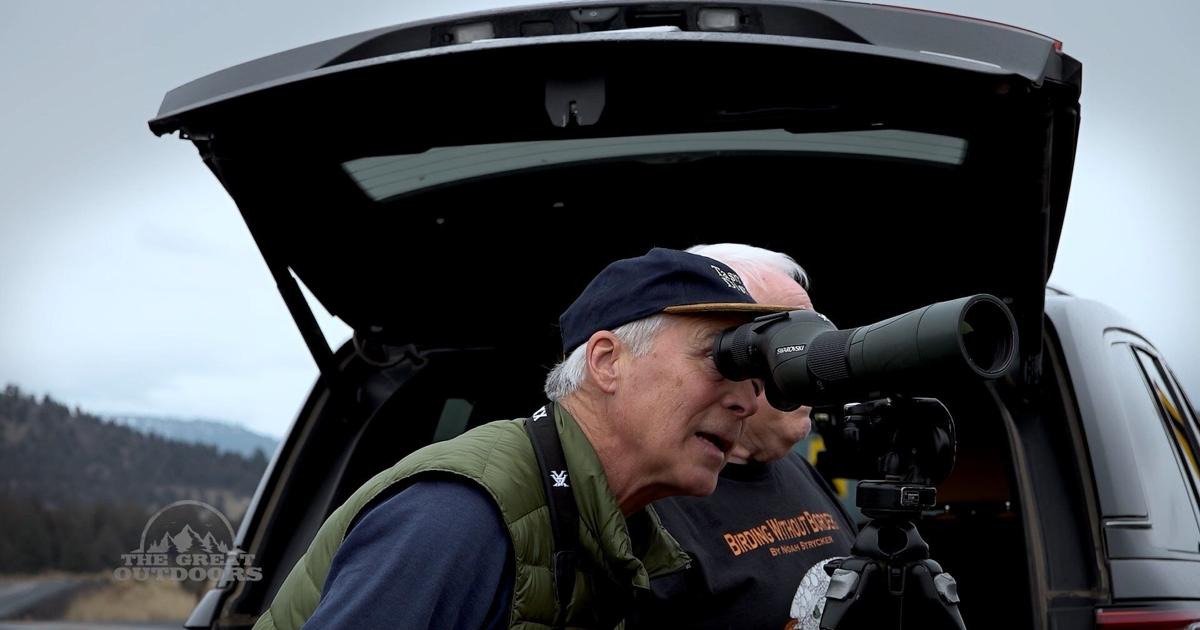
Gates and Allen Schauffler, volunteers with the East Cascades Bird Alliance, are conducting a winter raptor survey in the upper Paulina Valley, some 50 miles east of Prineville. This is one of several routes they drive every month in the depths of winter looking for hawks, eagles and owls.
“Check every phone pole, power pole, wire, fence post, fence line, ridgeline. Check it all, just to see if there’s anything that catches your eye that’s different,” Schauffler said.
Raptor surveys are conducted by volunteers who drive designated routes once a month in December, January and February, recording each raptor seen.
“This shows the route we’ll be taking as we go through different sections,” Gates said, indicating a clipboard and form. “We keep track of the raptors that we find in each of those sections, and then we total them up at the end.”
The data they collect is submitted to the World Center for Birds of Prey in Boise, Idaho, which shares it with federal agencies such as the U.S. Fish and Wildlife Service.
Raptors are a bit of a canary in the coal mine. Because eagles, hawks and owls are at the top of the food chain, chemicals and pollution can build up in their bodies. A tragic example occurred in the 1960s when a pesticide known as DDT thinned the eggshells of bald eagles and put the national symbol on the endangered species list.
Bald eagles have since recovered, but it took decades of environmental policy changes, careful wildlife management and monitoring to bring them back.
“We can get a really good grip on what the environment is like in Central Oregon if we take a look at those raptors and watch to see if their populations are rising or falling,” Gates said. “Up is a good sign that we are doing the right things. Down is a bad sign.”
These surveys, which have been going on for more than 20 years, are finding growing numbers of raptors. This kind of long-term, broad-based, scientifically valid data gathering and reporting suggests environmental policies are benefiting all animals, not just the majestic birds of prey.
“The learning process is just fascinating for me. How do you actually look? I mean, look out here,” Schauffler said, gesturing at the broad landscape. “How do you actually pick out a hawk, an eagle or a falcon out of all this territory? Learning the tips from Chuck — look for anything on a tree that doesn’t look like a tree. Look for any light dot in a dark background. That could be a mature bald eagle.”
The winter raptor survey is citizen science in action. These volunteers are helping underfunded and understaffed federal agencies adequately monitor wildlife populations, and they get to look at their favorite birds of prey while doing so.
“We want to gather information so that we know what’s going on,” Gates said. “We don’t want to be blindsided. It’s happened too many times when a species gets too far gone before you even realize it. Species like the passenger pigeon have gone extinct because of that very thing. We didn’t realize it was a problem until it was too late. We learned those lessons from birds like that, and we don’t want to see it happen again with any bird species — any animal species at all.”
In the few hours I spent with the raptor survey volunteers, we spotted several bald eagles, red-tailed and rough-legged hawks, a harrier and a kestrel.
“This is fun. Gorgeous country. Spectacular wildlife. Really pretty birds — a continual learning process. It’s just click, click, click. It keeps me going,” Schauffler said.
“I just go out and count birds, record the data and contribute to our knowledge of what birds are here. It’s fun for me,” Gates said. “What’s also fun for me is to take people who are not very experienced and show them the birds. They are always fascinated by it. That’s why I do it.”