

As one of only four states helping to cover the loss of federal health insurance subsidies, Connecticut has earmarked $120 million over the next 18 months to soften the blow for more than 150,000 Connecticut residents. That includes about $70 million for the current calendar year as state officials do not know when the issue might be resolved in Washington, D.C.
President Donald Trump’s administration and the Republican-controlled Congress did not renew the Affordable Care Act subsidies that had made health care more affordable with enhanced federal credits since 2021.
Unlike more than 20 million Americans across the country who saw government subsidies for health insurance cut off on New Year’s Day, Connecticut residents can still sign up to get state-subsidized health insurance for at least three more weeks.
Access Health CT, which operates the system in Connecticut, pushed the enrollment date for health and dental plans to Jan. 31, but officials said that deadline could be extended again until the end of February or beyond.
“We’re trying to do everything we can to keep up with the changing landscape down in Washington,” Gov. Ned Lamont told reporters Wednesday at the state Capitol in Hartford. “The subsidies on the exchange have been on and off. (Congress) thought they had a compromise. Then they didn’t have a compromise.”
The assistance goes to a wide range of incomes, depending on the size of the family.
“For everybody earning up to about $56,000, there’s no out-of-pocket, no cost,” Lamont said. “Families earning up to about $128,000, we’ve got your back. Many of you will see your health insurance costs go down. For folks up to about $165,000, we can’t make up for all the loss of the subsidies, but we can make up for about half of that. Rather than paying an extra $1,000 or $2,000 out of pocket per month, it’s going to be a lot less than that.”
Despite the confusion in Washington, the enrollment in Connecticut was actually up by about 3% as of Jan. 2, officials said.
It was still unclear Wednesday if the state might eventually receive reimbursement in the future to recover the subsidies.
When asked by The Courant if the overall funding is enough, Lamont responded, “No, we’re not going to be able to make up all of the federal shortfall forever. But at least we can give people confidence right now that we’ve got your back. You’re probably going to see your rates stay the same or even go down for everybody earning up to about $160,000 per year.”
Besides Connecticut, the states offering help on the subsidies are Maryland, California, and New Mexico, officials said.
The state’s acting insurance commissioner, Josh Hershman, delivered a simple message to anyone listening to top state officials.
“Get health insurance, please,” Hershman said with Lamont standing nearby. “If you’re out there today, log on to accesshealthct.com.”
Federal level
The U.S. House of Representatives is scheduled to vote as early as Thursday on an extension of the aid.
“Republicans failed to advance a three-year extension of the Affordable Care Act subsidies that would keep health care affordable for 26 million Americans and 143,000 Connecticut residents this year,” said U.S. Rep. Rosa DeLauro, a key player as ranking member of the House Appropriations Committee. “However, thanks to the efforts of House Democrats and a few Republicans, we were able to force a vote on a three-year extension of these desperately needed subsidies. I urge my Republican colleagues to stand with their constituents who are struggling because of the affordability crisis President Trump has intensified.”
The issue has gained national attention for months.
“We’re fortunate in Connecticut that Governor Lamont has stepped up to cover some of the cost for our most vulnerable residents, and I applaud his efforts to ensure residents of Connecticut do not fall in the gap,” DeLauro said. “But this is not and cannot be a long-term solution for keeping health care affordable. We must reenact these subsidies.”
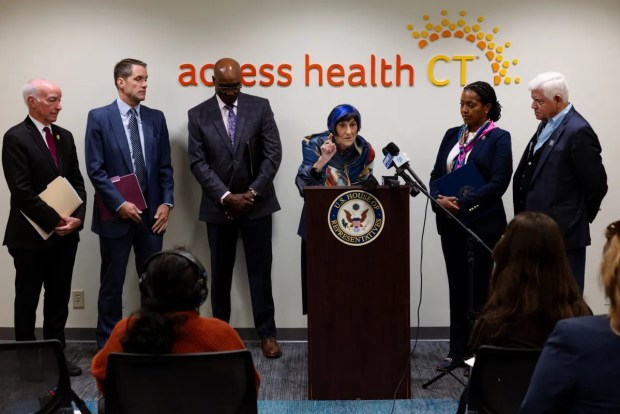 Connecticut’s Congressional delegation has been seeking increased healthcare subsidies in Washington, D.C. Here, U.S. Rep. Rosa DeLauro of New Haven is shown during a press conference at Access Health CT in Hartford in October 2025. U.S. Rep. Joe Courtney, Rep. Jim Himes, Access Health CT CEO James Michel, Rep. Jahana Hayes and Rep. John Larson stand behind her. (Shahrzad Rasekh / CT Mirror)
Lamont’s plan, which has been submitted to the legislature after $500 million was set aside for overall social service needs, calls for replacing the expiring premium tax credits “for residents enrolled in Covered CT, including adjusting the current assessment on total premiums to reimburse carriers for potentially higher utilization in this program through June 30, 2027, in the amount of $64,100,000.”
In addition, the plan also calls for replacing the subsidies “for individuals between 100% of the federal poverty level (FPL) and 200% FPL who are not on Covered CT and 50% of the lost subsidy for individuals between 400% FPL and 500% FPL during calendar year 2026 in the amount of $50,760,000.”
Christopher Keating can be reached at ckeating@courant.com