
Support CleanTechnica’s work through a Substack subscription or on Stripe.
Windows are a blessing and a curse. They are a blessing because they let sunshine in to make the interior of buildings feel airy and bright. But that sunlight also allows heat in, which requires us to use more air conditioning to keep those inside comfortable. Worldwide, about 40 percent of all energy use is devoted to heating and cooling buildings. There is a lot of interest in solar windows, but there may be more important news about windows.
What if there was a way to let light through but reduce the amount of heat that gets transmitted through those windows — either from the outside in or the inside out? That would go a long way toward reducing the demand for electricity, which would have the knock-on effect of lowering greenhouse gas emissions that make the planet even hotter than it already is.
Researchers at the University of Colorado Boulder say they have invented just the thing — a coating just 5 millimeters thick that contains millions of tiny air bubbles. It allows 99 percent of the available light to pass through while reducing heat transfer by 90 percent. Their research was published December 11, 2025, in the journal Science, but since it is behind a paywall, we will let the press release by UCB explain it.
Meet MOCHI
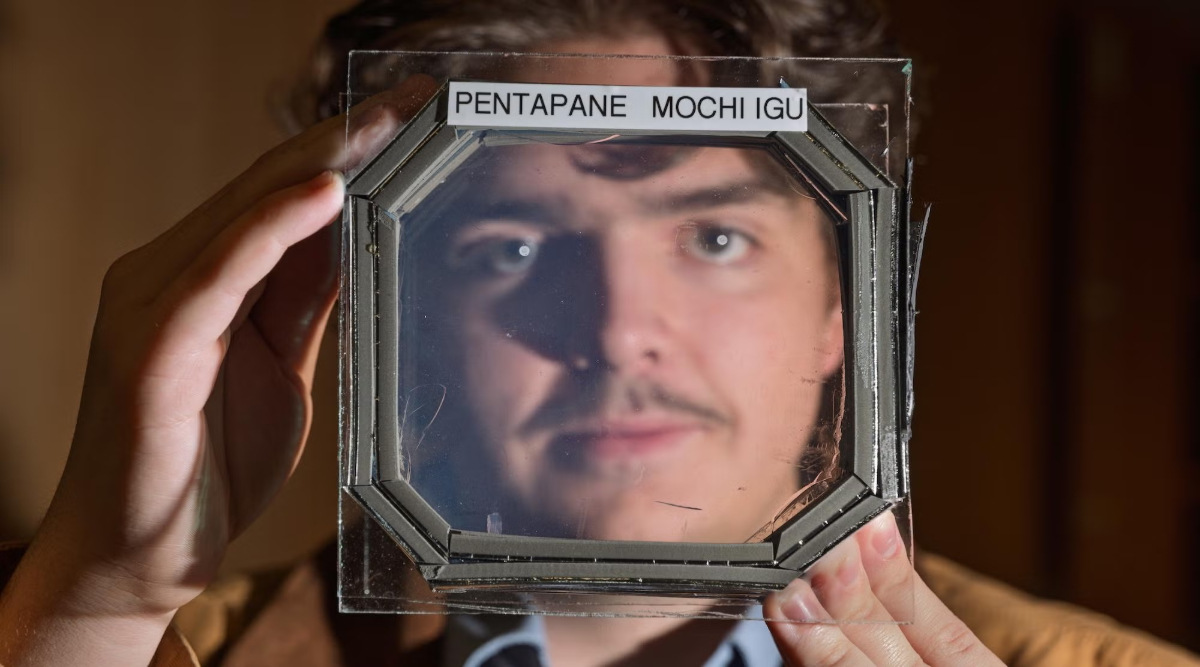
The material the researchers invented is called Mesoporous Optically Clear Heat Insulator — MOCHI for short. It comes in thin sheets that can be applied to the inside of any window. The researchers say MOCHI is long-lasting — up to 20 years — and almost completely transparent.
“To block heat exchange, you can put a lot of insulation in your walls, but windows need to be transparent,” said Ivan Smalyukh, senior author of the study and a professor of physics at CU Boulder. “Finding insulators that are transparent is really challenging.”
MOCHI is a silicone gel with a twist: The gel traps air through a network of tiny pores that are many times thinner than the width of a human hair. Those tiny air bubbles are so good at blocking heat that you can use a MOCHI sheet just 5 millimeters thick.
“No matter what the temperatures are outside, we want people to be able to have comfortable temperatures inside without having to waste energy,” said Smalyukh, a fellow at the Renewable and Sustainable Energy Institute (RASEI) at CU Boulder.
Like An Aerogel Only Better
The secret, he says, is to precisely control those pockets of air. The team’s new invention is similar to aerogels, a class of insulating material that is like bubble wrap and is widely used in many applications today. NASA uses aerogels inside its Mars rovers to keep electronics warm, for instance.
Like MOCHI, aerogels trap countless pockets of air, but the bubbles tend to be distributed randomly throughout the material and often reflect light rather than let it pass through. As a result, these materials often look cloudy, which is why they’re sometimes called “frozen smoke.”
Smalyukh and his colleagues wanted to take a different approach to insulation. In making MOCHI, they mixed a special type of molecule known as surfactants into a liquid solution. The molecules clump together naturally to form thin threads in a process not unlike how oil and vinegar separate in salad dressing. Next, molecules of silicon in the same solution begin to stick to the outside of those threads.
Using a series of steps learned in the lab, the researchers then replace the clumps of detergent molecules with air. The result is silicone surrounding a network of microscopically small pipes filled with air. Smalyukh compares it to a “plumber’s nightmare.” The trapped air accounts for more than 90 percent of the volume of the MOCHI material.
Tiny Bubbles
Smalyukh said that in normal aerogels, heat passes through the air or gas trapped in the bubbles in a process much like a miniature game of pool: Heat energizes atoms in the gas, which then bang into other atoms, transferring the heat energy.
However, the bubbles in MOCHI material are so small that the atoms inside can’t bang into each other, which prevents heat from being transferred through the material. “The molecules don’t have a chance to collide freely with each other and exchange energy,” Smalyukh said. “Instead, they bump into the walls of the pores.” At the same time, the MOCHI material only reflects about 0.2% of incoming light.
The researchers see a lot of uses for this clear-but-insulating material. Engineers could design a device that uses MOCHI to trap the heat from sunlight, converting it into cheap and sustainable energy, for instance. “Even when it’s a somewhat cloudy day, you could still harness a lot of energy and then use it to heat your water and your building interior,” Smalyukh said.
Anthropocene Magazine adds that the thermal transmittance — a measure of how much heat is lost through a window for every degree of temperature difference between the inside and outside — of MOCHI beats that of conventional windows by a big margin. While the best commercial windows have a transmittance of 0.2 watts per square meter per Kelvin, the new material boasts a thermal transmittance of 0.01 watt per square meter per Kelvin.
You can’t buy MOCHI for your windows at your local building materials store, however. It works in the lab, but whether it can be manufactured profitably at scale is unknown. While the materials used to make MOCHI are relatively inexpensive, the way it is made in the lab today is very time consuming. Time is money and there’s many a slip twix’t the cup and the lip, my old Irish grandmother liked to say. History is littered with examples 0f brilliant ideas that never made the transition from lab to production for one reason or another.
But Smalyukh believes that his team can develop a more efficient manufacturing process. After all, manufacturing lithium-ion battery cells is an idea that did not spring full grown from the brow of Elon Musk. It took decades to get that process to where it is today.
Making the transition to a commercially viable product is never assured, but can you imagine what the impact on global energy demand would be if we could reduce thermal transmittance by 90 percent? That’s not an improvement; it’s a revolution. Hey, it could happen!
Sign up for CleanTechnica’s Weekly Substack for Zach and Scott’s in-depth analyses and high level summaries, sign up for our daily newsletter, and follow us on Google News!
Advertisement
Have a tip for CleanTechnica? Want to advertise? Want to suggest a guest for our CleanTech Talk podcast? Contact us here.
Sign up for our daily newsletter for 15 new cleantech stories a day. Or sign up for our weekly one on top stories of the week if daily is too frequent.
CleanTechnica uses affiliate links. See our policy here.