
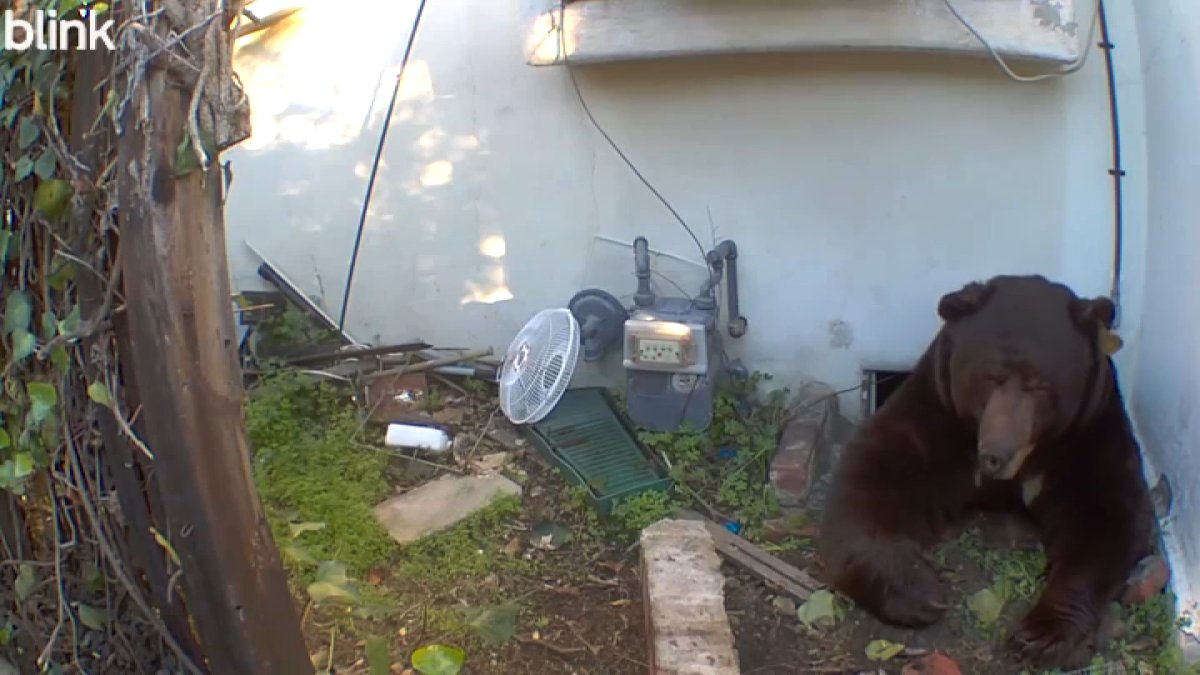
A hefty bear that spent part of the holiday season living in the crawl-space under an Altadena home has apparently made a new start in the new year.
In a statement Thursday to NBCLA, the California Department of Fish and Wildlife said the bear, which was tagged by wildlife officials, is no longer living under the San Gabriel Valley residence.
“I can confirm that yellow 2120 is no longer under the home and the access point to the crawl-space has been secured,” said Cort Klopping, of the Department of Fish and Wildlife.
More details were not immediately available.
Yellow 2120 gained a degree of fame when video showed the large bear entering and exiting the crawlspace under Ken Johnson’s house — an arduous process that appeared to require significant effort.
“I feel nervous all the time,” Johnson said in early December. “I’m always looking over my shoulder to see if he’s coming out.”
Black bears, which can have different color coats, like to feed on plants, insects, nuts, berries and whatever else they think of as edible — such as the contents of trash bins. If food is scarce in their natural habitat, bears are likely to forage elsewhere, bringing them into Southern California foothill neighborhoods.
California’s black bear population has been on the rise over the last two decades, growing from an estimated 10,000 to 15,000 in the early 1980s to between 25,000 and 30,000 — and that’s a conservative estimate, according to the state department of fish and wildlife.
Black bears, recognized by their small, narrow heads and small ears, have coats that range in color from tan or brown to black. Females grow up to about 200 pounds and males can be a hefty 350 pounds with some giants weighing in at more than 600 pounds.
About half of the state’s bear population can be found in the Sierra Nevada Mountains and areas to the north and west. Only an estimated 10 percent of the black bear population inhabits central western and southwestern California.
Although its on the state flag, the fearsome grizzly bear no longer can be found in the California wild. The last grizzly bear observed in California was shot in the early 1920s.