
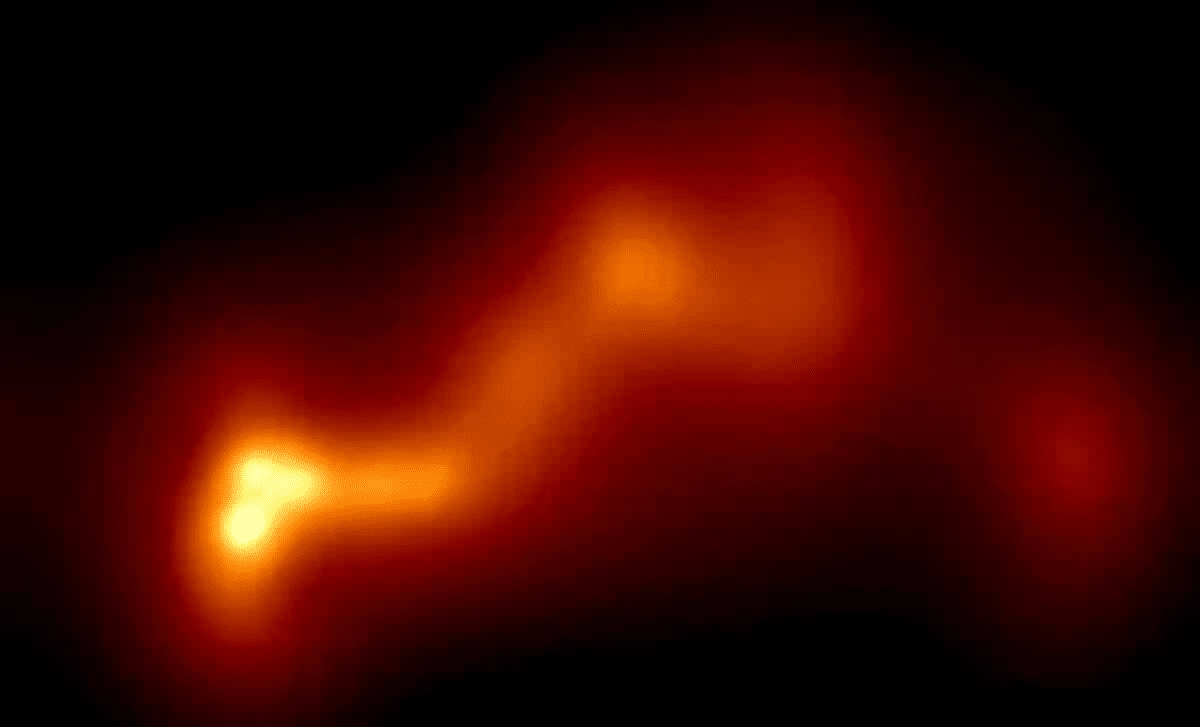
In a new study published in Astronomy & Astrophysics, astronomers have made an extraordinary breakthrough by observing the interaction between shock waves and pressure waves in the jet of a supermassive black hole system. This incredible observation, made possible by the Event Horizon Telescope (EHT), marks the first time such an interaction has been directly witnessed, opening new doors in our understanding of the complex physics governing black hole jets. Located an astonishing 4 billion light-years away, the binary black hole system, OJ 287, revealed dramatic changes in its relativistic jet, showcasing the dynamic forces at play in these extreme cosmic environments.
The Event Horizon Telescope: A Technological Marvel
The Event Horizon Telescope (EHT) is a network of radio telescopes spanning the globe, working in unison to create a virtual telescope the size of Earth. This vast collaborative effort makes it possible to capture the most detailed images and data from across the universe, even from incredibly distant and small-scale phenomena like black holes. EHT’s resolution is so precise it can spot a ping pong ball on the Moon, a level of clarity that allowed the researchers to witness the minute changes happening in the jet of the OJ 287 system. This capability is key in making such groundbreaking observations possible, and the results are a testament to the power of global collaboration in modern astronomy.
Through advanced interferometry techniques, the EHT synthesizes data from radio observatories located from the South Pole to Europe, South America, and the Pacific. This synchronization creates a telescope far beyond the capability of any single instrument. As a result, astronomers are now able to probe the regions around supermassive black holes with unprecedented detail, revealing the intricate mechanics of cosmic jets and their surrounding magnetic fields.
OJ 287: A Binary Black Hole System with a Strange Dance
At the heart of this study is OJ 287, a binary black hole system about 4 billion light-years away in the constellation of Cancer. The larger of the two black holes has a mass over 18 billion times that of our Sun and is roughly nine times the size of Pluto’s orbit. Its smaller companion weighs in at 150 million times the mass of our Sun and is about six times as wide as Earth’s orbit. These two black holes orbit each other in an elliptical pattern, with the smaller one completing a revolution every 11 to 12 years. This unusual motion causes peculiar effects, especially in the relativistic jet emitted by the system.
The system’s active behavior is a key feature that made it such an intriguing subject for the study, published in Astronomy & Astrophysics. The interaction between these two supermassive black holes produces enormous energy, which is channeled into the jet, a powerful beam of particles that moves outward at nearly the speed of light. As the jet moves through the surrounding space, it continuously changes in shape, providing astronomers with a dynamic view of the jet’s inner workings. Observations made between April 5 and 10, 2017, were particularly fruitful, capturing these rapid changes as they occurred.
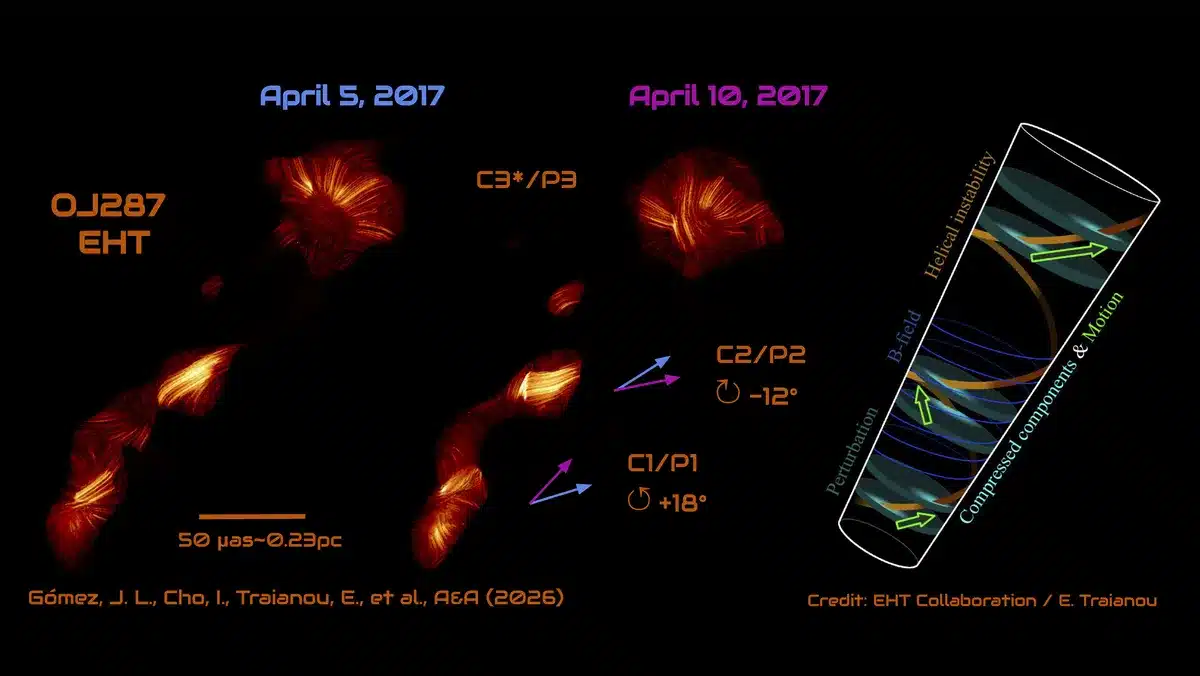 Event Horizon Telescope observations of OJ 287 on April 5 and 10, 2017, revealing the jet structure at unprecedented resolution just 0.75 light-years from the supermassive black hole. The polarization images (left panels) show three bright components that visibly evolve over the five-day interval, the shortest timescale on which such changes have been directly imaged in this source. The two innermost components exhibit opposite-direction polarization rotations: the faster-moving component C1/P1 (blue-cyan arrows) rotates counterclockwise by +18° while the slower component C2/P2 (pink-magenta arrows) rotates clockwise by -12°. Component C3*/P3* further downstream displays radial polarization characteristic of a recollimation shock. The schematic (right) illustrates how shock components (green arrows) propagating at different speeds through the jet interact with a helical Kelvin-Helmholtz wave pattern (orange lines), sampling different phases of the helical magnetic field (blue lines) and producing the observed opposite rotations. Credit: EHT Collaboration / E. Traianou. (Gómez, J. L., Cho, I., Traianou, E., et al., A&A 2026, DOI: 10.1051/0004-6361/202555831)
Shock Waves and Kelvin-Helmholtz Instabilities in the Jet
The core finding of the study revolves around the detection of shock waves moving through the relativistic jet of OJ 287. These shock waves, which travel at different speeds, interact with slower-moving material around them, resulting in Kelvin-Helmholtz instabilities. This phenomenon, commonly associated with fluids, occurs when velocity shear within a fluid leads to the formation of vortices. While typically observed in earthly systems, such instabilities are now seen in the extreme conditions surrounding black holes.
“We observed substantial changes over five days,” said Dr. Efthalia Traianou, one of the paper’s lead authors and AGN Working Group Coordinator for the EHT collaboration. “This is the first time we’ve directly observed this shock-instability interaction in a black hole jet.”
The fact that this interaction has been observed directly for the first time marks a significant leap in our understanding of black hole jets, especially their dynamic structures and the complex interplay between forces in these environments.
These observations highlight the dramatic changes in the jet’s structure, which undergoes significant shifts as it moves through space. The interactions between different components of the jet generate unique magnetic-field distortions that further reveal the extreme physics at play in this system.
Unveiling Magnetic Field Geometry: The Jet’s Launching and Collimation Regions
A crucial part of the study involved tracing the magnetic-field geometry in the regions where the jet is launched and collimated. “These measurements let us directly trace the magnetic-field geometry in the jet’s launching and collimation region,” explained Dr. Ilje Cho, co-lead author of the paper and an expert from the Korea Astronomy and Space Science Institute. The team’s ability to measure these magnetic structures at such an enormous scale, spanning distances 10-100 times that of the largest black hole radius, provides crucial insight into how these jets form and evolve.
This breakthrough is especially important because it allows astronomers to study the processes that govern jet formation near black holes, a phenomenon that has long been difficult to observe in detail. By understanding the magnetic-field structures and the forces involved, scientists can better understand how these powerful jets influence the surrounding galaxy and the intergalactic medium.