
Liquids may seem simple, but on the molecular level, they are anything but. Molecules in a liquid are constantly in motion, shifting and reorganizing in complex ways. Understanding how molecules behave in these dynamic environments is critical to fields ranging from chemistry to biology, where liquids play essential roles in everything from chemical reactions to the transport of proteins and RNA. However, the rapid interactions between molecules in liquids have remained largely invisible to scientists, as traditional techniques struggle to capture the necessary speed and detail.
A new approach, high-harmonic spectroscopy (HHS), has changed this. Researchers from Ohio State University and Louisiana State University have demonstrated that HHS can track electron motion on attosecond timescales, offering a detailed look at how molecules in liquids interact. This method uses short laser pulses to temporarily eject electrons from molecules and analyze the light emitted when those electrons return. This technique, which previously worked mainly in gases and solids, is now able to detect rapid molecular movements and structural changes in liquids.
Overcoming the Challenges of Studying Liquids
Studying liquids is no easy feat. Unlike solids, which have a fixed structure, liquids lack long-range order, and their constantly moving molecules complicate the analysis of their behavior. According to the researchers, two main obstacles have traditionally stood in the way of applying HHS to liquids: the absorption of light by the liquid and the difficulty in capturing the rapid, fluctuating movements of molecules. To address these challenges, the researchers developed an ultrathin liquid “sheet” that reduces light absorption, allowing more of the emitted harmonic light to escape. This breakthrough made it possible to observe electron dynamics in liquids with unprecedented detail.
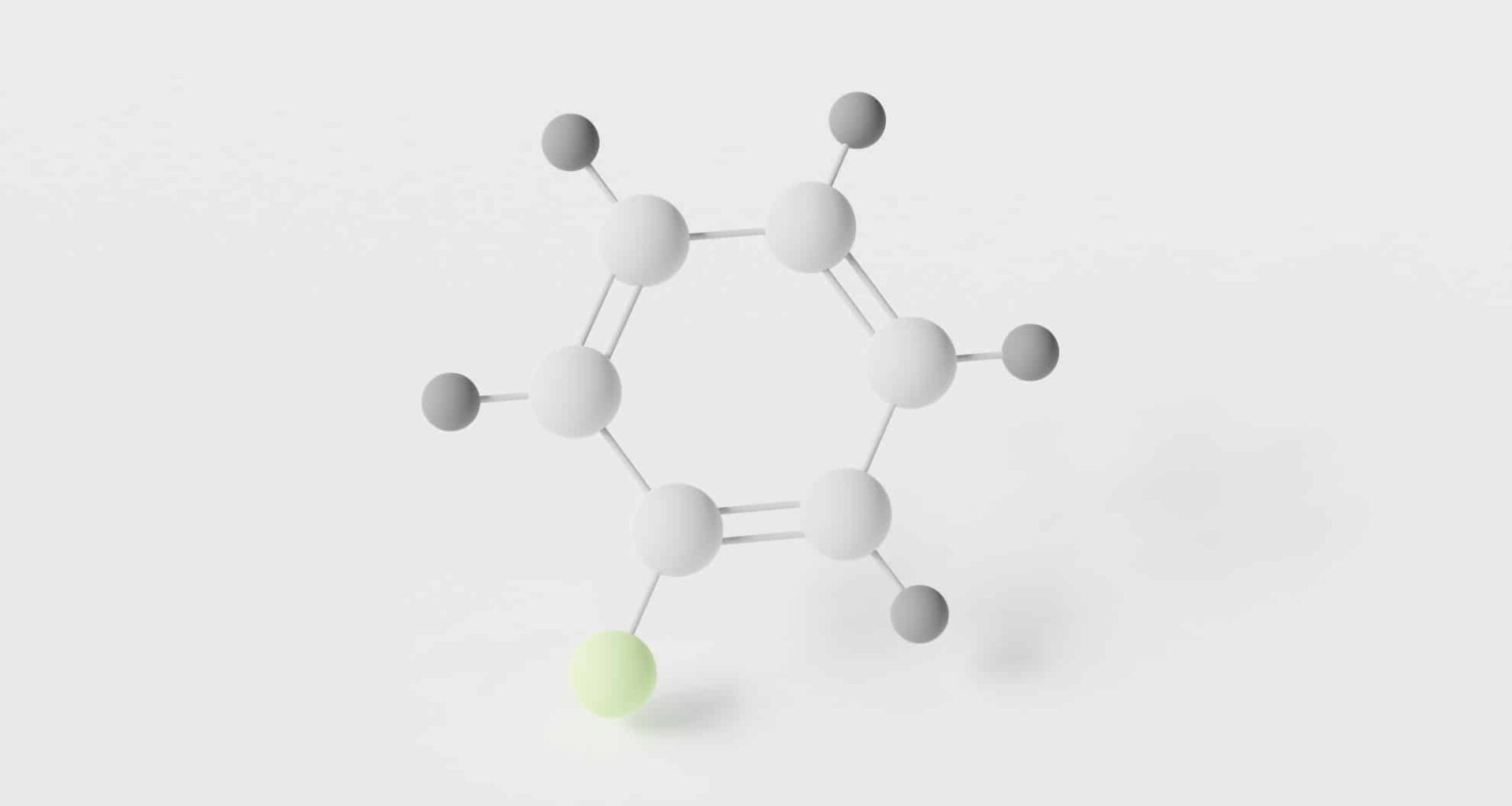
The experiment focused on mixtures of methanol and various halobenzenes, which are nearly identical except for one atom. These mixtures allowed the researchers to analyze how different solutes interact with the solvent on ultrafast timescales. Most mixtures displayed predictable results, with the harmonic signals appearing as a simple blend of the two liquids. However, one combination, methanol and fluorobenzene (PhF), exhibited an unexpected result: a complete suppression of one harmonic. This striking behavior pointed to a specific molecular interaction that disrupted the electron motion in the mixture.
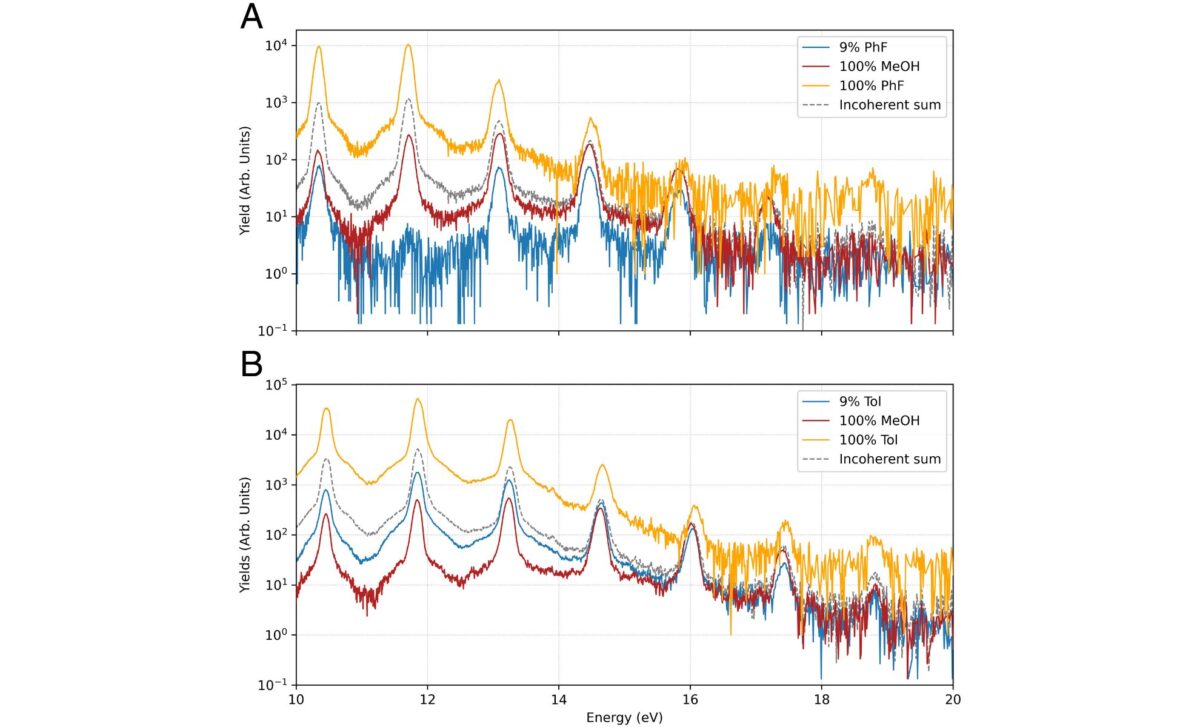 Harmonic spectra for pure MeOH, PhF, toluene, and their 9% solutions with 1,800 nm laser at 30 TW/cm². ©PNAS
The Mystery Behind the Suppressed Harmonic
The team’s observations of the PhF-methanol mixture raised an intriguing question. Why did this particular mixture show such unusual behavior, with a harmonic disappearing entirely? According to Lou DiMauro, professor of physics at Ohio State University, this deep suppression of light pointed to a “destructive interference” caused by something near the emitters in the liquid. Unlike other mixtures, the PhF-methanol combination produced less light overall, and one specific harmonic was entirely absent. This was a rare phenomenon, suggesting that a specific molecular interaction was disrupting the usual electron behavior.
To explore this further, the team turned to large-scale molecular dynamics simulations. According to John Herbert, professor of chemistry at Ohio State University, the simulations revealed that the presence of fluorine in the PhF molecule promoted a unique “molecular handshake” with the methanol molecules, forming a more organized structure in the liquid. This hydrogen bond between the fluorine atom and the oxygen-hydrogen end of methanol created a local structure that acted as a barrier for the electrons, interfering with their motion and suppressing the harmonic signal.
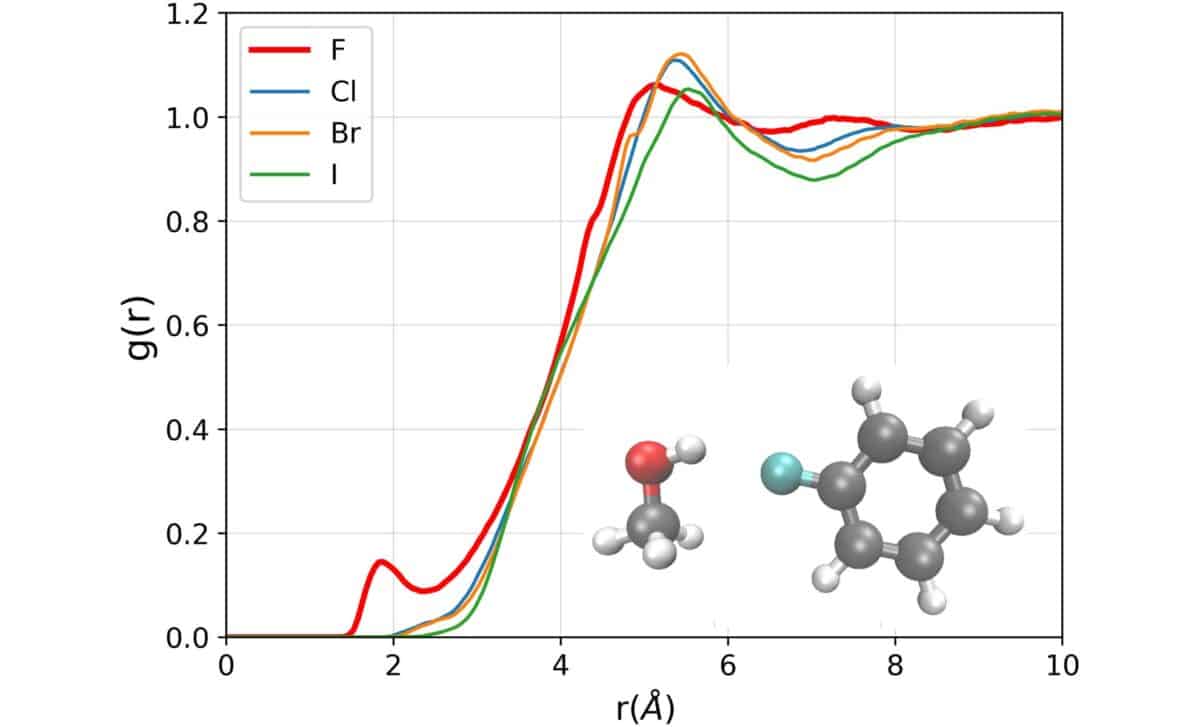 Site-site RDF for 9% PhX in MeOH showing CH3OH⋯FC6H5 hydrogen bond in PhF–MeOH. ©PNAS
Potential Implications for Chemistry and Biology
This new understanding of electron behavior in liquids could have significant implications for a range of scientific fields. Many key chemical and biological processes, from protein transport to chemical reactions in cells, occur in liquid environments. By using HHS to directly observe how molecules in liquids interact at the ultrafast timescale, researchers could gain valuable insights into these processes. As DiMauro notes, “solution-phase high-harmonic generation can be sensitive to the particular solute-solvent interactions and therefore to the local liquid environment.” This ability to probe the local structure of liquids could lead to advancements in chemistry, biology, and materials science.
Researchers hope that the continued refinement of HHS experiments will allow them to further unlock the mysteries of liquid environments. The ability to observe electron dynamics in real-time could offer a more precise understanding of how liquids behave under various conditions, with applications ranging from improving chemical reactions to studying radiation damage in biological tissues.