
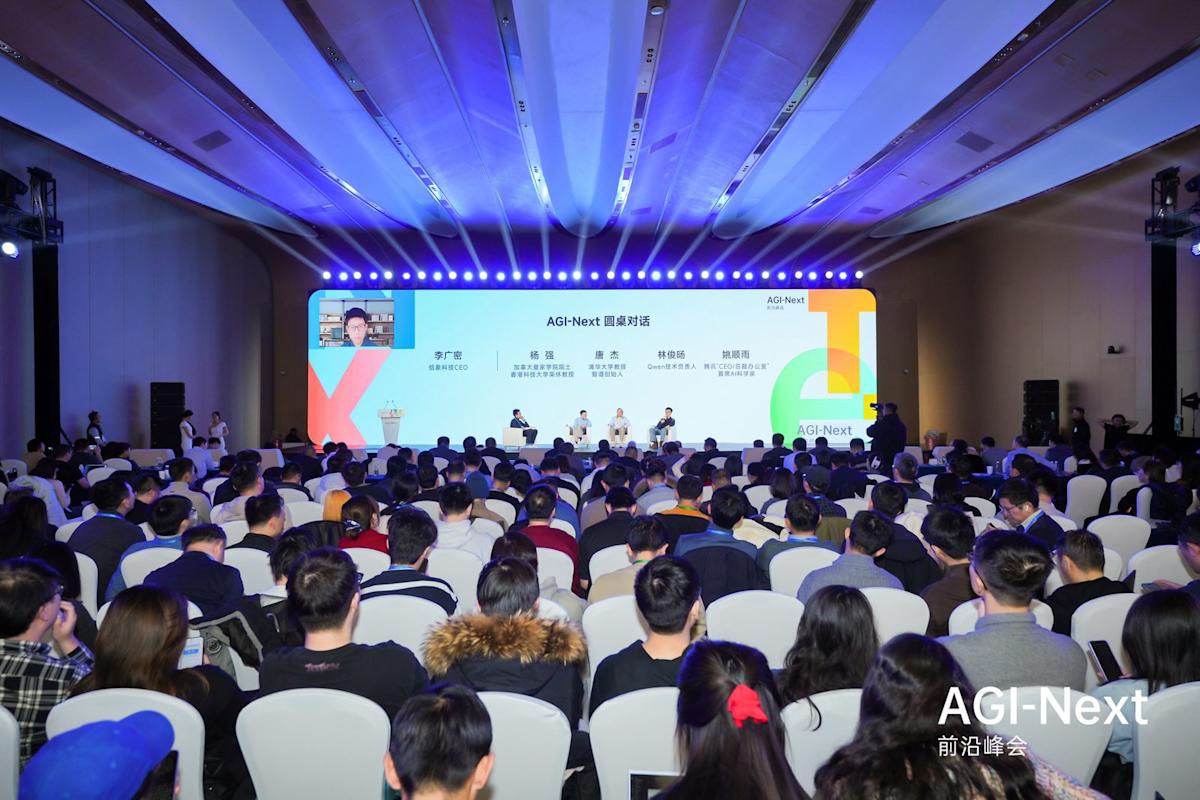
 Source: AGI-Next
(Bloomberg) — Some of China’s most prominent figures in generative artificial intelligence warned that the Asian nation is unlikely to eclipse the US in the global AI race anytime soon.
Justin Lin, head of Alibaba Group Holding Ltd.’s Qwen series of open-source models, put at less than 20% the chances of any Chinese company leapfrogging the likes of OpenAI and Anthropic with fundamental breakthroughs over the next three to five years. His caution was shared by peers at Tencent Holdings Ltd., and at Zhipu AI, which this week helped lead Chinese large-language model makers in tapping the public market.
Most Read from Bloomberg
“A massive amount of OpenAI’s compute is dedicated to next-generation research, whereas we are stretched thin — just meeting delivery demands consumes most of our resources,” Lin said during a panel at the AGI-Next summit in Beijing on Saturday. “It’s an age-old question: does innovation happen in the hands of the rich, or the poor?”
The event, co-organized by Zhipu and Tsinghua University, followed market debuts this week in which Zhipu and Shanghai-based MiniMax Group collectively raised more than $1 billion. MiniMax shares more than doubled on their Friday debut, while Zhipu has climbed 36% since its debut a day earlier.
Still, China’s AI heavyweights struck a cautious note on the chances of overtaking the US in developing state-of-the-art models at the gathering in Zhongguancun, a technology hub often described as Beijing’s Silicon Valley. Joining Lin in that assessment were Tang Jie, Zhipu’s founder and chief AI scientist, and Yao Shunyu, who recently joined Tencent from OpenAI to lead the AI push for China’s most valuable company.
“We just released some open-source models, and some might feel excited, thinking Chinese models have surpassed the US,” Tang said. “But the real answer is that the gap may actually be widening.”
The breakout success of DeepSeek’s R1 model at the start of 2025 spurred a wave of Chinese firms — from giant Alibaba to startups like Zhipu — to open-source their latest AI iterations. Such models have rapidly closed the gap with US proprietary offerings from the likes of OpenAI, Anthropic and Google.
Key Constraints
While acknowledging progress, the speakers cited limited resources and US export controls on chips and lithography equipment as key constraints.
Yao urged his industry peers to focus on the bottlenecks of next-generation models — such as long-term memory and self-learning.
The tech leaders also offered a primer on where they’re placing bets for the coming year. Yao said he’s helping Tencent leverage AI to generate greater value for its massive user base — for example, by linking the company’s Yuanbao assistant with WeChat chat history.
Lin highlighted Alibaba’s bet on multimodality and real-world agents, while both Tang and Yang Zhilin, who founded Moonshot AI, touted newer releases of their flagship foundation models.
“Meaningless internal competition serves no purpose,” said Tang. “We should represent China to push AGI further for the world,” he added, referring to artificial general intelligence.
Most Read from Bloomberg Businessweek
©2026 Bloomberg L.P.