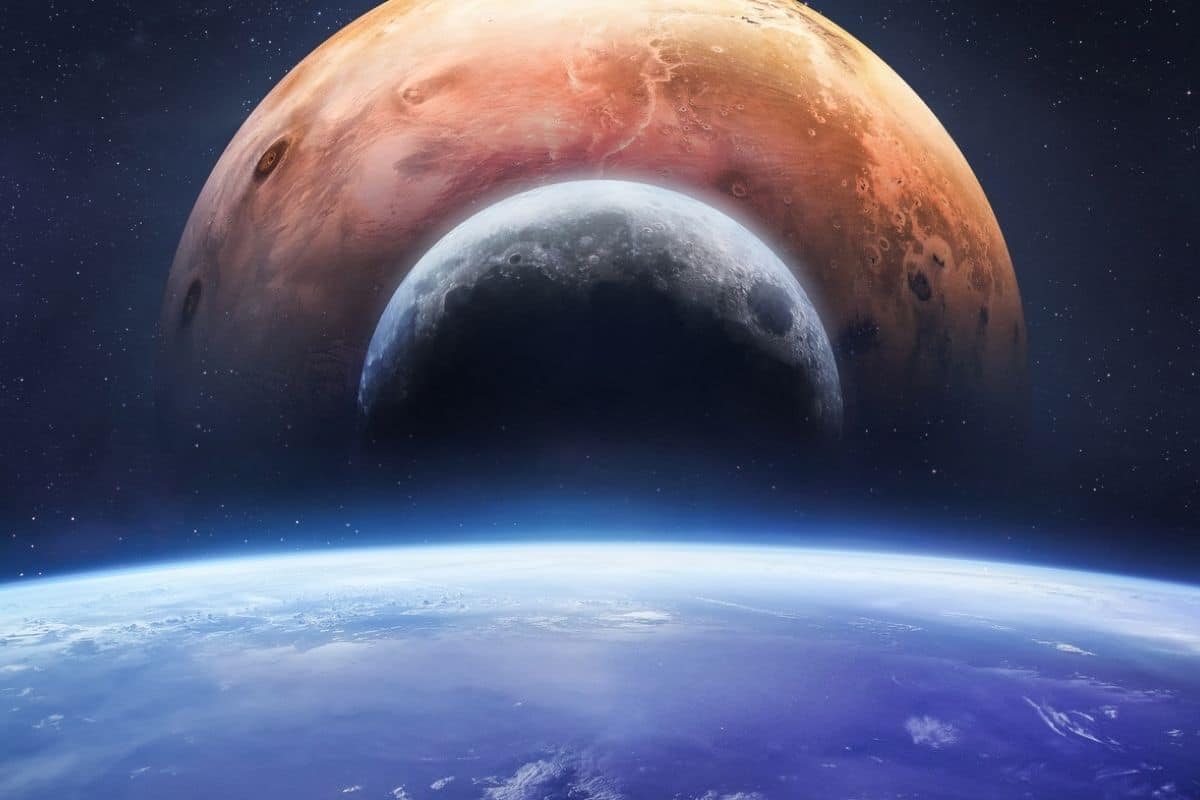
Could a hidden planet—a twin of our own world—be lurking on the edge of the solar system? According to two Japanese astronomers, it’s possible. They believe a cold, dark, Earth-like body may be orbiting far beyond Neptune on a sharply tilted path.
Planetary scientists Patryk Sofia Lykawka of Kindai University and Takashi Ito of Japan’s National Astronomical Observatory describe the potential discovery in The Astronomical Journal. Their model suggests this mysterious world could be no more than three times Earth’s mass and might orbit within 500 astronomical units of the Sun.
“We predict the existence of an Earth-like planet and several trans-Neptunian objects with unique orbital patterns,” the researchers wrote. “These could provide observable evidence of the planet’s gravitational influence.”
A mass larger than Earth’s
If such a planet exists, its distant, inclined orbit could help explain several puzzling features of the Kuiper Belt — the vast ring of icy bodies and dwarf planets beyond Neptune.
According to Ito and Lykawka, three major traits stand out: a large population of trans-Neptunian objects whose orbits lie beyond Neptune’s pull, a cluster of objects on steeply tilted paths, and a handful of extreme bodies moving along unusually stretched orbits.
Their calculations indicate that this hypothetical Earth-like world would have between 1.5 and 3 times Earth’s mass, an aphelion — the farthest point from the Sun — ranging from 250 to 500 astronomical units, and an orbital tilt of about 30 degrees relative to the solar plane.
If true, this hidden planet could also account for the strange paths of objects inclined more than 45 degrees, including the dwarf planet Sedna, whose elongated orbit has long puzzled astronomers. The researchers say it might even clarify the behavior of certain trans-Neptunian groups linked to Neptune but often left out of previous studies.
While no telescope has yet spotted this elusive world, its subtle gravitational fingerprints may one day reveal its presence — a reminder that even our own cosmic neighborhood still holds mysteries waiting to be found.