
NASA is getting ready for the launch of Artemis II as early as next month. The launch window for the first flight of astronauts around the Moon since the Apollo program opens on February 6 and NASA plans to roll the rocket out to the launch pad on January 17, a week from today. A lot of work still needs to be done and tests to be conducted, so the four-person American-Canadian crew may need to wait a bit longer, but NASA is sharing the launch dates and times available in February, March and April.
NASA astronauts Reid Wiseman (commander), Victor Glover (pilot) and Christina Cook (mission specialist), and Canadian Space Agency astronaut Jeremy Hansen (mission specialist), have been in training since April 2023 and are ready to go.
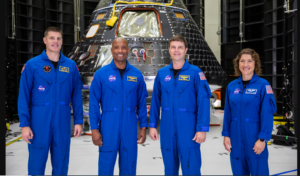 The crew of Artemis II stand in front of the Orion capsule they will fly around the Moon. L-R: Jeremy Hansen, Canadian Space Agency; Victor Glover, NASA; Reid Wiseman, NASA; Christina Koch, NASA. Photo credit: NASA
So is the Space Launch System (SLS) rocket that will send them on their way and the Orion capsule they will live in during the 10-day expedition. Boeing is the prime contractor for SLS, and Lockheed Martin for Orion.
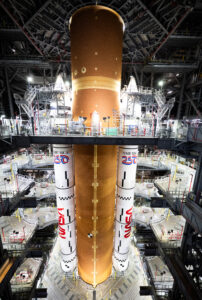 NASA’s Space Launch System rocket inside high bay 3 of the Vehicle Assembly Building at Kennedy Space Center waiting for the Artemis II crew to arrive to board their Orion spacecraft atop the rocket as part of the countdown demonstration test, Dec. 20, 2025. The orange segment is the Core Stage of the SLS rocket (Boeing) powered by Aerojet Rocketdyne (an L3Harris company) RS-25 engines. Three originally flew on the Space Shuttle and one is new. The two white “strap ons” on either side are Solid Rocket Motors (Northrop Grumman). Photo Credit: (NASA/Joel Kowsky) Not shown is the Interim Cryogenic Propulsion Stage (United Launch Alliance) that sits between SLS and Orion (see illustration below).
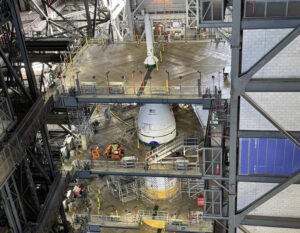 The Artemis II Orion spacecraft, named Integrity, on top of the SLS rocket that will send it and the Artemis II crew around the Moon. From the top: the white cylindrical Launch Abort System that could take the Orion capsule away from the rocket during launch in an emergency (Northrop Grumman); the white Orion capsule with an American flag on the side (Lockheed Martin); and the white and yellow European Service Module (European Space Agency/Airbus Defence and Space).
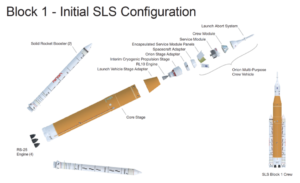 Illustration of the SLS/Orion system. Credit: NASA
All together, this Block 1 version of SLS with the Interim Cryogenic Propulsion Stage, Orion, and the Launch Abort System is 322 feet (98 meters) tall.
Artemis II is a crewed test flight following the uncrewed Artemis I test flight in November-December 2022. That launch was repeatedly delayed as weather and technical problems intervened.
NASA is making clear the same could happen this time. Tests including the Wet Dress Rehearsal (WDR) are still to come to shake out any technical issues with SLS/Orion or ground systems. Amentum is the prime contractor for Exploration Ground Systems.
During a WDR, a launch countdown is conducted that includes filling the rocket with cryogenic propellants — making it “wet” — and continuing down to as close as 30 seconds (T-30 seconds) before liftoff. For this WDR, they will count down to T-one minute 30 seconds, followed by a three minute hold, resume to T-33 seconds, recycle back to T-10 minutes and hold, and then resume to T-30 seconds. The propellant will be drained afterwards.
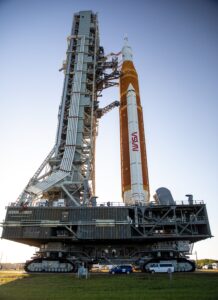 The Artemis I SLS/Orion stack attached to the Mobile Launcher (left) atop the Crawler-Transporter, June 6, 2022. In this case, the stack was on its way back to the Vehicle Assembly Building from the launch site, Launch Complex 39-B, after a failed Wet Dress Rehearsal. Photo credit: NASA.
Artemis I experienced a number of delays with several scrubbed WDRs over many months.
Artemis II will roll out to the launch pad for its WDR, hopefully the only one, atop the Crawler-Transporter on January 17. The WDR itself is planned for the end of January.
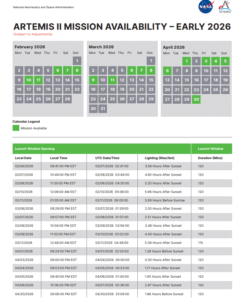
If all goes well, the first opportunity to launch is February 6 at 9:41 pm ET. Launches to the Moon can only occur when the Earth and Moon are properly aligned with a few days possible each month. The agency published a chart of the launch windows for February through April.
Lori Glaze, NASA’s Acting Associate Administrator for Exploration Systems Development, emphasizes there are “important steps remaining on our path to launch and crew safety will remain our top priority at every turn, as we near humanity’s return to the Moon.”
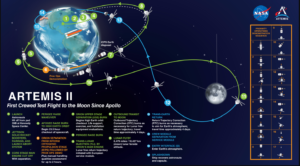
Artemis II will not try to orbit the Moon, never mind land, on this first crewed lunar mission since Apollo 17 in December 1972. They will spend one day in Earth orbit to check out systems, including life support, and then fly out past the Moon and back to Earth on a “free-return trajectory” that will bring them home even if the Orion propulsion system doesn’t perform as planned. It’s similar to what the Apollo 13 crew used in 1970 after an explosion in their propulsion system damaged the spacecraft.
 Credit: NASA
The next mission, Artemis III, is the one that will put American astronauts on the lunar surface for the first time since Apollo. The date for Artemis III has been repeatedly delayed – from 2024 to 2025 to 2026 to 2027 and now to 2028. Not only do SLS and Orion have to perform well on Artemis II, but a Human Landing System (HLS) is needed to get down to and back from the surface. Elon Musk’s SpaceX has the contract to build the HLS for Artemis III and IV using its Starship space transportation system, but that also is experiencing delays. Jeff Bezos’s Blue Origin has a contract to build another system, Blue Moon Mark II (MkII), but it’s not expected to be ready until Artemis V at the end of the decade though they are assessing whether they could do it sooner. (Blue Moon Mark 1 (MkI) is a smaller, uncrewed version that could launch this year.) The Artemis III crew also needs lunar spacesuits that are being built by Axiom Space and similarly are behind schedule.
The Artemis program began in 2019 during President Trump’s first Administration. As his second term began last year it initially appeared he might shift his focus to sending people to Mars, but more recently getting Americans back on the Moon before China puts taikonauts there has taken center stage. NASA Administrator Jared Isaacman conveyed Trump’s enthusiasm for lunar exploration and more on Fox News yesterday.
Artemis was never just about returning to the Moon, it was about staying, building, and unlocking long term scientific, economic, and national security potential.
Investing in infrastructure, nuclear power, and an orbital economy is how we accelerate discovery and set up the next… pic.twitter.com/cKwWAWsxTV
— NASA Administrator Jared Isaacman (@NASAAdmin) January 10, 2026
Sustained human presence on the Moon remains an Administration goal, but the President’s FY2026 budget request emphasized replacing SLS/Orion with commercial alternatives after Artemis III making the exact plan for the future unclear.
For its part, Congress has demonstrated unwavering bipartisan support for the existing Artemis program using SLS/Orion at least through Artemis V. That is required in the One, Big Beautiful Bill Act (OBBBA) and NASA’s final FY2026 appropriations bill rejects the Administration’s plan and firmly supports the current program. The bill passed the House on Thursday and could pass the Senate this coming week.
Last Updated: Jan 10, 2026 6:11 pm ET