
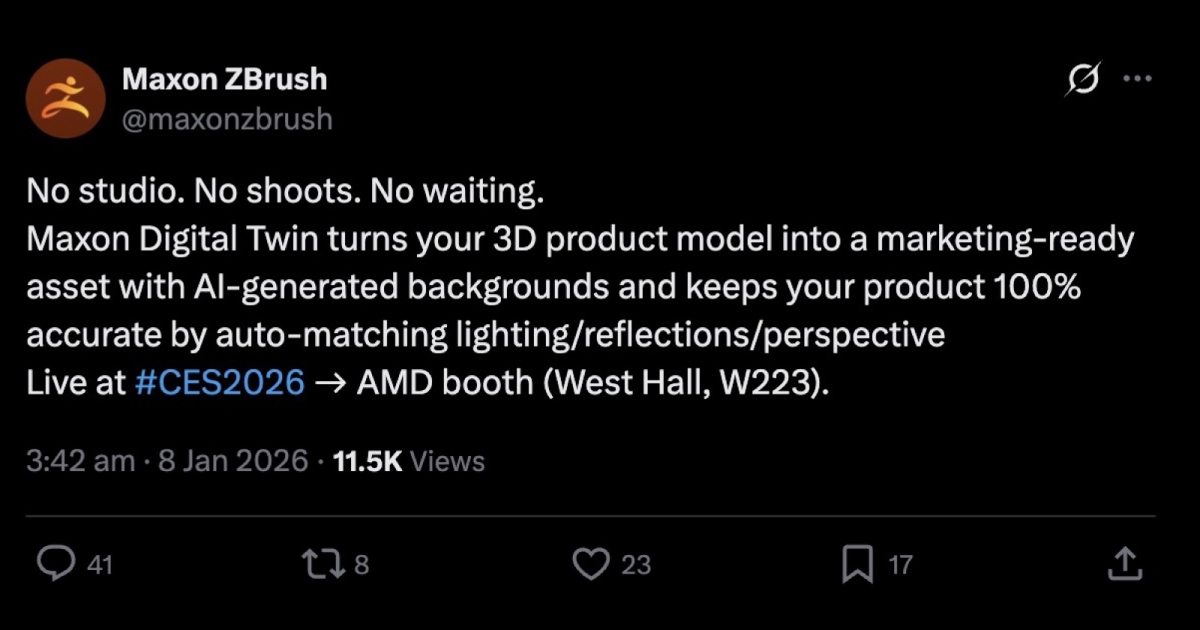
With the original statement featuring little to no information – yet taking its time to note that the tool would be able to produce “AI-generated backgrounds” – a number of questions immediately arose within the community. Is it a ZBrush feature or a separate tool? Was the AI trained on the work of ZBrush users? Should we expect more AI from Maxon? Why did the company choose to upset a sizeable portion of its customer base? And the list goes on and on.
If you’re among those artists and have been asking these same questions, you may be glad to hear that I was recently contacted by a Maxon representative, who addressed the controversial tool by providing answers to some of the most pressing concerns.
For starters, addressing the “ZBrush vs. standalone” kerfuffle, the representative clarified that while MDT does utilize Maxon’s technology and integrate with other Maxon tools, it will be a standalone product.
As for another major point of concern – the question of AI training – I was told that Maxon is not developing its own AI agent and is going to rely on a “third-party AI agent,” so the AI used in MDT was not trained on the works of Maxon users.
What is likely to upset many readers most is that the representative also stated that, going forward, Maxon will “work on integrating with AI agents and popular AI-enabled graphic design apps.” Since the statement did not clarify whether this applies only to MDT or to Maxon’s entire product lineup, concerns about tools like ZBrush or Cinema 4D being flooded with generative AI remain.
Lastly, here’s what I was told about what the tool actually is and who it’s intended for: