
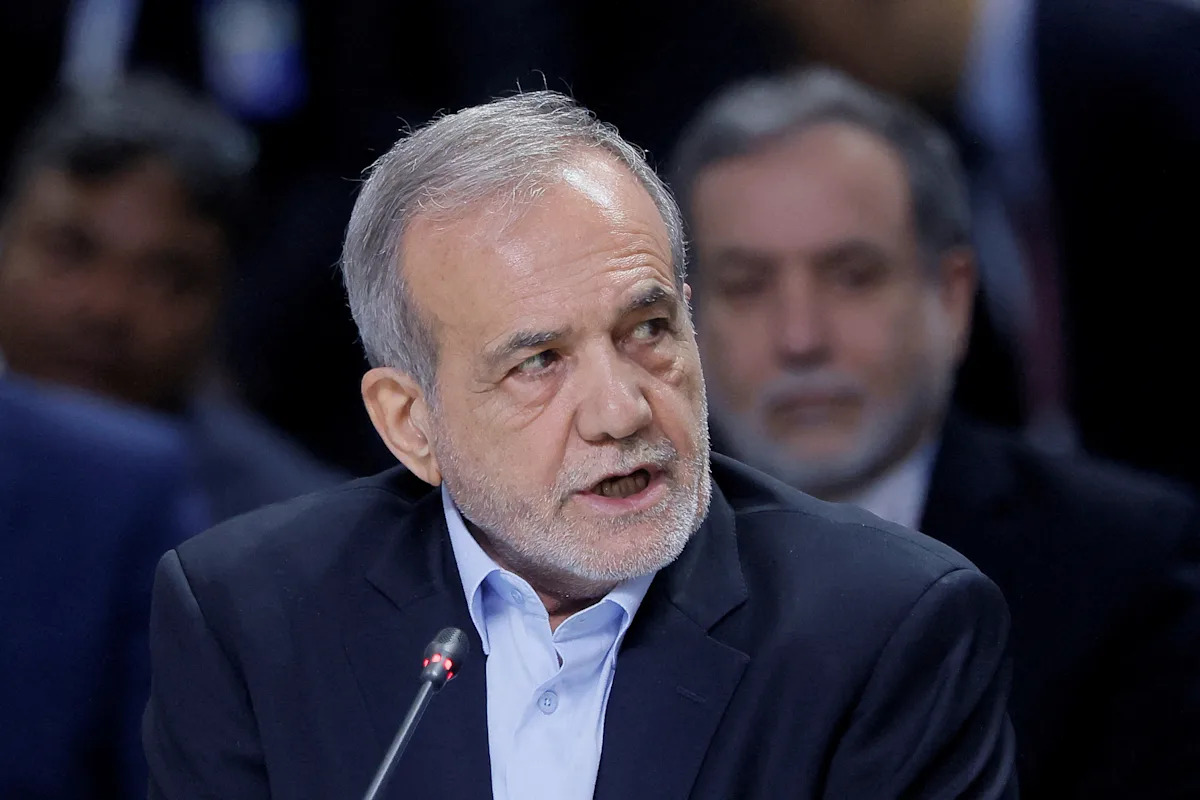
President Masoud Pezeshkian has pledged to overhaul Iran’s struggling economy, saying his government is “ready to listen to its people” after two weeks of increasingly violent nationwide demonstrations.
Pezeshkian adopted a conciliatory approach during an interview on state television on Sunday, saying his embattled administration was determined to resolve the country’s economic problems while accusing the United States and Israel of fomenting deadly unrest.
He said the government’s duty is to solve problems, address people’s concerns, and not allow what he called “rioters” to disrupt the country, according to the semiofficial Tasnim news agency.
“Therefore, we ask families not to allow their youth to get involved in the unrest of terrorists and rioters,” he was quoted as saying.
“The enemy has brought trained terrorists into the country … Rioters are not protesting people. We hear the protesters and have made every effort to solve their problems,” the president also said.
He added: “Our goal is to distribute everything we have fairly among the people; regardless of what party, faction, ethnicity, race, or even province, dialect, or language these people belong to.”
The crisis erupted after the Iranian currency plummeted in late December after years of economic duress, triggering mass protests over soaring living costs and inflation. Those protests have since taken on a more political and anti-government nature.
The demonstrations are the largest in Iran since a 2022-2023 protest movement spurred by the death in custody of Mahsa Amini, a 22-year-old woman who had been arrested for allegedly violating the strict dress code for women.
Tohid Asadi, Al Jazeera’s correspondent in Tehran, said Iranian officials had spent the past week trying to draw a distinction between protesters and what they described as foreign-trained rioters.
Asadi added that senior officials had acknowledged public anger as justified, citing “soaring prices, high inflation and the drastic devaluation of the local currency that right now puts a huge amount of pressure on the pockets of local people”.
State media reported that 109 security personnel have been killed during the protests. Opposition activists say the death toll is higher and it includes dozens of protesters.
Al Jazeera cannot independently verify the figures.
Parliament Speaker Mohammad Bagher Ghalibaf reinforced a distinction between peaceful and armed demonstrators during remarks to lawmakers on Sunday, saying Iran recognised “people’s peaceful protests over economic concerns” but would stand against “terrorists”.
A former Islamic Revolutionary Guard Corps commander, Ghalibaf also issued a stark warning to Washington after US President Donald Trump threatened military action if Iranian authorities kill demonstrators.
“In the case of an attack on Iran, the occupied territories [Israel] as well as all US bases and ships will be our legitimate target,” he said as some lawmakers reportedly chanted anti-American slogans.
Iranian authorities called for a nationwide rally on Monday to condemn “terrorist actions led by the United States and Israel” in Iran, state media reported.
Authorities on Sunday also declared three days of national mourning “in honour of martyrs killed in resistance against the United States and the Zionist regime”, according to state media.
Meanwhile, United Nations Secretary-General Antonio Guterres on Sunday said he was “shocked” by reports of violence against protesters in Iran and called on the government to show restraint.
Guterres “is shocked by the reports of violence and excessive use of force by the Iranian authorities against protesters,” his spokesperson Stephane Dujarric said in a statement, adding a call “to exercise maximum restraint and to refrain from unnecessary or disproportionate use of force”.
Iran’s Ministry of Interior claimed the unrest is subsiding as the attorney general warned participants they could face capital punishment. A nationwide internet blackout has persisted for more than 60 hours, according to monitoring groups.
Iran summoned Britain’s ambassador on Sunday to the Foreign Ministry in Tehran over “interventionist comments” attributed to the British foreign minister and a protester removing the Iranian flag from the London Embassy building and replacing it with a style of flag that was used prior to the 1979 Islamic revolution.