
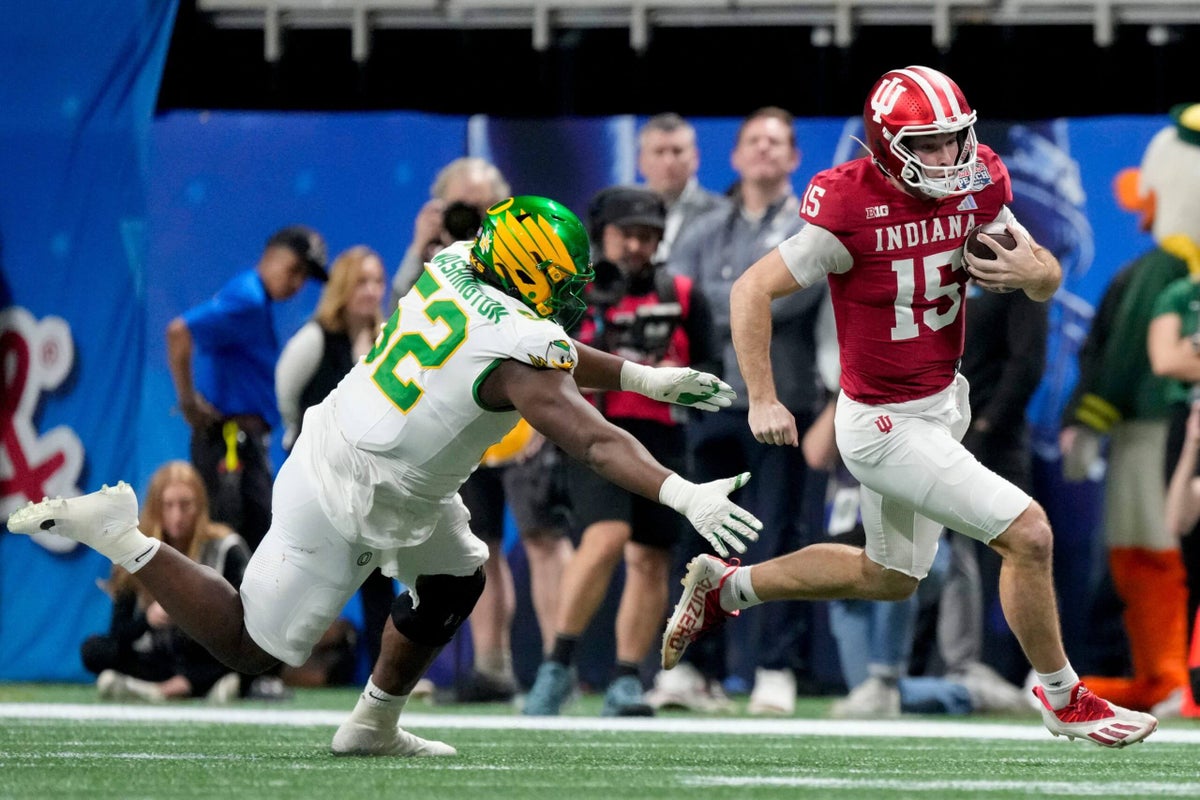
Indiana football is everything right now, representing at once the enhancement of the college football product on the field and the unsustainable reality off it.
No, Indiana didn’t do anything wrong — that we know of, anyway, though I’m sure other coaches would like to investigate Curt Cignetti and his players for spyware or cyborg blood or something. But as we wrap up a week that had the absolute best and worst of the sport clawing at each other for top billing, the Hoosiers should know they’ve made it so much harder for so many people.
Not that they should care. Go destroy Miami after people spend the week talking themselves back into why you can’t really be this good, then celebrate a national championship that would represent one of the most unforeseen, inexplicable, glorious stories in American sports history.
Indiana, even while making Friday night more boring than we wanted with a 56-22 semifinal thrashing of Oregon, is the prevailing example of why college football is in a great place as a product.
Transfer portal. Contracts. No loyalty. Whatever. Inject this stuff into MY VEINS!!!!!
— Dari Nowkhah (@ESPNDari) January 9, 2026
Never has there been more hope for so many. Membership in the exclusive club of heritage and built-in advantages is no longer required. A tallying of the recruiting stars next to names on a roster no longer produces a long and accurate list of programs with no shot of winning it all.
The landscape is always changing, never boring. Vanderbilt, Texas Tech, Ole Miss and Arizona State are among Indiana’s party-crashing undercards. The College Football Playoff is compelling. The games aren’t all thrillers, but enough of them are.
I would, though, like us to get through one of those good games without half of college sports media crowing on some app: “OH THAT’S WEIRD, I THOUGHT COLLEGE FOOTBALL WAS BROKEN.”
Because we all know darn well that, in ways, it is. Or maybe fractured sounds less dramatic. Chaotic. Problematic? Whatever makes you feel less bad. In the same week we’re enjoying the CFP semifinals, including an Ole Miss-Miami classic, we’ve got the former coach of Ole Miss keeping assistant coaches from attending the ball like he’s Cinderella’s stepmother.
We’ve got that same coach, LSU’s Lane Kiffin, courting one quarterback (Arizona State transfer Sam Leavitt) at a basketball game while another (Washington’s Demond Williams Jr.) announces he’s in the portal, apparently with the idea of joining Kiffin, except he had already signed to stay on with Washington. Except we have contracts in college sports that seek to sort of bind, while being careful not to make the person being paid sound as if he or she is being paid to play. Even though that’s exactly what’s happening.
So it’s the latest but far from the last “contract dispute,” this one finishing with Williams deciding to return to Washington. And hey, look, here comes the College Sports Commission promising to start cracking down on these predictable workarounds to pay enough to land top players in a market that is rising.
Which, at best, means an example made of a program or two, and in no way means any chance for the CSC to get its arms around things. Men and women with gavels and long, black robes will continue seeing to that. Lawmakers aren’t changing it.
Collective bargaining, in some form, is the only answer, and more and more people in the industry are coming around on that. The painful, inevitable journey continues. Hopefully, the past week serves as a bit of a jolt. I talked to an administrator who has been in that camp for a while and believes the athletic director and president levels are getting there.
But that will have unintended consequences, too. Go back and read what a lot of us were writing about name, image and likeness rights 10 or 15 years ago. I don’t recall anyone coming close to predicting all that has come with it.
And I must wonder how, with a cap of some sort in place while athletes get a bigger chunk of the revenue overall, the boosters at Ohio State, Alabama and Georgia are going to feel about officially being like everyone else, about parity as league design — about the caddies getting full-time access to the pool and golf course.
Which brings us to the thing I hear the most from folks in college sports in terms of long-term concerns. And this is where Indiana re-enters the discussion, in three words: return on investment. Indiana AD Scott Dolson has made what must be considered, two years later, one of the great hires in modern college football history. As hyperbolic as that may sound.
And for as much as this should be seen as an outlier that will spawn books and documentaries, it only serves to intensify the pressure elsewhere. All your resources, all that time, and you couldn’t figure this out, Penn State? Steve Sarkisian and Arch Manning can’t match this James Madison dude and Fernando Mendoza? Wasn’t USC the program with the great quarterback developer and offensive designer?
Those programs are at least having some success. All of them are begging the millionaires and billionaires who have helped build a facility or throw some nice cars at recruits of the past to sustain competitive payrolls. The TV money is good, but check the expenses. Colleague Seth Emerson wrote about “donor fatigue” in 2024 and, spoiler alert: No one has gotten any rest.
The wealthy folks who pay NFL players are called owners, and their investments are being multiplied many times over. The wealthy folks who pay college players get names on buildings, seats on the team plane and games of catch between the star quarterback and their grandkids. NFL owners lose, fire people, draft high and continue to profit; college boosters increasingly feel like they’re setting large piles of money on fire.
Which is why private equity looks as inevitable as collective bargaining. This is more than just a slight hairline fracture that will heal on its own.
I hope you can enjoy the college football right now. The product is soaring. Also, I hope anyone who cares about it understands that it can plummet without improved leadership that values common sense, the greater good of the industry and all of its employees.
If you’re an Indiana fan, soak in these experiences that are Cignetti-driven but still possible only because of NIL and the transfer portal. And plan to stay for a while. Cignetti never looks like he’s satisfied, and Mark Cuban is looking awfully happy right now.