
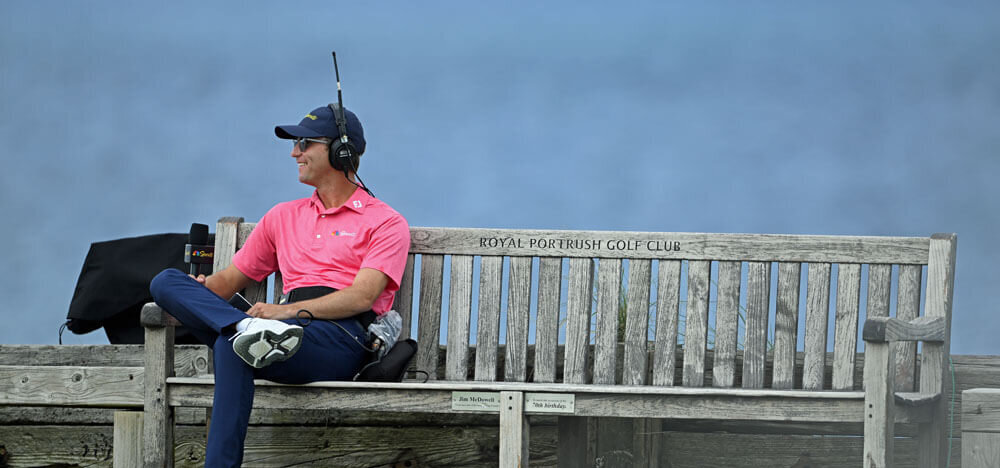
JUPITER, FLORIDA | It’s rehearsal night in advance of the inaugural Golf Channel Games at Trump National Golf Club Jupiter, an elaborate and sometimes charmingly chaotic made-for-television skills competition featuring Rory McIlroy and Scottie Scheffler with Smylie Kaufman there to be Smylie Kaufman.
It is a cool and breezy December evening when the elaborate lighting system is being tested, the format is being explained and Kaufman, an integral part of the broadcast team, is playing relay golf with fellow announcers Johnson Wagner, Brad Faxon and Keith Mitchell to give the television crew a sense of what is coming the next night.
The goal is for four players to play a hole as quickly – and in as few strokes – as possible. Mitchell hits the tee shot on the par-4 first hole, the ball disappearing into the night sky before suddenly reappearing just before landing, Johnson scurries over to hit the approach shot, Faxon plays the third shot at the green and Kaufman, his hoodie flapping as he runs, begs the ball to stop rolling as he hustles over to make the par putt, all in under 40 seconds.
They are like kids on the clock in a frenetic Easter egg hunt with similar energy and laughter and Kaufman, by nature, is at the heart of it, high-fiving Faxon when they get the ball in the hole. One night later, Kaufman will be on camera, providing color commentary while shuttling players from spot to spot in a golf cart, spanning the two sides of his professional career.
“He was born to do it and it’s an intangible you
either have it or you don’t. … There are a lot of guys that want to have it. He has it.”
— Tom Knapp, Golf Channel executive vice president
“I think I knew, like, within the first two or three days, that [broadcasting] is something that I wanted to pursue. I knew that this was like a calling. I just didn’t know how or why, because I felt like I could do it. It was natural,” Kaufman explains that evening, sitting at a small table in the ornate clubhouse, during a break in his prep work.
A decade ago, Kaufman might have been one of the eight players participating in the Golf Channel Games, his golf star ascending after a late-blooming college career at Louisiana State but that was, at least in career terms, a lifetime ago.
In case you’ve forgotten, Kaufman was in the final twosome on Sunday at the 2016 Masters, paired with his friend Jordan Spieth and one shot off the lead with 18 holes remaining. What most people remember is that Spieth unraveled on the final nine holes, not that Kaufman closed with 81, and that Danny Willett was the unlikely winner.
From there, Kaufman’s playing career began to fray and as 2026 comes to life, the 34-year-old has become one of the game’s most entertaining and informative voices largely by being himself. Kaufman has the gift of being able to talk to viewers and listeners, not at them, a subtle but significant difference, like inviting someone in for a cup of coffee rather than talking to them with the front door half open.
What began as an uncertain tryout at the 2022 PGA Championship at Southern Hills has grown into a multi-layered media career. Kaufman will work as an on-course reporter for NBC Sports this year, he will host his popular Friday afternoon happy hour segments with Kevin Kisner on Golf Channel and his podcast – “The Smylie Show” – will air on Wednesday mornings on Golf Channel starting Jan. 14.
“He was born to do it and it’s an intangible you either have it or you don’t. … There are a lot of guys that want to have it. He has it,” says Tom Knapp, executive vice president and general manager of Golf Channel.
*******
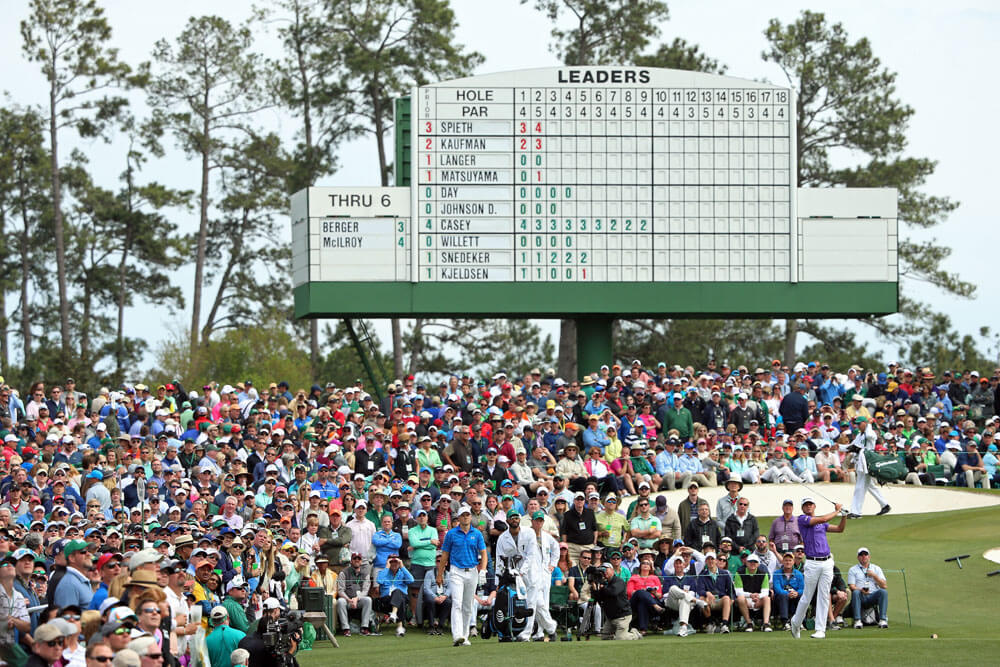 Smylie Kaufman (right) tees off from the third tee during the final round of the 2016 Masters. Andrew Redington, Getty Images
It was Sunday, April 10, 2016, at Augusta National and Kaufman stood on the first tee at 2:45 p.m., one stroke behind his friend and tournament leader Spieth. A morning that had dawned chilly had gradually warmed into the low 60s and the wind, which had tormented players on Saturday, had settled into a soft spring breeze.
Kaufman had jumped into contention with a 3-under-par 69 on Saturday, the lowest score in the third round. Six months earlier, Kaufman shot 61 on Sunday to come from seemingly nowhere to win the Shriners Hospitals for Children Open in Las Vegas but he understood as he awaited the final tee time in the Masters that he was in a different place.
Asked Saturday evening how he expected to handle his Sunday nerves, Kaufman said half-jokingly that it would be easier than watching his beloved LSU Tigers play football while acknowledging both the moment and the opportunity.
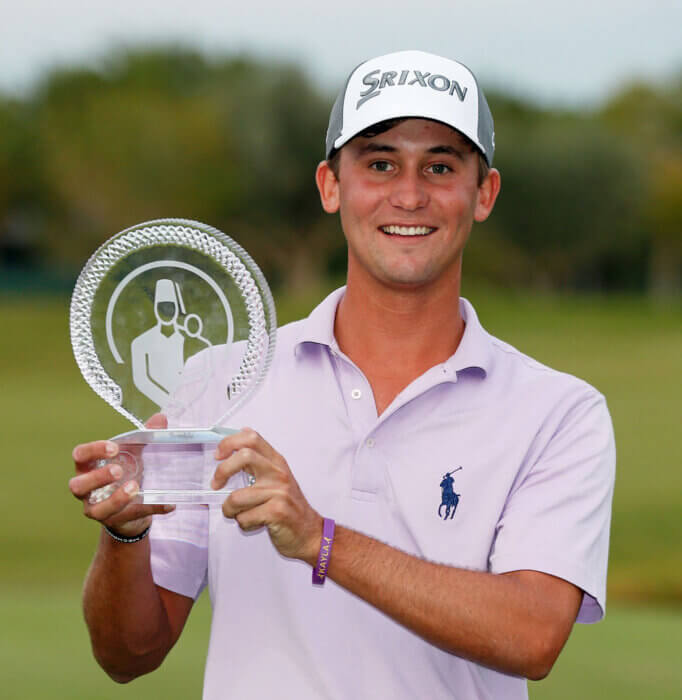 Smylie Kaufman celebrates with the trophy after winning the Shriners Hospitals For Children Open on October 25, 2015. Scott Halleran, Getty Images
“I don’t really have a great answer,” Kaufman replied in the media center. “I’m just kind of going with the flow and just going to try to play golf and just do the same thing I’ve been doing.”
Named Smylie for a paralyzed relative his father always admired, Kaufman was born with a natural optimism and curiosity. He grew up in Birmingham, Alabama, playing golf and basketball, putting one sport away when the other was in season.
He was winning club championships by the time he was 15 but it wasn’t until his senior year at LSU, where he had been a part-time player, that Kaufman’s game caught up with his dreams.
“The worst thing in college golf is to be the sixth man. Smylie had never really differentiated himself,” says his father, Jeff. “All of a sudden, boom, there was somebody who was carrying his team.”
Kaufman turned pro after graduating in 2014, qualified for what’s now the Korn Ferry Tour and went 0-for-5 on the circuit’s swing through South America in early 2015, either missing the cut or failing to get into events. Back in the States, Kaufman popped like spring flowers, winning the United Leasing Championship in late April and earning a PGA Tour card come season’s end. By Halloween, he was a winner on the big tour, hanging with his friends Spieth, Justin Thomas and Rickie Fowler on the road.
Hello, yellow brick road.
At the WGC-Cadillac Championship at Doral in March 2016, the four friends went to dinner on Saturday night with their then-girlfriends, the kind of thing they might normally do in an off week, but rarely with one tournament round to play. Thomas recalls being nervous because he had only been dating his now-wife Jillian for two months, it was her first tournament on the road with him and the drinks were flowing.
When it came time to pay the bill, they decided to play credit card roulette.
“Poor Smylie was handed this $2,500 tab,” Thomas says. “We felt so bad. He was fine but of the four of us he was less far along [in his career] than we were.
“In every game of credit card roulette, there’s always someone you want to lose and someone you want not to lose. We didn’t want Smylie to lose.”
Kaufman was left to pick up the hefty check.
“I just was coming off the Korn Ferry Tour. I’d just gotten a house, maybe right around that time. I was in a twin bed a year prior to that at my parents’ house. You can imagine 100 bucks was still a lot to me even though I was making a lot of money on the golf course,” Kaufman says.
“I’d had this run in the fall, I had some money, obviously, but still, when you’re still 23 years old, it’s not like all that money is in your wallet. So when you get that, you never had a bill like that … oh my gosh.”
Here’s the kicker: Kaufman needed a good round on Sunday to secure a spot in the top 50 in the world ranking and a spot in the U.S. Open that summer, and the dining experience had stayed with him.
“I’m obviously not feeling exactly 100 percent and I shoot 71, which was like just enough, finished eighth, and those guys still talk about the greatest round they’ve ever witnessed from me,” Kaufman says.
A month later, Kaufman and Spieth were together in the final Sunday pairing at the Masters.
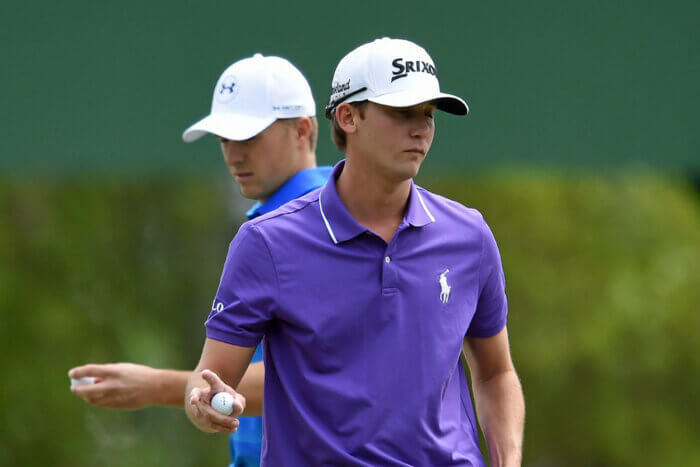 Smylie Kaufman (right) and Jordan Spieth had a disappointing final round together at the 2016 Masters. Jim Watson, AFP via Getty Images
Kaufman matched Spieth’s birdie at the par-5 second to stay within one of the Masters lead but then his Sunday began to melt away. By the time it ended, Kaufman had made nine bogeys and one double bogey and signed for a 9-over par 81 to finish tied for 29th. It was obscured to a degree by Spieth’s epic collapse – he was five ahead with nine to play but a bogey-bogey-quadruple bogey start to the second nine opened the door for Willett’s unlikely victory.
A few days after their respective Masters disappointments, Kaufman and Spieth joined Justin Thomas and Rickie Fowler for their version of a spring break trip to Baker’s Bay in the Bahamas, sharing their sun-splashed adventures on social media. A year later, they did it again in the Bahamas, fueling a social media frenzy that ultimately haunted Kaufman as his playing career, undone by his tendency to hit one or two wayward tee shots every round, began to evaporate.
A decade removed from the Masters, Kaufman insists he thinks mostly about the good parts.
“I do because not many people had the opportunity to play in that event, and I got to experience every like possible thing you could. I made a hole-in-one in the Par-3 Contest, I got to play in the event I dreamed of playing, and then getting to the final group and really, like, legitimately feeling like I had a chance to win the Masters,” Kaufman says.
“If you told me three years prior when I’m sitting there on the phone with my dad (talking about) should I play pro golf and now I’m sitting there in the final group at the Masters, it’s like … I accomplished a lot in a short period of time.”
But as social media commentary was burning itself into a bonfire, Kaufman became a target. Videos showing him being silly in the Bahamas with his buddies were mocked. The more he struggled with his game – Kaufman had just three top-10 finishes in his PGA Tour career after the 2016 Masters – the more he became a target.
“People don’t understand how quickly it can happen in this sport. (Kaufman) went from final group of the Masters to within the next year or two being in a completely different place with his game and career. It’s so hard and it sucks.”
— Justin Thomas
“I caught a blunt force of the fake accounts, you know, they seemed to want to give me a hard time, like the online kind of bullying nature that I was kind of dealing with. … I wanted to be on social media, but I knew it wasn’t a healthy place for me at the time, because it was such a negative place, and so many people had an opinion, and it just is the life of being a professional athlete,” Kaufman says.
“So I spent at least two plus, three years without it, and it was so much better. But there was always that in the back of my mind when I would put the tee in the ground, that I think I lost my purpose of why I was playing, because I wanted to prove people wrong so badly that sometimes I kind of got in my own way.”
Jeff Kaufman watched as his son struggled to keep his tee shots in play.
“He wasn’t having any fun playing. It was not fun going out there banging your head every day. He saw on social media people just hammering him. I think it got to him,” he says.
As Smylie struggled, his parents would receive occasional messages from Rod Fowler, Rickie’s father, and Mike Thomas, Justin’s dad, encouraging them to hang in there. There were good rounds but few good weeks, which turned into months and then into years.
“People don’t understand how quickly it can happen in this sport. He went from final group of the Masters to within the next year or two being in a completely different place with his game and career. It’s so hard and it sucks,” Justin Thomas says.
“As a friend, you never want to see anyone go through it. As a golfer, to have the competitor, he had that taste and he had won and he’d been there … he knows what it feels like and not to go through that or feel you can do that when you have, it’s hard to explain and hard to swallow.
“I was gutted for him.”
*****
It’s quiet inside the clubhouse at Trump National Golf Club Jupiter except for a handful of people walking through the main room as Kaufman settles into a seat not far from a fireplace. The holiday decorations are up but what action there is on this Tuesday night one week before Christmas is outside where dozens of people are putting the finishing touches on the buildout for the Golf Channel Games.
Kaufman has just left a meeting with the players and the support staff, going over what will happen in 24 hours while enjoying face time with Rory McIlroy, Scottie Scheffler and others. He’s carrying a wedge with him, at times leaning on it, at other times spinning it in his hands while making small talk with the players and his broadcast partners.
The 2022 Puerto Rico Open was Kaufman’s last PGA Tour start. Rounds of 78-79 led to another missed cut, his 58th in 93 career starts on the big tour. He was 30 years old and drifting.
“With the game of golf, I saw every bit of high and every bit of low and not a ton of like in the middle. So … when I was really struggling for like, three plus years, like grinding so hard, hitting more golf balls than anybody, but somehow still getting worse, I was just, like, exploring. Just like, is there anything else I could do in this game? Because I feel like I maybe I have something to offer to this game still, and I just wasn’t sure quite what that would be,” Kaufman says in the quiet of the clubhouse.
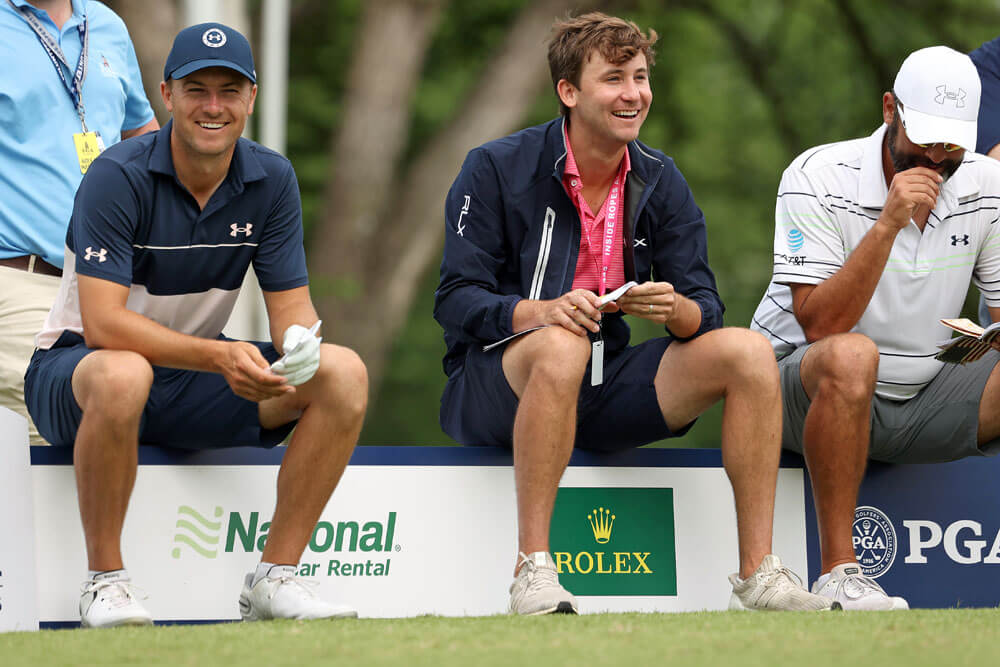 Smylie Kaufman (center) got his start in television working the 2022 PGA Championship. Maddie Meyer, PGA of America via Getty Images
When his manager, Jimmy Johnston, mentioned that ESPN was interested in using Kaufman to do feature group commentary for its digital coverage of the 2022 PGA Championship at Southern Hills, Kaufman quickly said yes.
It’s one of Kaufman’s endearing traits – he sees opportunities more than obstacles. In middle school and high school, he was involved in student government, and at LSU Kaufman sought out leadership roles. It’s something he took from his father and from an older friend who tended to run toward things rather than away from them.
Television work was another one of those things. Kaufman knows the game. He knows the players. He knows how to talk.
“The people that I talked to prior, they’re like, yeah, it’s like sink or swim, like you can either do it or you can’t. I was like, oh, that’s encouraging, like, that’s not exactly what I wanted to hear, about to potentially get into a new career, and that it could be over in 18 holes if it doesn’t go right,” Kaufman says.
When Kaufman completely botched one of his first on-course calls – he said Will Zalatoris would be lucky to get his approach shot on the green from behind a tree on Southern Hills’ 10th hole only to see the player stuff it 4 feet from the hole – he kept moving forward.
Now more than three years into an expanding career, Kaufman remembers a piece of advice from veteran broadcaster Steve Sands.
“He said that even when these players prove your opinion wrong that doesn’t mean that the call was wrong. It’s important to call it how you see it, and sometimes you just give the players the benefit of the doubt of, wow, that was something that I didn’t think was possible,” Kaufman says.
“When I got into this media place, it was like, oh God, I’m finally away from this damn game. I can be myself again. It’s like the shield kind of came off of me.”
— Smylie Kaufman
Working with Sands, Dan Hicks, Curt Byrum, Terry Gannon and others, Kaufman immersed himself in learning his new craft. He understood what to say and what the players were thinking but needed to learn how to say it in seven-second bursts.
Because he was a contemporary of the players he was covering, Kaufman had instant credibility and he understood the boundaries of what he could say, what he shouldn’t say and when to be their buddy and when to be a reporter.
Kaufman has a boyish congeniality that radiates through television sets and computer screens and most places Kaufman shows up.
“My friends from home that he’s been around, they all love him,” Thomas says. “It’s not a situation like, ‘Who was that guy?’ It’s ‘that was the time when Smylie came to town and we went and did this.’ ”
It’s that twinkle, that energy that put Kaufman on the famous 16th tee at the Waste Management Phoenix Open in February 2023. NBC Sports, then the parent company of Golf Channel, had tried to get Jimmy Fallon to host a happy-hour style show inside golf’s most famous stadium but it didn’t work.
Instead, they put Kaufman and the cleverly sarcastic Kevin Kisner together on the 16th tee and told them to have fun. Bad weather had disrupted the tournament to the point that the leaders were on the opposite side of the golf course when the happy hour debuted, forcing Kaufman and Kisner – who can own any room they are in – to improvise.
“We had the bad wave coming through and Kiz and I just were, like, unfiltered, because there was nothing to talk about. And these guys are eight to 10 to 12 shots back of the lead, and we just emptied the bank and just basically had way too much fun. Everybody loved it, and they wanted to keep it going and they were like, ‘Let’s have you host it,’’ Kaufman recalls.
The best in almost any field have a gift of making something difficult appear easier than it is. That is one of Kaufman’s talents.
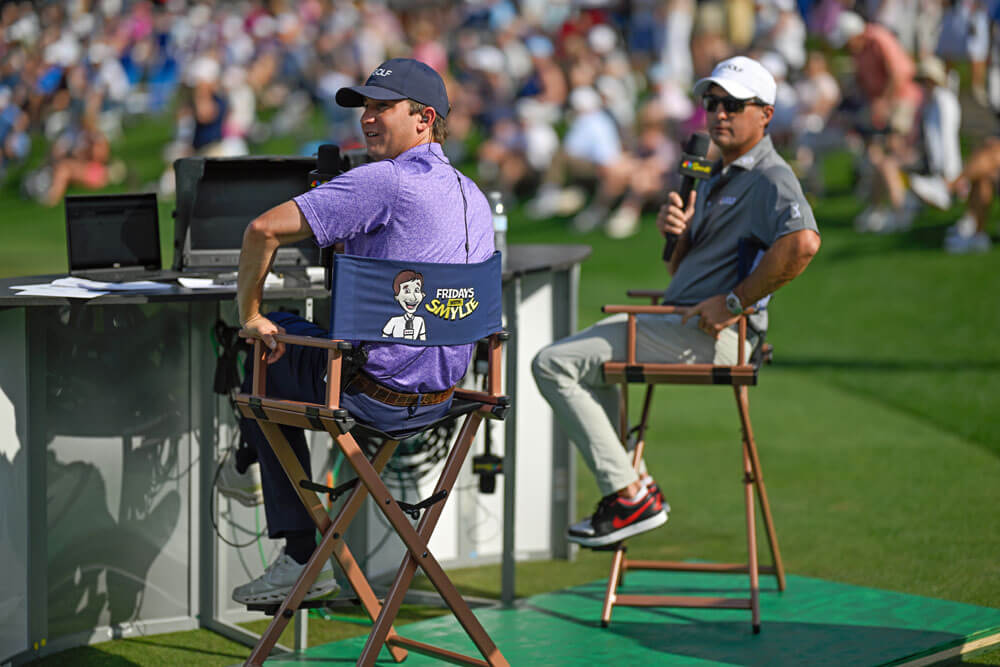 Smylie Kaufman and Kevin Kisner host a popular afternoon happy hour segment for NBC Sports. Ben Jared, PGA TOUR via Getty Images
“He’s just being himself. When it’s time to be serious, he’s serious. He knows Friday and Saturday we can maybe joke around and tell a joke about the guys we know and people love that. They like to hear you talking about people you know. That’s what he does so well. He knows the guys,” Kisner says.
When Kisner shows up for the show, Kaufman is there with a file full of notes, most of them freshly mined on site that week. In the same way he worked at his golf game, Kaufman works to be as good behind the mic as he can be.
“To be able to always have the words when you don’t know what to expect, he’s done a crazy good job of that,” Kisner says.
Kaufman never formally announced he was finished playing professional golf and he’s still capable of playing at a high level but his life has changed. The father of two young children, Kaufman still lives in Birmingham but he is a media personality now.
His podcast has been so popular that it’s now a weekly show on Golf Channel. He has the respect and trust of his peers and the ear of his audience.
As Kaufman sits near the fireplace in the clubhouse, Johnson Wagner, another tour player who has transitioned successfully to television, walks by and gently taps Kaufman on the shoulder and gives him a smile, knowing rehearsal outside is moments away.
“I think because of the journey that I went through a lot of times, I want to bring that out in other people and just try to get them to be honest. I think the vulnerability that I eventually developed, that I didn’t have for many, many years when I was playing and especially struggling … that’s something that I wish I would have had more of and talked to more people and just been more open,” Kaufman says.
“I feel like I was a shell, like, I just was not myself, was not the Smylie that I had been in when I was playing well. I just felt like I was trapped in a box and I couldn’t get out.
“When I got into this media place, it was like, oh God, I’m finally away from this damn game. I can be myself again. It’s like the shield kind of came off of me.”
They’re calling for Kaufman outside as the rehearsal resumes. He grabs his wedge, excuses himself and heads toward the first tee, smiling as he goes.
Top: Smylie Kaufman sits on the bench on the sixth tee box during the third round of the 2025 Open Championship in Portrush, Northern Ireland. Ben Jared, PGA TOUR via Getty Images
© 2026 Global Golf Post LLC