
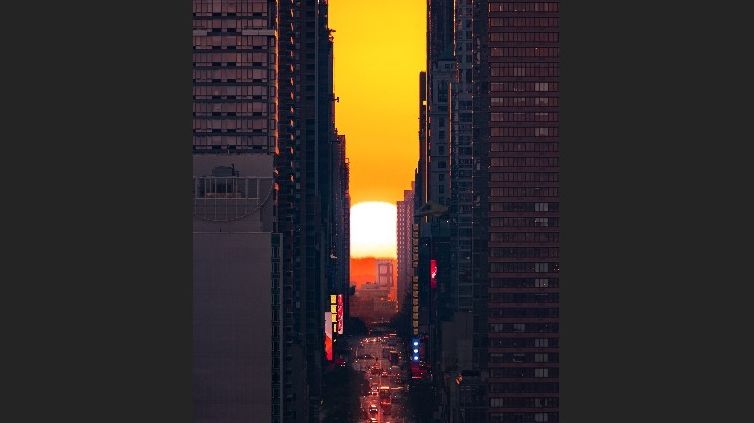
When sunbeams radiate precisely with Manhattan’s crosstown streets, many New Yorkers pause from the bustle to get a glimpse of the sunset phenomenon known as Manhattanhenge.
Tomorrow morning, around 7:20 a.m., people in the borough can witness a similar phenomenon known as Reverse Manhattanhenge, the National Weather Service said.
“Manhattanhenge, obviously, is the sunset, and this is the reverse. We can see it [the sun] kind of lined up with our east-to-west grid there in Manhattan during sunrise,” National Weather Service meteorologist Dominic Ramunni said.
Reverse Manhattanhenge happens twice a year, before and after the winter solstice, with the first one this year occurring Jan. 11 and 12.
Ramunni said cloudy skies made the event too difficult to see on Sunday.
Ideal locations to see Manhattanhenge include 57th Street, 34th Street and 14th Street, according to the New York City Department of Parks & Recreation.
During the winter months, the phenomenon can typically be caught in the same places but in the opposite direction, meteorologists say. Better views are usually available farther west.
Yet the reverse phenomenon is less popular than Manhattanhenge, in part due to frigid winter temperatures, The Old Farmer’s Almanac said.
Temperatures on Monday morning are expected to be in the mid-30s, with dry conditions, meteorologists said.
“It looks like we’ll have few enough clouds in the sky that it probably” will be visible, Ramunni said in a phone interview on Sunday.
In 1997, astrophysicist Neil deGrasse Tyson conceived of the term Manhattanhenge, inspired by a trip to the prehistoric Stonehenge structure in England, according to The Associated Press. Tyson, who grew up in New York, saw similarities between how sunlight struck Manhattan’s urban skyline and Stonehenge.

Tiffany Cusaac-Smith is a general assignment reporter for Newsday. She previously worked at USA TODAY and is an alum of Howard University.