
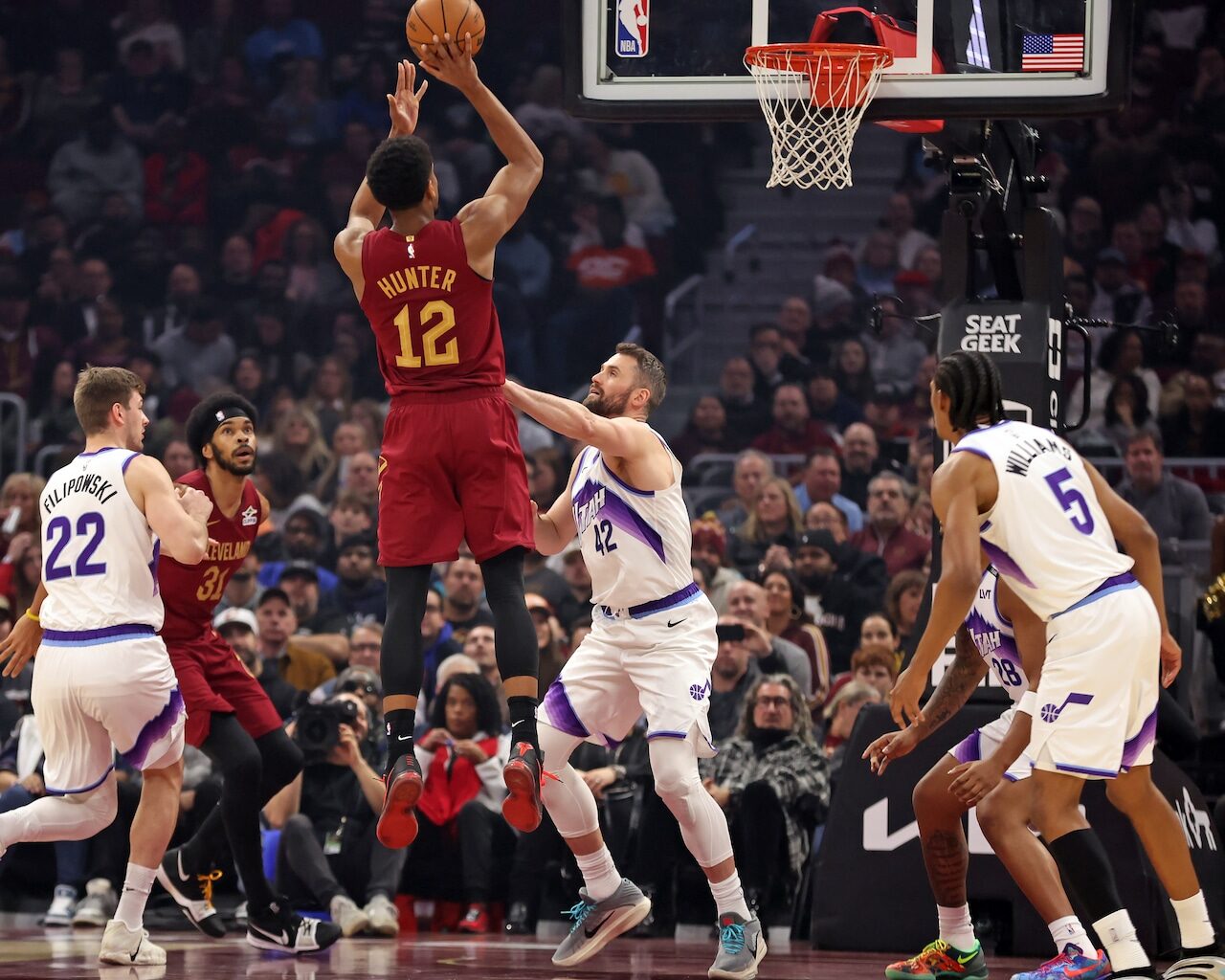
CLEVELAND, Ohio — A little less than an hour before tipoff, Utah Jazz forward Georges Niang strolled onto the court with a walking boot protecting his achy foot and reunited with some of his old Cavs buddies.
A warm embrace with Donovan Mitchell. A few jokes with Darius Garland. A trip down memory lane with coaches seated on the bench.
Then came another member of the Cavs organization.
We miss you around here.
It’s been nearly a year since Cleveland sent Niang to Atlanta, along with steady reserve Caris LeVert and future draft capital, for swingman De’Andre Hunter — a bold trade expected to help the Cavaliers take the next organizational step, giving them a volume-scoring postseason weapon and possible answer to the ongoing small forward question.
Cleveland knew the risks. Locker room dynamics are delicate. Conflicting emotions are natural. Leadership is invaluable. For all his on-court imperfections, Niang was a cherished behind-the-scenes pillar and an authentic, candid voice.
Nonetheless, it was a bet worth making.
What the Cavs lost was supposed to be concealed by what they gained. Hunter a missing piece. Niang a distant memory.
Only that’s not the case.
Not with Hunter in the midst of one of worst, least productive campaigns of his seven-year career.
“He’s a hell of a player,” Mitchell said when asked about Hunter following Monday’s 123-112 loss to the Jazz. “He’s a guy that we believe in, and we trust in every day. We see the work he puts in on his body, on his shot, on everything. I think [when] you’re not necessarily making shots, it can definitely feel like a lot. But we have our arms around him. He’s a guy that comes in every day with the same positive spirit. It’s tough. You’re not always going to have great stretches. But we’re continuing to have his back. It’s going to come around.”
Hasn’t yet.
This version of Hunter, averaging just 14.3 points on 42.7% from the field and 30.6% from 3-point range in 27.2 minutes, is a shadow of the guy Cleveland coveted for years and finally acquired in February.
During Monday’s inexplicable setback against the road-weary 25-loss Jazz who are more focused on ping-pong balls, Cavs coach Kenny Atkinson benched Hunter for the entire fourth quarter. Atkinson had no choice.
Hunter finished with a season-low-tying two points — the second time in less than three weeks — on 1 of 5 shooting. He didn’t grab a rebound. Had as many turnovers (3) as assists. Played just 18 minutes.
“It’s not clicking,” Atkinson admitted when asked specifically about Hunter’s struggles. “I think it’s a prolonged batting slump. It happens in every sport. Trying to support him. Trying to get him some touches. Part of my job is to help him. He’ll snap out of it. He’s too good of a player to be playing like this. He’ll turn it around. We need him.”
Atkinson has already tried a few things.
Following a summertime conversation with Hunter, Atkinson put Hunter into the Opening Night starting lineup — a controversial move given Hunter’s success and comfort as a sixth man.
It didn’t work. Not for Hunter. Not for the Cavs.
On Dec. 17, Hunter slid back into his old bench spot. The thinking was two-fold: Create more scoring balance between starters and reserves and unlock Hunter.
More touches. More shots. More freedom. More responsibility. Higher usage.
That hasn’t worked either.
Like the Cavs as a whole, there have been intriguing flashes, moments where it looks like Hunter is primed to snap out of this prolonged funk, morphing back into the second unit linchpin that was enjoying a career breakthrough — until arriving in Cleveland.
But those continue to get overshadowed by nights like Monday. Or Saturday — four points on 1 of 5 shooting. Or Dec. 27 in Houston — missing every shot attempt and mustering only two points.
Statistically, the Cavs are better with Hunter off the floor — a differential of 5.4 points per 100 possessions.
This rapid — and unexpected — decline has left the team puzzled.
“I don’t know,” Atkinson said. “You support because he’s got a long body of work in this league. I don’t know. We’ve got to figure it out because obviously it’s not just on the player. It’s on the coaching staff. Gotta figure how we can get him in better positions to succeed. He’s trying to get through this slump. He’ll get through this. Needs to see a couple go through. I think that would help. Just got to support him and give him confidence until he breaks out.”
Cleveland has invested numerous resources in an effort to fortify its wing spot. A four-year contract to lure Strus from Miami in 2023. A first-round pick on Jaylon Tyson. A multi-year extension for Sam Merrill this past summer. Trading for Lonzo Ball who is currently out of the every-night rotation.
Hunter was supposed to be the most reliable option, bringing defense, physicality, floor spacing, shooting, versatility and three-level scoring while fitting seamlessly alongside the ballyhooed Core 4 — Evan Mobley, Jarrett Allen, Garland and Mitchell.
Instead, Atkinson has been pushed into uncomfortable choices, spending the first half of the season searching for viable lineups and combinations.
Tyson. Merrill. Wade. Mitchell. Nae’Qwan Tomlin. A revolving small forward door that keeps spinning.
Ahead of training camp, president of basketball operations Koby Altman was asked how the organization planned to address the position in Strus’ extended absence.
Altman shrugged it off. Didn’t even see it as a problem.
“It’s really an underrated story in terms of how much De’Andre Hunter is going to put a stamp on this season,” Altman said. “We’re super excited about him.”
“De’Andre Hunter, you could argue, has been our best player in the offseason,” Atkinson added. “He’s had an incredible offseason. That was part of that offseason goal for me was to get to know De’Andre better and spend some time with him, a lot of time to define his role more.”
Sources tell cleveland.com that team decision-makers have rebuffed trade offers to this point, including at least one for Hunter. The focus has been internal improvement. There’s still belief in this group. A desire to see what it looks like at full strength — or close to it.
But it’s now the halfway point of the season and the high-priced Cavaliers, the league’s only second apron outfit, continue to underachieve. Monday’s baffling loss dropped them back out of playoff position in the weaker Eastern Conference.
With Hunter out of sorts, Strus still sidelined and Wade battling a problematic knee that recently required a precautionary MRI (it came back clean), the Cavs are suddenly back where they were around this time last year — eyes starting to wander toward the trade deadline, wondering if there’s a better option.