
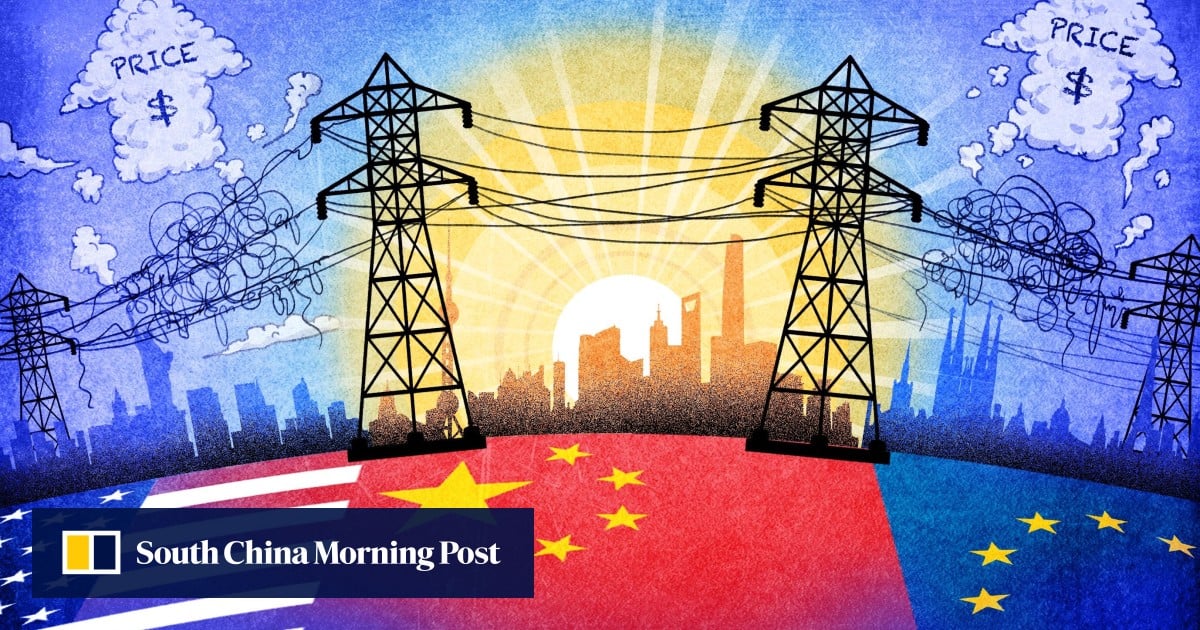
Near the end of last year, thousands of European travellers saw their holiday plans unravel after a prolonged power outage in the Eurotunnel – the underwater train passage linking Britain and France – caused by a fault in the overhead supply.For many, this brought back memories of chaotic scenes the previous April, when rolling blackouts struck much of Portugal and Spain. The United States also suffered from multiple power outages last year, including major disruptions in California – most recently in San Francisco, where a substation fire cut electricity to around 130,000 homes days before Christmas.On the other side of the globe, the situation is quite different. After a series of regional outages from 2020 to 2022 – the first large-scale blackouts the country had seen in over a decade – China has maintained a stable electricity output with rare interruptions to services.
Beyond the periodic blackouts, relatively high energy costs in Europe and the US are creating another problem: meeting the increased demand generated by the industries viewed as essential for growth and dominance in advanced tech.
The massive data centres which leading artificial intelligence (AI) firms are erecting to train their new models are projected to consume enormous quantities of electric power, putting even more stress on grids already struggling to meet ordinary output levels.
Conversely, even after previous construction sprees, China is continuing to widen and deepen its energy network. New power plants, grids and other big-ticket projects are under way or in the planning stage, including a US$137 billion hydropower project on the Yarlung Tsangpo River in the country’s far western Tibet autonomous region.
“In terms of electricity capacity, the differences between China, the US and the EU are substantial, and China is clearly staying ahead of the curve across scale, structure and growth momentum,” said Alberto Vettoretti, managing partner at consultancy Dezan Shira and Associates.