
Despite repeated warnings from medical professionals, staff at the Sangamon County Jail placed 27-year-old Tiffany Rusher — who had a long, documented history of suicide attempts and self-harm — in an isolated cell for nearly four months, a lawsuit and jail records show.
In March 2017, she was found dead with “a strip of hand towel wrapped tightly around her neck.,” according to a lawsuit filed by her family.
Doctors had advised jail staff that Rusher should not be held in solitary confinement, noting her dozens of prior attempts to harm herself and her high risk for suicide.

Jackie Mathias, director of inmate services and behavioral health at McLean County Jail, discusses jail programs.
CLAY JACKSON, THE PANTAGRAPH
Rusher’s mother, Kelli Andrews, later sued Sangamon County and Advanced Correctional Healthcare, alleging that despite knowing Rusher had attempted to kill herself at least 10 times and had injured herself in 27 other incidents — including swallowing pens, toothbrushes and other inedible objects similar to the cloth available to her in jail — officials still housed her in conditions medical staff had explicitly warned against.
Michael Shmikler, a social worker for ACH, described Tiffany as “high-risk” due to the known danger that she presented to herself, according to the lawsuit.
People are also reading…
“The defendants also knew, or at the very least should have known, that placing a person with Tiffany’s mental state in solitary confinement would only exacerbate her deteriorated mental condition, cause severe psychological trauma, and make it more likely that Tiffany would try to kill herself,” the complaint read.
The defendants would admit that Rusher was reported to suffer from mental illnesses and was documented to engage in self-harm. However, they would deny that all of her illnesses were known to all defendants that the referenced illnesses were severe at all times during her incarceration.
According to the Illinois Criminal Justice Information Authority’s Death in Custody Report, at least 112 inmates died between 2019-2022 in Illinois county jails. Of those, 24 were reported as suicides.
Nationally, between 228 and 369 suicides of local jail detainees were reported annually between 2000 and 2019, according to the Bureau of Justice Statistics.
As the number of state-operated treatment centers and beds for inmates with mental health concerns in Illinois dwindle, the pressure falls on county jails and community-based clinics to provide restorative mental health services. Even private health care contractors hired to provide medical services to detainees don’t always provide mental health professionals.
County jail administrators and sheriffs across the state say that handling the needs of people experiencing some of the worst mental health conditions has become a burden too heavy for their staff to carry and for the county to fund on its own.
“We are having a mental health crisis,” said Rock Island County Sheriff Darren Hart. “It is a challenge in being able to maintain those individuals, because we have only a level of care available to us here locally, where the state may have a higher level of care that they can provide.”
Advanced Correctional Healthcare (ACH) contracts with about half of the county jails in Illinois and nearly 400 facilities across the country. The company often partners with community-based organizations, like Freedom Behavioral Health, to outsource mental health care.
Jessica Young, ACH President and CEO, said some facilities use volunteers because they do not have any funding for a behavioral health program.
“Suicide is the number one cause of death in jail, so it is important to have qualified mental health staff to assess and treat detainees in crisis and to determine when to place detainees on suicide precautions or release them from precautions,” said Young. “The nationwide suicide rate has grown by over 16% in the last year.”
Coles County Sheriff Kent Martin
Photo provided
Coles County Sheriff Kent Martin says the nursing and medical professional shortage makes an already difficult situation worse. Coles County also contracts with ACH for medical services and with Freedom Behavioral Health for mental health services.
“We go through two or three mental health professionals a year,” he said.
He added that Coles County Jail is better off than most of the agencies in the surrounding area, but that having 24-hour mental health care would be ideal.
“But as we know, the funding is never there for that,” Martin said.
Treatment and segregation
Rusher’s suicidal behavior while in the custody of the Logan County Correctional Facility continued after her committal to McFarland, now known as the Elizabeth Parsons Ware Packard Mental Health Center. She was then transferred to Sangamon County Jail after being charged with aggravated battery.
Illinois County Jail Standards requires jail officers to provide personal observation of inmates at least every 30 minutes. However, jails may require more frequent checks if it’s determined that the patient is a risk to themselves or others.
Dr. Arun Abraham, a physician at the Sangamon Jail employed by ACH, said during a deposition that under Sangamon County Jail’s suicide prevention program, a detainee that is identified as trying to harm themselves can be put on “high risk” status. Inmates with this designation are observed every 15 minutes and spoken to regularly be mental health staff.
Sangamon County inmates designated as “mentally unstable” are subject to 10-minute checks whereas inmates designated as “suicidal” are subject to 10-minute checks or 24-hour continuous observation depending on the circumstances.
During her detainment in Sangamon, Rusher was deprived of all property, stripped naked and barred from having any undergarments or clothing except for an anti-suicide blanket.
Melissa Caldwell, president of behavioral health services for Freedom Behavioral Health, said in a deposition for the Rusher lawsuit that recommendations can be made for an at-risk inmate to not have clothes if they have used clothing to harm themselves.
In the months leading up to her death, staff members recorded that Rusher was mentally unstable for 76 days, suicidal for two days in February 2017 and had five instances of needing medical precautions such as health screenings, quarantine and isolation for potential or confirmed illnesses, according to court records.
In addition, Abraham assessed Rusher as having bipolar disorder and schizoaffective disorder, which were documented in a medical progress note.
Alan Mills, executive director of the Uptown People’s Law Center, represented Rusher’s estate in the case and said mental health care at the time consisted of isolation and medication.
“And that meant (Rusher) was heavily medicated for part of the time and that she was isolated all the time that she was there,” Mills said. “Isolation is one of those things that is actually a predictor of suicide and that’s true both in the community and in jails.”
The hope would be that staff should be fixing their procedures as a result of the case, he added. However, there was no requirement to do so in the settlement.
Sangamon County Sheriff’s Department officials said procedures changed following the incident but declined to comment further about the Rusher case.
In some instances, jails rely on the guidelines of the National Commission on Correctional Health Care for the treatment of mentally ill individuals even if they are not accredited by the agency.
According to a position statement adopted by the commission in 2016, “isolation for clinical or therapeutic purposes should be allowed only upon the order of a health care professional and for the shortest duration and under the least restrictive conditions possible and should take place in a clinically designated and supervised area.”
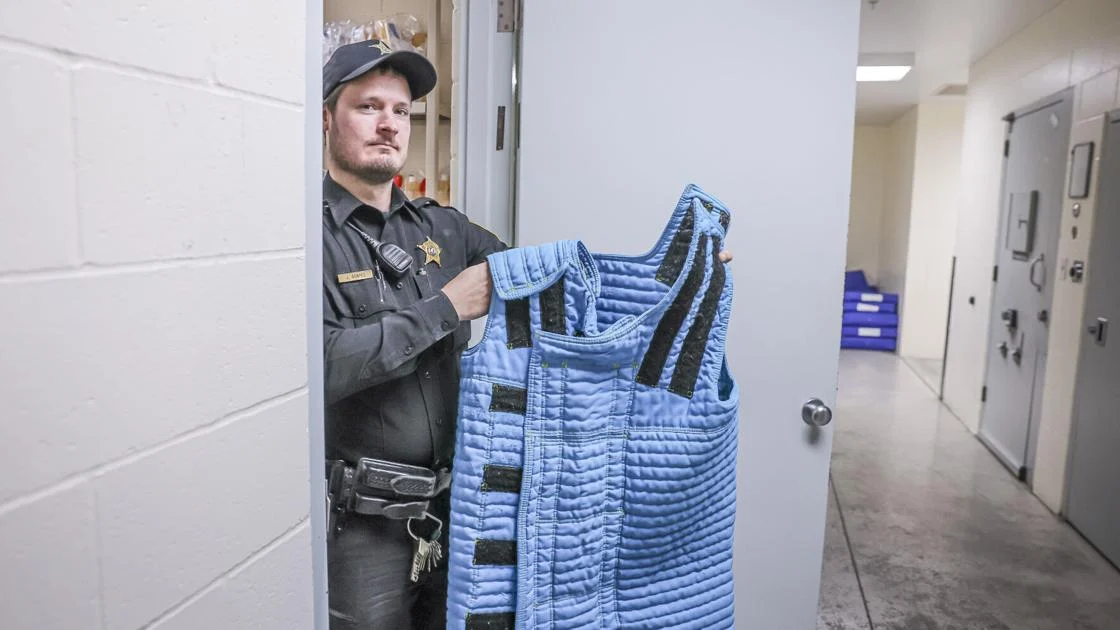
A Woodford County deputy shows a protective vest used for at-risk detainees on January 24, 2025, at the Woodford County Jail.
CLAY JACKSON,THE PANTAGRAPH
Caldwell said in her deposition that Rusher’s housing conditions were not equivalent to the solitary confinement conditions you would see in prisons. And at times, they are necessary to ensure patient safety.
“If it was to keep her safe and others safe, then I am comfortable with it,” Caldwell said in her deposition. “It is not optimal but it is necessary for safety.”
She added that an at-risk inmate’s separation from the general population does not or should not mean unsupervised isolation. Defendants denied that Rusher was confined under conditions of extreme isolation or that she was in solitary confinement for more than 30 days.
“It should mean that there’s a lot of monitoring and eyes professionally happening with that individual in a safer environment,” Caldwell said in her deposition. “And it should be time limited while we’re trying to help the individual stabilize.”
For many jails, housing of mentally unfit inmates depends on the severity of their condition.
In Livingston County, Jail Superintendent Lisa Draper said if the detainee can be placed in housing safely, staff will try to do that to keep them from being isolated. The jail’s Job Management System typically flags inmates who may pose a suicide risk.
“However, if we can’t we place them on administrative segregation,” Draper said. “During this time, we still offer recreation and time out of their cell if they choose to do so.”
Jackie Mathias, director of inmate services for the McLean County Jail, said there are 16 cells in the McLean County Jail’s special needs and behavioral health unit and there is usually a waiting list. In addition to detainees who are unfit to stand trial, the unit also holds people who may be violent or destructive to property on a repeat basis.
Those waiting to be sent to the behavioral health unit who pose a safety threat can be held in the booking area unless they have a serious medical issue, she added.
Macon County Jail Superintendent Jamie Belcher said every correctional officer goes through training to identify individuals who may be experiencing a mental health issue.
Officers then go through more extensive mental health training as they achieve their certification. However, counselors are able to offer more effective tools and resources to inmates.
“When somebody gets here they kind of start to lose hope,” he said. “There’s a lot of anxiety that comes with that. The counselor does a good job of dealing with those folks and helping them with coping mechanisms and journaling.”
Delayed transfers
Although mental health and suicide prevention training is required for correctional officers, many jails are still unequipped to handle the needs of inmates who are unfit to stand trial. And the wait to transfer these inmates to mental health facilities can take much longer than the 60-day deadline imposed by the state.
In 2022, Khayla Evans, a 24-year-old woman with an intellectual disability and a history of mental illness, had been in Lake County custody for 170 days and found unfit to stand trial for 67 days before she was found unresponsive in her cell.
At the time of her booking for aggravated battery in June 2022, jail staff and members of Wellpath, Lake County Jail’s medical provider, had knowledge that Evans was on multiple medications for ADHD and Intermittent Explosive Disorder. They were also aware that Evans’ disability made it difficult for her to advocate for her own care.
According to a lawsuit filed by her family, the months leading up to her death consisted of multiple psychiatric episodes with self-harm, severe abdominal pain, refusing meals for consecutive days and leg numbness that left her unable to use the toilet on her own.
According to an affidavit from a physician with 40 years of experience in emergency medicine, the defendants’ failure to assess Evans’ condition, order appropriate diagnostic testing and imaging and adequately treat her condition contributed to a delay in her diagnosis and treatment, resulting in her untimely death.
Christopher Covelli, public information officer for the Lake County Sheriff’s Office, said he could not comment specifically about the Evans’ passing. The defendants have either denied the allegations or stated that they don’t have enough knowledge or information sufficient to form a belief, according to the suit.
The Illinois Department of Human Services reported 151 individuals unfit to stand trial or not guilty by reason of insanity awaiting beds at mental health facilities as of September 2025. At that time, the average wait time to transfer one of these at-risk detainees to a state-operated mental health facility was 74 days.
“The number of referrals IDHS receives monthly has more than doubled since early 2020,” said Rachel Otwell, DHS director of communications. “In the wake of this unprecedented increase in the number of referrals since the COVID-19 pandemic began, IDHS is building forensic capacity at our hospitals.”
Woodford County Chief Deputy Dennis Tipsword, R-Metamora, who also represents the 105th Illinois House District, said their jail was not holding any detainees deemed unfit to stand trial or not guilty by reason of insanity at the beginning of 2025.
Tipsword
But in 2024, the county was holding two of these detainees: one who was waiting 160 days for a transfer and one who was waiting 140 days. And for a jail with a maximum capacity of 88 and limited mental health resources, these warehoused inmates’ mental health often deteriorated to a point worse than when they were first booked.
“And what typically happens in a situation like that after that much time is (mentally ill detainees) end up in solitary confinement in one of our medical rooms or in our detox room,” Tipsword said. “And that is horrible for their mental health to be locked away like that but we just don’t have options.”
Delayed transfers also add to the daily duties of the jail staff, according to Sangamon County Jail Superintendent Larry Beck. This could include more frequent cleanings of their cells, making sure inmates are bathing though they may consistently refuse to do so, ensuring they are taking their medications, and other modifications that can in some cases require 24-hour monitoring.
“They just really can’t function on their own,” Beck said.
However, suicide watch and other inmate designations don’t always mean that an inmate will be isolated or even transferred to a location for specialized care.
After months of psychiatric episodes with symptoms ranging from hallucinations to banging her head against her cell door, Evans had been placed on suicide watch in the Lake County Jail, yet she would remain in the general population as opposed to a medical unit or a hospital.
The next month, Evans’ inmate classification was changed to allow “closer supervision and the special attention of jail administration” due to her risk of self-harm, according to her wrongful death suit. But she would not be transported to a hospital or referred to a physician leading up to this decision.
Bed availability
As of last year, IDHS currently operates six state hospitals with a total of 822 forensic beds for individuals found unfit to stand trial or not guilty by reason of insanity. Since 2021, more than 200 forensic beds have been added across the state, she added.
IDHS is also in the process of rehabilitating the Alton Mental Health Center’s Willow building, which would expand forensic service capacity by 100 beds. This $27.9 million capital investment is expected to be completed in 2026.
The department also contracts with private psychiatric hospitals to provide additional capacity when clinically appropriate, Otwell said.
Scott Block, statewide behavioral health administrator of the Administrative Office of Illinois Courts, said when there is a lack of community-based treatment, the thought is that any avenue to get someone treatment will improve outcomes.
“What people don’t understand is competency restoration services are not the same as what you would expect in psychiatric or mental health care,” Block said. “Mental competency restoration services are really meant to restore somebody to a state to where they are able to stay on trial and to litigate and then adjudicate the case.”
Beck said that once inmates become a ward of the state, IDHS’ mental health facilities have the ability to force medication and when that happens, it doesn’t take long for these individuals to be restored to a better mental state.
“Then what happens after that is when (IDHS) declares that (inmates) are fit, they send them back to me,” Beck said. “In a week, some of them will immediately become noncompliant with meds again and it doesn’t take long for them to deteriorate.”
Although McLean County Jail has mental health resources that have managed to restore at least 11 detainees to competency without a DHS referral in the last three years, administering treatment is a difficult process.
“And then even if you come here, it’s not like we can force medications or we can force treatment on you,” Mathias said.
Hart said Rock Island County has been lucky to have a partnership with the Robert Young Center, which has provided mental health caseworkers and providers that manage the caseload of the jail.
“It helps identify individuals that need additional care,” said Hart, adding that he believes the services offered through Robert Young Center have played a significant role in decreasing the number of instances of self harm and suicides.
The county’s 708 Mental Health Board was established in 1976 through the Illinois House Bill 708, which enables the county to collect and allocate revenue for mental health, substance abuse and developmental disabilities services. The board funds around $200,000-$250,000 worth of mental health services, eliminating that cost for the county.
“We’re thankful that we received the resources to be able to do that,” Hart said. “Because if not, that would add another cost on top of operating the Rock Island County Jail.”
If you or someone you know is struggling with thoughts of suicide, you can call or text 988 to reach the Suicide & Crisis Lifeline for free, confidential help 24/7.
As anxiety and isolation take a toll on employee mental health, here’s how managers improve workplace culture
As anxiety and isolation take a toll on employee mental health, here’s how managers improve workplace culture
As more Americans become aware of the importance of mental health, work-life balance has become a priority for many working individuals. This makes sense, considering Americans working a traditional 40-hour workweek spend nearly 2,000 hours at work annually.
Technological advances like smartphones, email, and work-messaging platforms have allowed for near-constant contact between bosses and employees. At the same time, the rise of remote work and working with colleagues across time zones has blurred the line between working and nonworking hours.
In 2022, the Surgeon General issued guidance on workplace mental health, noting the relationship between work and well-being. Workplace stress, exacerbated by working long hours or in a toxic work environment, can have long-term effects on employees and their employers.
A 2024 American Psychological Association survey found that 2 in 3 workers reported experiencing signs of burnout in the previous month, such as reduced interest or effort at work, low energy levels, lack of motivation, or feelings of loneliness or isolation.
Economic factors such as stagnant wages and rising prices can also affect one’s mental health. An October 2024 survey of 5,000 working adults showed financial insecurity had become a significant factor in decreased productivity, with a quarter of workers identifying finances as their greatest source of stress.
WorkTango examined data from the APA and health technology firm TELUS Health to see how employees feel about the culture surrounding mental health at work and how it’s changed since 2020.

PeopleImages.com – Yuri A // Shutterstock
Workers’ mental health stabilizes but still needs improvement
Overall, workers’ mental health has improved since the COVID-19 pandemic upended the way people do their jobs and how they feel about them, according to the TELUS Mental Health Index, or MHI. The index measures the emotional well-being of employed adults on a scale of 0 to 100, with 80-100 being the optimal score.
Workers’ mental health was at its lowest level in April 2020, when TELUS launched the index. By fall 2024, things had improved slightly but plateaued at 70.6. For the past three years, anxiety and isolation have continued to strain workers’ mental health, with scores staying persistently low compared to other health measures, such as work productivity, depression, and financial risk.
Still, the latest data shows that fewer workers fell into the high-risk mental health group in October 2024 than in April 2020, when 1 in 4 workers were in that risk category. The type of job one has can play a role; managers have better mental health scores than laborers or those working in the service industry.
This can create a gap in understanding between employers and employees regarding workplace mental health and well-being, as well as a fear of speaking out. While workers are generally satisfied with their jobs—with 9 in 10 saying they’re proud of their work, according to the APA—3 in 5 reported that their work environment is not as mentally healthy as their employer thinks. More importantly, 2 in 5 believe disclosing a mental health condition to their employer would negatively impact them.
WorkTango
How employers and employees can work to improve mental health at work
Creating a psychologically safe work environment, or a space where employees can voice their opinions without fear of reprisal, is vital for employers and employees. According to the APA, trust in the workplace fosters teamwork and helps creativity and innovation to flourish, which increases overall performance. Encouraging well-being in the workplace can also reduce the risk of chronic illness or stress, which can affect productivity.
The Surgeon General’s 2022 report suggests five essentials for improving workplace culture: protecting workers from harm by prioritizing safety and security, creating an inclusive community that fosters belonging and trusted relationships, providing work-life balance with autonomy and flexibility, ensuring that people feel like they matter in the workplace, and allowing growth opportunities for their careers.
On an individual level, one strategy employees can use to reduce the likelihood of burnout and protect their mental health is to set boundaries to protect their time and energy. This could look like taking breaks for lunch, not checking work emails outside work hours, or discussing appropriate workloads.
There is no doubt that creating a work environment that prioritizes employee mental health and actively works to reduce the risk of burnout has wide-ranging benefits for both employers and employees. It fosters productivity, job satisfaction, and overall well-being while delivering measurable bottom-line results.
Story editing by Natasja Sheriff Wells. Copy editing by Paris Close. Photo selection by Clarese Moller.
This story originally appeared on WorkTango and was produced and distributed in partnership with Stacker Studio.
Theera Disayarat // Shutterstock
Contact Drew Zimmerman at 309-820-3276. Follow Drew on Twitter: @DZimmermanLee
Khayla Evans’ timeline in custody of Lake County Jail from June 30 to Dec. 16, 2022
June 30: Evans arrested and placed in the custody of Lake County Jail.
July 1: Evans started feeling effects of missing doses of prescription medication for ADHD and Intermittent Explosive Disorder, Wellpath and jail staff alleged to have “altered the pharmacologic regimen” of Evans during her custody.
July 4: Evans suffers psychiatric episode where she throws a chair and says she needs to be transferred to a mental hospital or she will be “leaving in a body bag.”
July 9-13: Evans reports severe stomach pain and anxiety to staff.
Aug. 12: Evans suffers psychiatric episode where she was in an out of psychosis, hallucinations and bouts of banging her head against her cell door.
Aug. 14: Staff were made aware that Evans was not eating and refused four meals.
Aug. 26: Evans suffers psychiatric episode where she exhibits “bizarre behavior.”
Sept. 7: Evans suffers psychiatric episode where she was banging her head against a cell window and scratching her arms claiming there were bugs on her.
Sept. 12: Evans suffers psychiatric episode and screams for help to staff.
Sept. 23: Evans falls from her cell, no physician was contacted and Evans was not transported to a hospital.
Sept. 25-30: Evans continues to refuse meals but is not appropriately assessed by any medical provider.
Oct. 11: Evans declared unfit to stand trial.
Oct. 25: Evans reportedly refused meals for three straight days.
Oct. 30: Evans’ classification changed for closer supervision due to risk of self-harm.
Nov. 12: Evans suffers psychiatric episode where she was banging on her cell door.
Nov. 16-17: Evans falls in her cell twice, no physician is contact and Evans is not transported to a hospital.
Nov. 20: Evans reports that she can’t move her legs.
Nov. 22-23: Evans reportedly has not eaten for days and reports that she can’t stand.
Nov. 23: Evans transported to Vista Medical Center East, no diagnostic testing or imaging is ordered nor is she admitted for treatment, Evans returns to Lake County Jail later that day.
Nov. 24-26: Evans reportedly throwing up medication and is fitted with a diaper due to her inability to use the toilet.
Dec. 2: Evans transported to Vista Medical Center East for the second time, no diagnostic testing or imaging ordered, complete history reportedly not obtained.
Dec. 5: Evans discharged and returned to Lake County Jail.
Dec. 7-9: Evans unable to change diaper or hold medication, continues to experience abdominal pain.
Dec. 9: Evans transported to Vista Medical Center East for the third time.
Dec. 10: 60-day deadline to transfer Evans to a state mental health facility elapses, CT scan shows small infiltrate in right lung but not followed up on.
Dec. 13: Ultrasound of Evans’ lower extremities performed, visualization of two leg veins reportedly incomplete. Evans discharged and returns to Lake County Jail
Dec. 14: Evans reportedly screaming non-stop.
Dec. 16: Evans found unresponsive in jail cell having suffered from fatal cardiac arrest.
Sign up for our Crime & Courts newsletter
Get the latest in local public safety news with this weekly email.