
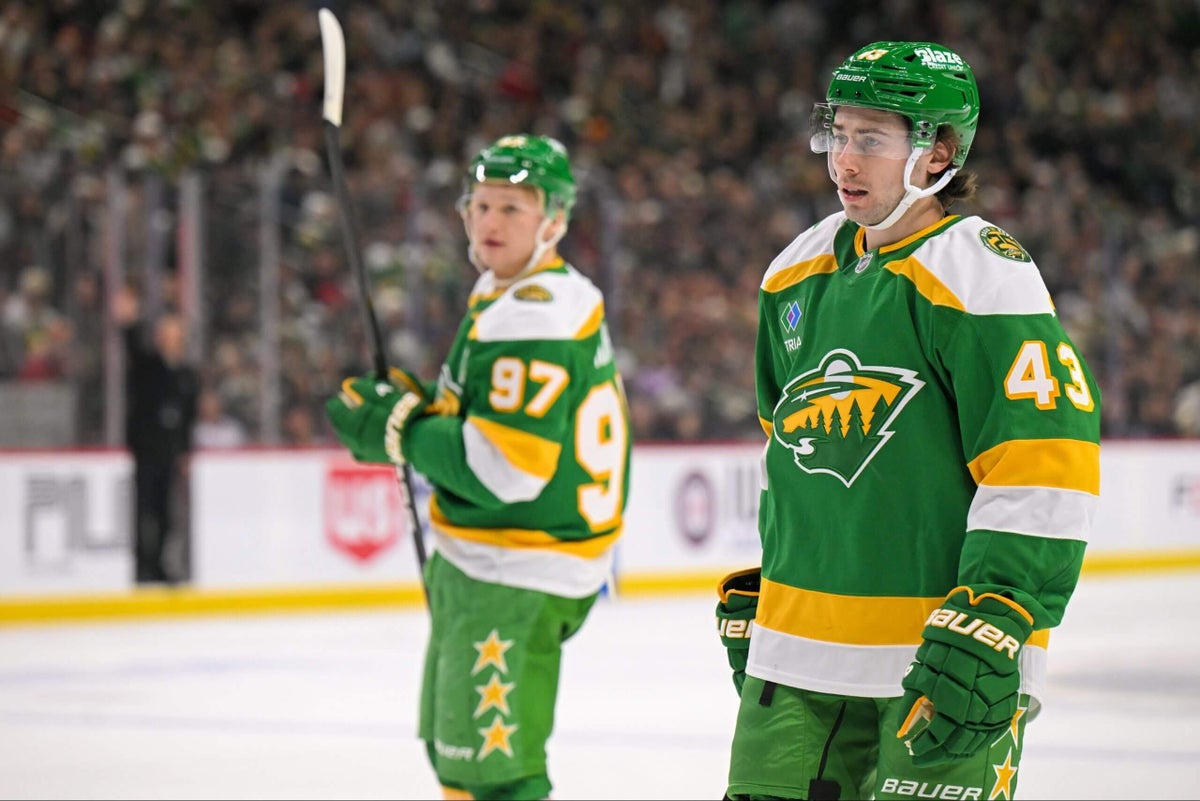
ST. PAUL, Minn. — The boos came raining down from the Grand Casino Arena rafters on Tuesday, a rare occurrence for the Minnesota Wild, one of the NHL’s top teams the past two months with only one loss in regulation in their previous 17 home games.
But the crowd’s displeasure was deserved.
The 5-2 loss to the struggling New Jersey Devils was a rough one for Minnesota, which wasn’t sharp all night. The Wild were missing nets on grade-A chances throughout the first two periods, lost a battle behind the net on the go-ahead Devils goal in the final seconds of the second and then missed backchecks and assignments throughout the third.
It’s a continuation of a leaky stretch for the Wild, who have lost four of their past five (1-2-2) heading into Thursday’s game against the Winnipeg Jets. We knew this group wouldn’t just roll through the rest of the season like a wagon, Quinn Hughes or not. Speed bumps were expected.
But with a challenging schedule ahead of the Olympic break, this is a key moment for the second half.
“I like the way we’ve been playing,” alternate captain Marcus Foligno said, noting they’d felt the absences of Joel Eriksson Ek and Zach Bogosian. “It was a tough road trip, we were successful on it, and the way we’ve been playing the last two months, we’re in a good spot.
“We’ve got to make sure we get our rest. I don’t know if it’s fatigue, but just get our rest and get ready for Winnipeg.”
There are significant questions that will define the second half. Here are five:
What’s next?
As we pointed out in our midseason report, there is just no chance general manager Bill Guerin is done.
Guerin bought himself four years by buying out Zach Parise and Ryan Suter, but with the cap shackles off, fans have been patient enough, and so has he.
He made it clear after last season that he was tired of not being able to be involved in big swings.
Well, he swung for the fences for Hughes, trading four huge assets — Marco Rossi, Zeev Buium, Liam Ohgren and a first-round pick for a second consecutive year. Hughes has less than a year and a half on his contract, so the Wild need to show him and themselves that they can make some noise this season.
You don’t give up that much to get Hughes to try to elevate yourself into the Colorado Avalanche/Dallas Stars stratosphere, then look at this current roster and think you’re done and it’s locked and loaded for a long run.
Anybody can see the Wild are a scoring winger or first-line center away from true contender status.
Guerin wants to win now and is going to try to take at least one more big swing, dealing picks and prospects probably for a center.
Still, he has to be smart here and show some restraint, as much as he may want to get ahead of the competition on the market.
He mortgaged a lot of the future in the David Jiricek trade 14 months ago and last month’s Hughes deal. And as much as he’s willing to use more picks and prospects to get better for the now, these assets are hardly infinite.
Sure, Guerin could dangle even more future firsts. Maybe even Danila Yurov, Charlie Stramel, Adam Benak, Riley Heidt or Hunter Haight.
But these aren’t A-plus prospects.
You know who is, even though he’s a full-time NHLer right now?
Jesper Wallstedt.
With Filip Gustavsson signed until 2031, would it shock any of us if Guerin at least considers this? If Wallstedt’s what it would take to get a legit No. 1 center or star winger?
Remember, we all figured Buium was untouchable … until Hughes came on the market.
However, because the prospect pool is starting to dwindle, Guerin really has to be careful not to be overly aggressive and use his remaining bullets for a good or very good player now — just in case a bigger fish appears on the market before the March 6 deadline.
For instance, Vincent Trocheck may be a good target for the Wild. He’s a center who wins faceoffs at a high level, can play in the top six and could be a much-needed right-shot on an all-lefty No. 1 power play.
But if you trade significant assets for Trocheck now, you could be out of the game if a true star center or winger becomes available later.
You can say the same thing about Ryan O’Reilly, Evgeni Malkin (this is a 39-year-old Malkin, not a 29-year-old Malkin), Nazem Kadri and Brayden Schenn.
Like if Hughes’ longtime buddy, Robert Thomas, is potentially available — as our Chris Johnston says in his trade board 3.0 — wouldn’t he be worth going after aggressively? What if Artemi Panarin became available? Or Alex Tuch? Wingers, yes, but maybe a rental winger makes sense.
And what about, dare we say, Sidney Crosby or another of the really big fish?
Jump at the first thing, and the Wild could be on the sidelines for something they really want later.
Assistant GM Chris Kelleher conducted pro scouting meetings last month, not long before the Hughes trade. Guerin begins his midseason scouting meetings in Arizona on Sunday.
After that, we’ll have to keep all eyes on the Wild, although most teams may want to wait until after the Olympics to make significant moves, just in case players get hurt in the Olympics. Beyond wanting to gauge your own team’s health, it would be devastating to trade for an Olympian, then see him get hurt in Milan.
Either way, it’ll be fascinating to watch the Wild before and after the Olympic trade freeze because there’s just no chance Guerin is done.
Are they healthy post-Olympics?
It speaks well of the Wild that they have such a large number of players — eight — representing their countries in the Olympics in February. But there’s a potential downside to it. There’s definitely a risk of injuries to some really important players.
This will be the fastest and highest level of hockey many guys have played — with NHL players in their first Olympics since 2014 — and we know there have been questions about the arena/ice quality in Milan.
The Wild have their top two defensemen, Brock Faber and Hughes, going, along with Jonas Brodin. Up front, there’s Eriksson Ek, who is already dealing with an injury, Matt Boldy and Nico Sturm. And the team’s two goalies, Gustavsson and Wallstedt, will be playing for Team Sweden.
Think about what happened last season.
There was a question about whether Brodin would play in the 4 Nations Face-Off due to an injury. He played and then dealt with an injury the entire second half, and it recurred in the World Championship, leading to surgery in June.
Brodin, who’s chronically day to day — and we mean that with respect — has been banged up for a while as a result of blocked shots.
Eriksson Ek also went to 4 Nations last season and returned with a broken bone in his leg. He’s currently dealing with a lower-body injury he’s had before. It’s more minor than the one he sustained in the first half of last season, and he is the kind of hard-nosed guy who has to deal with body maintenance every second of a season.
Let’s put it this way: His current injury is to his right leg. The entire back of his left leg is purple right now, which shows you what he’s willing to play through.
On a team that lacks center depth, Eriksson Ek is the most irreplaceable player, so even the risk of him getting further banged up is a concern.
To illustrate this, just look at the Wild’s record with and without Eriksson Ek this season, last season and since he became a regular in 2017-18 (according to NHL Stats):
SeasonWith Eriksson EkWithout Eriksson Ek
2025-26
26-11-8 (.667)
0-1-1 (.250)
2024-25
30-13-3 (.685)
15-17-4 (.500)
Since 2017-18
322-191-61 (.614)
39-37-14 (.511)
What happens with the goalie rotation?
Since early November, the Wild have kept a pretty strict rotation between Wallstedt and Gustavsson. Wallstedt’s red-hot November dictated as much, as he became one of the league leaders in save percentage, goals-against average and shutouts.
Why change what’s working, right?
Coach John Hynes has indicated he’d rather have both goalies playing well and playing often than having one goalie grab the net and run with it.
But what if the results start to get uneven, or one struggles?
Cracks have started to show in Wallstedt’s game, with the rookie allowing four or more goals in three of his past six starts, including five Tuesday. Not that those goals were all on Wallstedt. The Wild were far from sharp in front of him. Gustavsson has been solid, but also not immune to off games, such as Saturday’s loss to the New York Islanders.
It’ll be interesting to see how the Wild play this. It doesn’t seem like a problem now to split the goalie starts, but Hynes may eventually consider playing one more than the other if it gives them the best chance to win. Both Wallstedt and Gustavsson will get a chance at the Olympics with Sweden, and that could provide a boost for them (depending on who gets a chance to play more).
Goaltending is considered a strength of the Wild — and a big reason their season turned around after a humbling October. But it’s hard to imagine the team rotating two goalies in a playoff series, so we’ll see who steps up and earns the most trust down the stretch.
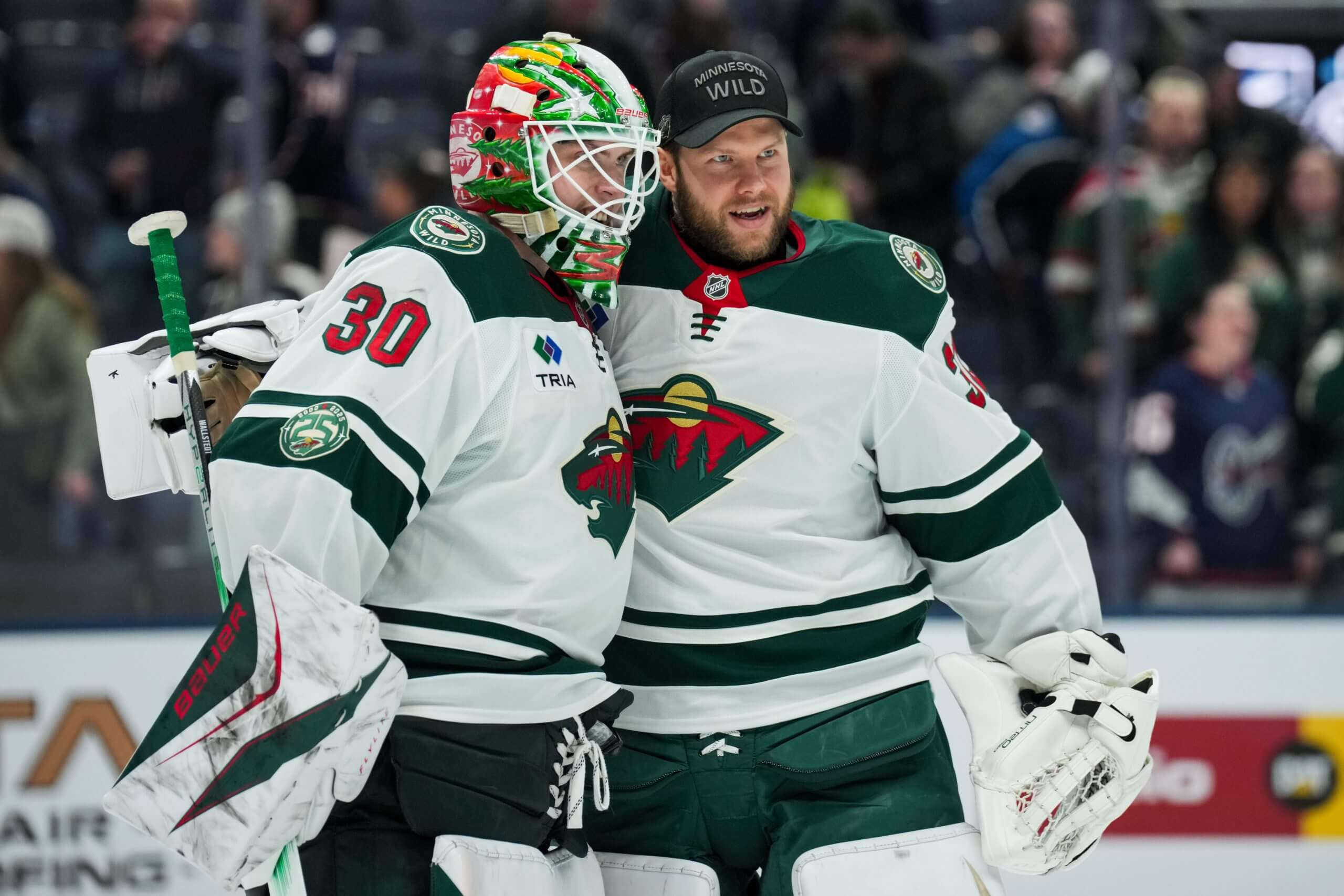
Minnesota goalies Jesper Wallstedt and Filip Gustavsson have had an even rotation of late. (Aaron Doster / Imagn Images)
Can Kaprizov show why they gave him the big bucks?
Kirill Kaprizov is a superstar and soon will be the league’s highest-paid player at $17 million annually. It comes with a very high standard.
Kaprizov’s 25 goals and 52 points in 47 games are nothing to sneeze at. He’s tied for fifth in the league in goals and 12th in points.
However, the consistency hasn’t been there, and there also haven’t been as many clutch moments as in previous seasons. He’s got two game winners this season and none in the past 24 games.
Saturday’s 4-3 overtime loss against the Islanders was one example. Kaprizov was dynamic, racking up seven shots on goal. He scored, moving him into second place all-time for the Wild in points. But even Kaprizov wasn’t satisfied, and it had to hurt that he was on the ice for the OT winner.
“I have chances every period, I think,” Kaprizov said. “Need to score more goals.”
To be fair, Kaprizov could use a No. 1 center. The Wild traded Rossi in the Hughes blockbuster, and even before then, they were without a top front-line pivot. Yurov, the rookie, has filled in admirably, and his development has been impressive, but it’s no surprise that a center is atop the team’s shopping list.
Regardless, Kaprizov needs to step up. Boldy was the team’s MVP in the first half, not because his numbers were so much better than Kaprizov’s but because he was “on” every night — a difference maker. He took over games and scored timely goals and shootout winners.
There have been several games this season in which opposing top players were simply better than Kaprizov, from San Jose Sharks teenager Macklin Celebrini to Colorado Avalanche star Nathan MacKinnon to Edmonton Oilers stars Connor McDavid and Leon Draisaitl.
The Wild will only go as far as both Kaprizov and Boldy can take them.
Kaprizov knows this, and it’s probably why we saw him try to carry the team during its rough October stretch.
“I think that’s what makes him an elite player, is not only does he have elite ability, but his expectations for himself are very high,” Hynes said. “It’s trying to find that balance of expressing things that he does well, but it can’t be just end-result-based.”
It’s time for him to start taking over games or at least dominating when the Wild need somebody to step up.
Can they go on an actual playoff run?
This is the only question that matters to many Wild fans, who haven’t seen their team go beyond the first round in a decade.
This is arguably the best roster the franchise has ever had — and the first time it’s ever had three stars in Kaprizov, Boldy and Hughes. The Wild have goaltending and a deep blue line. The move for Hughes put them closer to the division rival Stars and best-in-the-league Avalanche — the teams they’d likely have to face in the first two rounds.
However, these playoffs are meaningful from a big-picture perspective. Guerin knows the Wild’s window is the next few years, and showing they can win could go a long way in convincing Hughes to stay beyond his current contract.
How this core performs down the stretch and in the postseason could influence the decisions the Wild make this summer on familiar faces. And, eventually, the spotlight will fall on Guerin and his staff if these big swings don’t result in playoff success.