
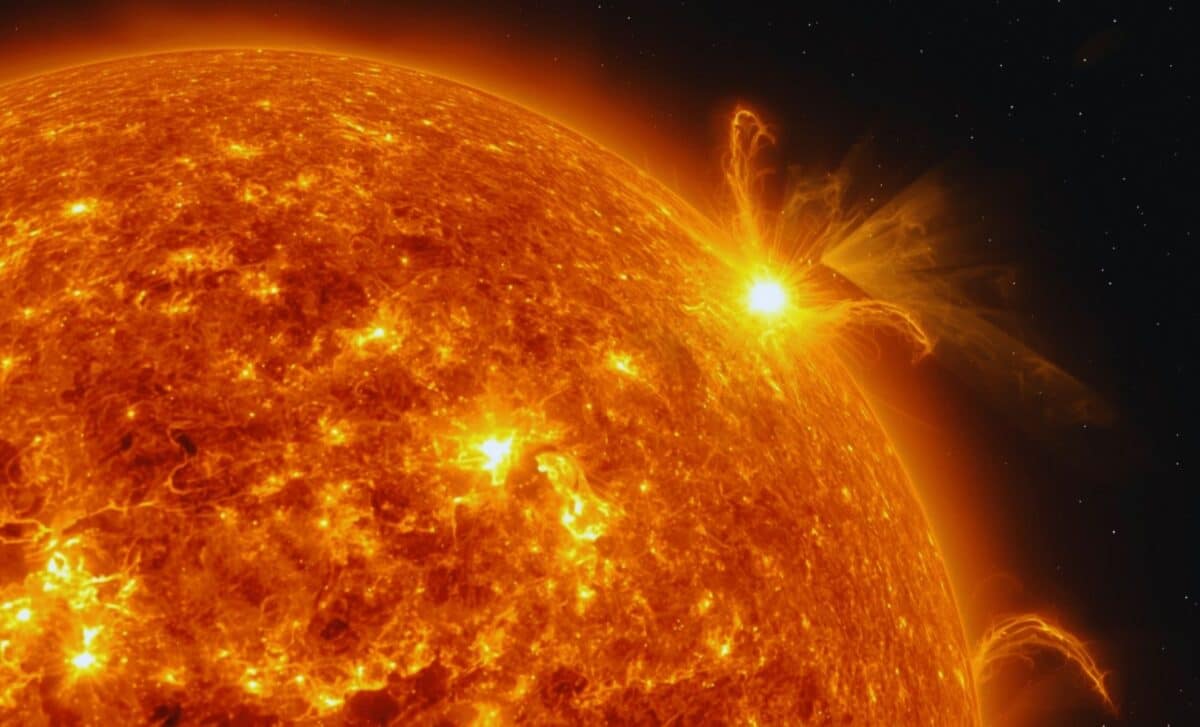
A team of researchers tracked an unusually intense region on the sun from its birth to its decay, capturing its activity over 94 continuous days. Known as NOAA 13664, the region produced the strongest geomagnetic storms Earth has seen in more than two decades, disrupting satellites, agricultural systems, and even railway signals.
This long-term monitoring was made possible by combining data from two spacecraft: the European Space Agency’s Solar Orbiter, which observed the Sun’s far side, and NASA’s Solar Dynamics Observatory, which kept constant watch on the Earth-facing side. The result was a complete timeline of a solar region’s evolution, something that has never been achieved before.
When NOAA 13664 Took Over
Solar regions normally remain visible from Earth for only about two weeks before rotating out of view. But Solar Orbiter, launched in 2020, follows a wide orbit around the Sun, enabling it to view areas usually hidden from Earth. According to Ioannis Kontogiannis, solar physicist at ETH Zurich, this orbit allowed scientists to detect NOAA 13664 long before it became visible from our planet. By May 2024, the region had rotated into view and immediately proved itself extraordinary.
“This region caused the spectacular aurora borealis that was visible as far south as Switzerland,” noted Louise Harra, ETH Zurich professor and director of the Davos observatory.
The researchers were able to observe the region during three complete solar rotations, giving them a continuous view of its magnetic transformation.
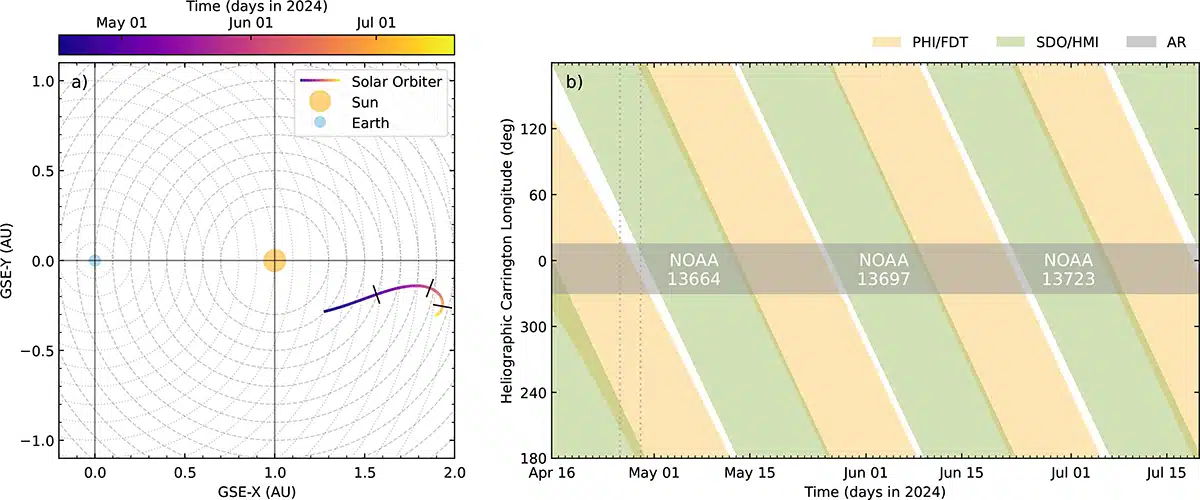 Orbital geometry and visibility of the evolving active region complex NOAA 136641369713723 from April to July 2024. Credit: Astronomy & Astrophysics
Earth Reels From Solar Fury
The effects of NOAA 13664 went well beyond colorful skies. Harra pointed out that modern technologies were hit hard in May 2024, with digital agriculture being one of the most affected sectors. Satellite signals used by drones, field sensors, and autonomous equipment were disrupted, leading to working delays and crop losses.
Other infrastructures were affected too. “Even signals on railway lines can be affected and switch from red to green or vice versa,” she said. This reflects growing concerns about how space weather events interact with aging or sensitive terrestrial systems.
Past events showed similar consequences. As ScienceDaily recalled, in February 2022, heightened solar activity destroyed 38 of 49 newly launched Starlink satellites. NOAA 13664 reminded scientists and operators just how vulnerable our modern environment is to activity from 150 million kilometers away.
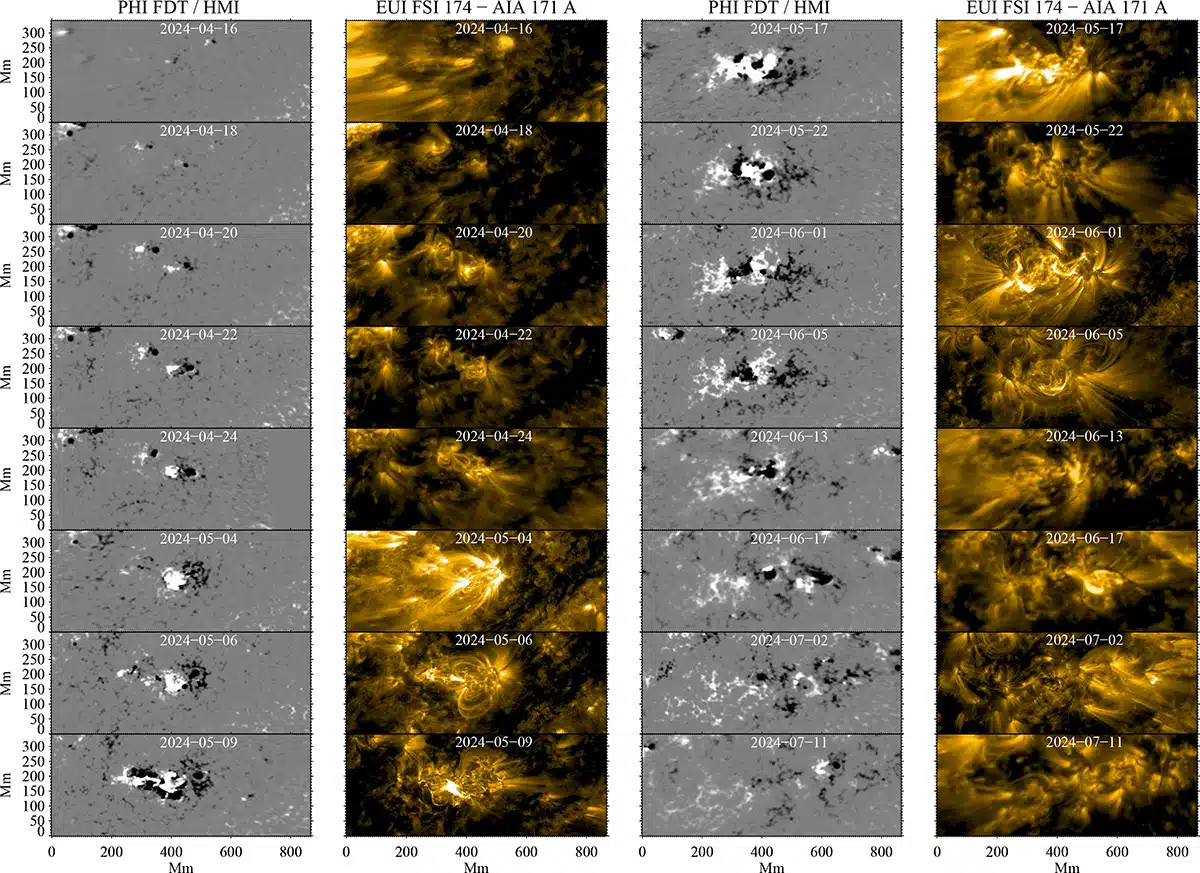 A closer look at NOAA 136641369713723 through snapshots taken since 16 April 2024. Credit: Astronomy & Astrophysics
Magnetic Chaos on the Sun
The region’s power came from its intense and evolving magnetic field. Solar active regions form when magnetized plasma rises to the surface and disturbs the Sun’s structure. As explained by Harra:
“When we see a region on the sun with an extremely complex magnetic field, we can assume that there is a large amount of energy there that will have to be released as solar storms.”
As mentioned in the study published in Astronomy & Astrophysics, this is exactly what happened with NOAA 13664. Over the 94-day observation window, its field became more tangled and unstable. The most powerful flare erupted on May 20, 2024, from the far side of the Sun, out of direct view from Earth but captured in detail thanks to the dual-spacecraft strategy.
Though scientists still can’t predict exactly when or how a region will erupt, the unique dataset captured in this study represents a major step toward deeper understanding of solar weather mechanics. As Kontogiannis put it:
“We live with this star, so it’s really important we observe it and try to understand how it works and how it affects our environment.”