
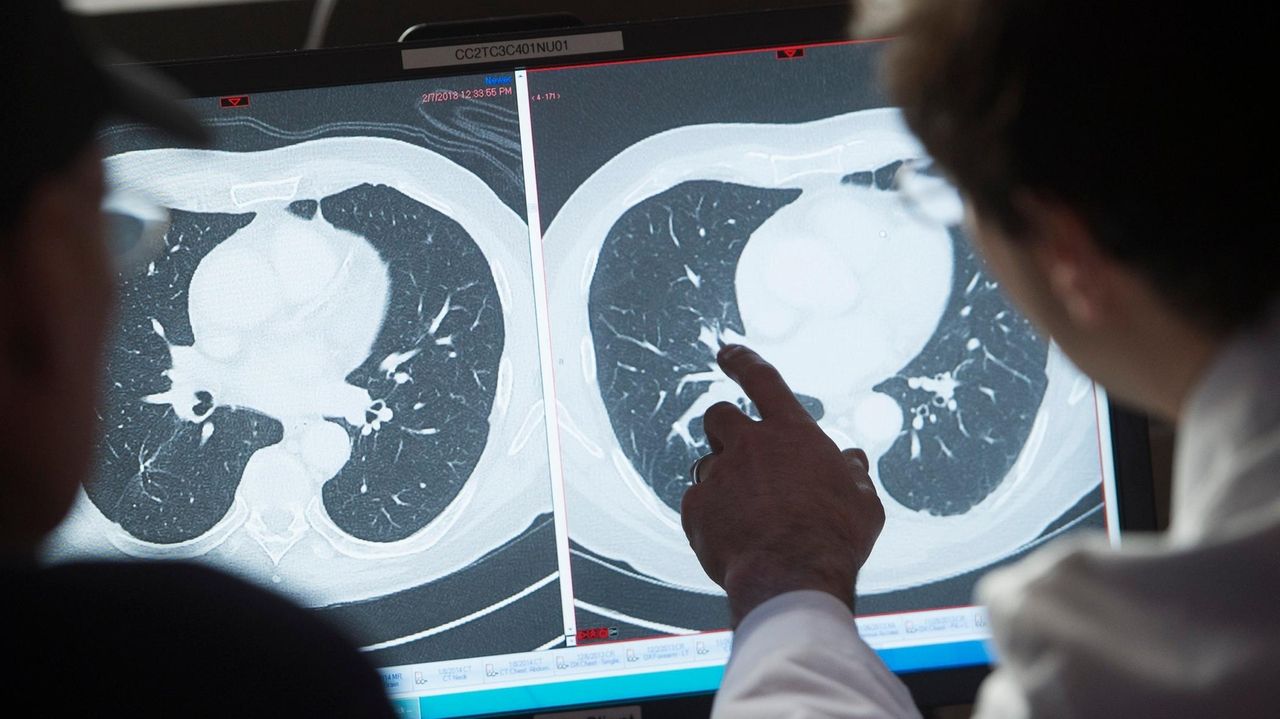
Less than a year ago, Jane Schlossman noticed pain in her leg she thought was due to a nerve issue. When it was followed by aches in her back and ribs, she got a PET scan in hopes of ruling out cancer.
Instead, the test confirmed the 61-year-old former marketing professional from Massapequa had adenocarcinoma of the lung — stage 4 and spread throughout her body.
Eating well and exercising, along with a positive attitude and a strong group of supportive friends, are helping her handle treatments and pain.
She’s also undergone targeted therapies because doctors were able to map out her specific gene mutation — EGFR.
WHAT NEWSDAY FOUNDA new data report from the American Cancer Society found around 70% of people diagnosed with cancer are living five years or more, an increase from about 50% in the 1970s.The increase is dramatic for some cancers: 7% to 22% for people with liver cancer, 32% to 62% for myeloma and 15% to 28% for lung cancer.Genetically profiling an individual’s tumor and then using targeted therapies has helped lead to the increase in survival rates.
“I have a family that needs me, things to do, things to accomplish,” she said in an interview Tuesday. “What I have is terminal but it’s not terminal right now.”
The chances cancer patients like Schlossman will live longer after diagnosis are better than ever before, according to a new report released Tuesday from the American Cancer Society.
More than 70% of people diagnosed with cancer in the United States now survive for five years or more, a milestone experts said is due to improvements in treatments and screening. In the 1970s, about 50% of people diagnosed with cancer survived five years.

Jane Schlossman, of Massapequa, was diagnosed with a type of lung cancer less than a year ago. Credit: Courtesy Jane Schlossman
Experts said steady funding for research and clinical trials — which have faced federal cuts in recent months — are key to continued progress.
Some of the more striking findings, doctors said, were among people with high-risk cancers. For example, in the 1990s, people diagnosed with liver cancer had a 7% chance of living five years. Now it’s 22%. For people diagnosed with myeloma, that survival rate almost doubled from 32% to 62%.
The American Cancer Society’s annual report focuses on the survival rate among people with all cancers diagnosed between 2015 and 2021.
Rebecca Siegel, lead author of the report and the senior scientific director of surveillance research at the American Cancer Society, said in a statement the “stunning victory” is the result of “decades of cancer research that provided clinicians with the tools to treat the disease more effectively, turning many cancers from a death sentence into a chronic disease.”
Dr. Richard Barakat, physician in chief and executive director of the Lake Success-based Northwell Health Cancer Institute, said the gains highlight the importance of innovative therapies for patients.
“Nowadays, you select appropriate treatments for cancer patients by profiling their tumors to determine if a particular genetic mutation is driving the growth of their cancer,” said Barakat, who was not involved with the American Cancer Society report. “Once you determine which mutations are driving their cancer, you can select a drug that targets that mutation and potentially reverses its effect. That’s what’s known as precision medicine.”
Barakat also credited a “flood of immunotherapies” — treatments that help use the body’s own immune system to fight cancer.
He noted the five-year survival rate for regional lung cancer nearly doubled, from 20% in the 1990s to 37%. Regional lung cancer includes cancer in the lungs, lymph nodes and other nearby parts of the body as opposed to distant or metastatic cancer, where the disease has spread far beyond the primary cancer site.
Dr. Ryan Sugarman, a gastrointestinal medical oncologist and medical site director for Memorial Sloan Kettering Cancer Center Nassau in Uniondale, said reduction in smoking and access to health care also helped drive up the survival rate.
“Several of the cancers with [the] highest death rate have modifiable risk factors, and individuals can lower their risk by avoiding tobacco, minimizing alcohol, maintaining a healthy [weight] and receiving HPV vaccination, if age appropriate,” he said in an email.
The five-year survival rate for people with localized cancer increased from 54% to 69%. For people with metastatic cancer, where the disease has spread to other parts of their body, the survival rate increased from 17% to 35%.
Doctors emphasized the five-year survival rate does not mean the individual is cured of the disease.
The American Cancer Society estimates there will be 2.1 million new cancer diagnoses in the United States this year and more than 626,000 people will die from the disease. In New York, those estimates are 125,860 new cases of cancer and more than 31,140 deaths in 2026.
Cancers with the highest mortality rates are lung, colorectal and pancreatic.
Sugarman pointed to several concerning trends such as the rise in incidence of colorectal cancer in people younger than 50 and disparities such as Black men having more than twice the risk of prostate cancer death.
“Continued progress is dependent on support for cancer research, as well as public awareness of risk factors for developing cancer,” Sugarman said.

Lisa joined Newsday as a staff writer in 2019. She previously worked at amNewYork, the New York Daily News and the Asbury Park Press covering politics, government and general assignment.