
Most people think they know exactly where “down” is. It’s the direction your feet point. But that familiar sense of orientation starts to unravel when viewed from space. What happens to “down” when you’re floating in orbit, or drifting between galaxies where there’s no floor, no sky, and no gravity to guide your senses? A recent study by The Conversation tackles this fascinating question through the lens of astronomy, peeling back layers of cosmic structure to explore what actually lies below our planet in a universe where direction is anything but absolute.
How Gravity Shapes Our Sense Of “Down”
On Earth, gravity is the invisible force that shapes our understanding of space and direction. To us, “down” simply means toward the planet’s center. No matter where you are, whether in California or Kenya, you’ll point to a different patch of space when asked to show which way is down, but you’ll still be pointing toward Earth’s core. That’s the beauty and limitation of gravity-based orientation. It works locally, but it loses coherence across global or interstellar scales.
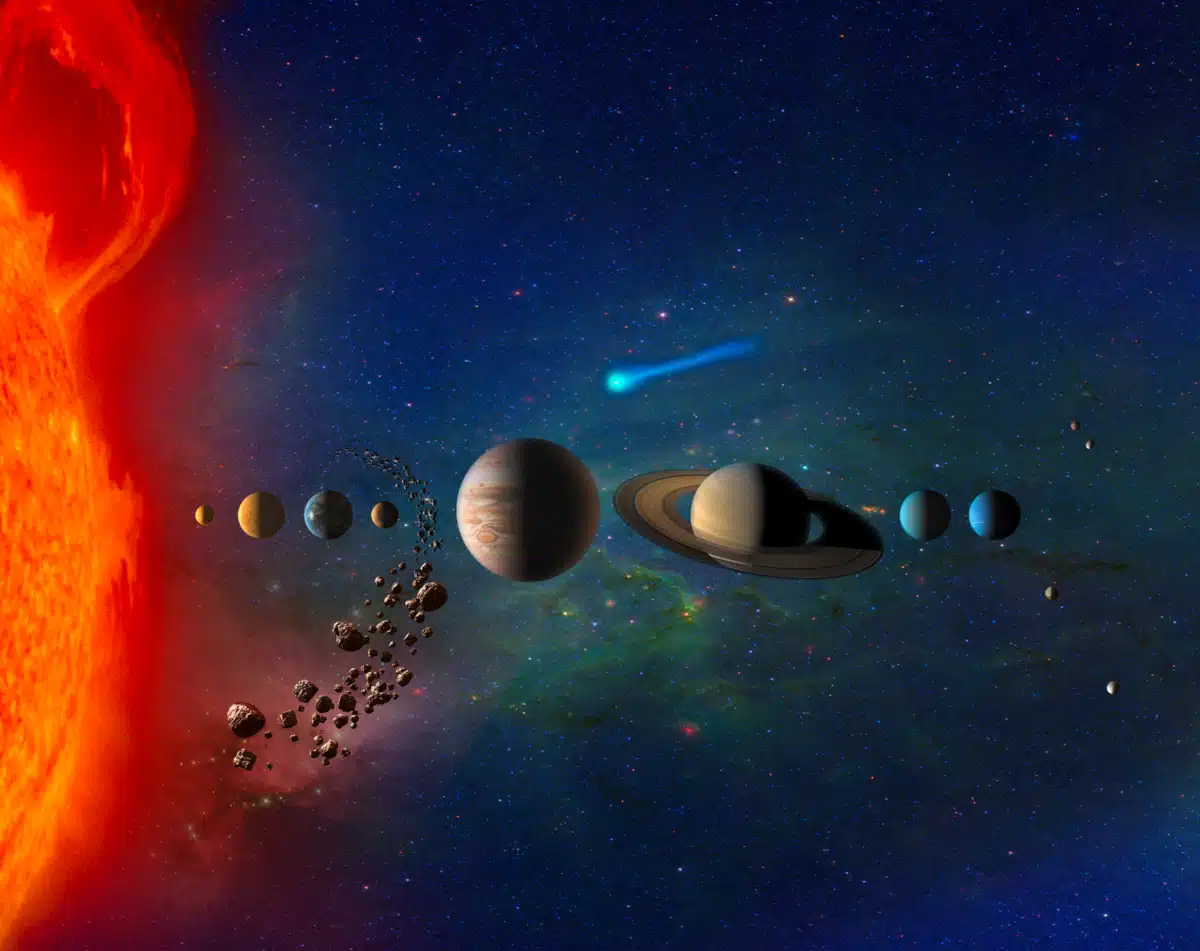 An artist’s concept of our solar system.
Credit: NASA
From the surface of Earth, it’s easy to forget that we’re on a spinning sphere suspended in space. Once we move beyond this frame of reference, “down” starts to depend on what’s nearby. Within the solar system, astronomers often define direction using the ecliptic plane, the flat, disk-shaped zone where most planets orbit the Sun. In this framework, looking “down” on the solar system means seeing the planets move counterclockwise. Flip it, and from the opposite side, they orbit clockwise. Already, we can see that “down” is more about convention than cosmic law.
A Universe Built On Planes, Not Points
The article published by The Conversation makes a compelling case for understanding space through the alignment of massive structures. The solar system, for instance, didn’t start out as a neat planetary orbit. It was born from a chaotic cloud of gas and dust known as the solar nebula. Over millions of years, that cloud collapsed under gravity, began to rotate, and eventually flattened into a spinning disk. The resulting structure dictated the orbits of the Sun and planets, giving us the familiar ecliptic plane we use today.
But this isn’t unique. Zoom out further and we see that stars, including our Sun, orbit within the flat galactic plane of the Milky Way. Step even farther back and the galaxies themselves tend to align along yet another massive structure called the supergalactic plane. The angle between these planes, solar, galactic, and supergalactic, isn’t consistent. For example, the galactic plane is tilted about 60 degrees relative to the solar ecliptic. And the supergalactic plane is almost perpendicular to the galactic one. These orientations are shaped by initial conditions like angular momentum and gravitational interactions, not by any absolute direction like “up” or “down.”
What You Find “Below” Earth Depends On How Far You Go
If you were to shoot straight “down” from your spot on Earth, what would you find? For a while, nothing much. You’d drift through the solar system, past planets and asteroids, crossing under the ecliptic plane. Eventually, you’d reach deep space where other stars and planetary systems orbit in entirely different orientations.
There’s no wall, no bottom, no cosmic floor. “Below” is just a direction among infinite others, and in this case, one that happens to be relatively empty compared to the dense orbital traffic of the solar plane. If you kept going, you’d find stars moving along the Milky Way’s galactic disk. Keep going still and you’d exit into the vast ocean of intergalactic space, eventually encountering galaxies drifting along the supergalactic plane. Each new layer introduces its own definition of structure and direction, making “down” a concept with no fixed meaning beyond your local environment.
Cosmic Direction Is All About Perspective
One of the article’s most powerful insights is that direction in space is not a fixed truth but a matter of perspective. On a city street, everyone would agree on where the ground is. But if you asked people from every continent to point to “down,” their fingers would stretch out in nearly every direction. Ask a being on another planet in another star system, and their answer would be different again.
In space, without a global gravitational center, direction becomes a concept shaped by context. Our notions of “up” and “down” only make sense when tied to a local force or structure like Earth’s gravity or the ecliptic plane. This perspective-shifting idea is a reminder that many things we take for granted are grounded in human experience, not universal laws. As The Conversation puts it, what lies below Earth isn’t a place. It’s a question of where you are, what you’re near, and how far you’re willing to look.