
History repeated itself at CES 2026. At this year’s event, Pebble—a popular but short-lived smartwatch pioneer of the 2010s—was on the show floor displaying its latest wearables, much as it had a decade ago. And the person providing that demonstration was again Eric Migicovsky, Pebble’s original founder.
Of course, not everything is the same. Pebble’s first launch followed a startup playbook. The company received VC funding, grew to several hundred employees, and quickly sold to Fitbit in 2016. This time around, Pebble is more like a passion project. The company is self-funded with just five full-time employees, PebbleOS is open source, and Migicovsky’s goal is not to revolutionize wearables but instead to return them to their roots.
“I had a box of Pebbles, and I used them. Over the years, eventually, I realized I would have to use someone else’s smartwatch. I tried everything. And I found I have a very esoteric set of needs,” said Migicovsky.
Pebble returns with not one, but three gadgets
Pebble’s big CES 2026 reveal was the Pebble Round 2, a smartwatch with a 1.3-inch circular e-paper display. It ditches some common wearable features, like a heart rate monitor, to deliver an ultrathin 8.1-millimeter profile.
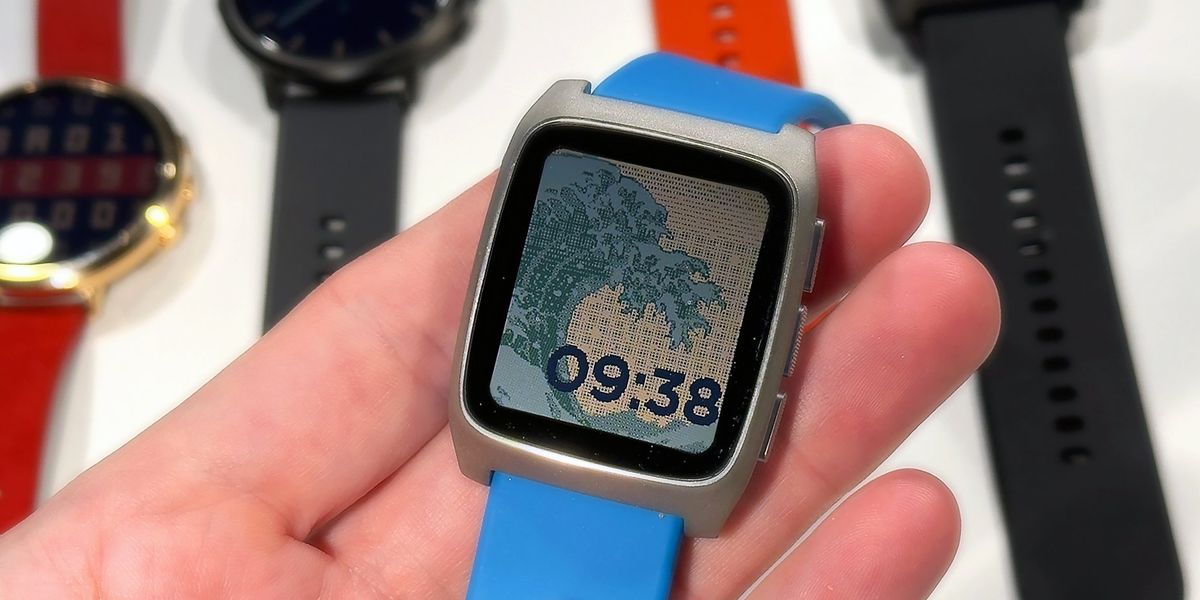
However, Pebble also showed two other wearables that were announced in the months before the show: the Pebble Time 2 and the Pebble Index. The Pebble Time 2 is a larger smartwatch with a 1.5-inch rectangular e-paper display, a heart rate monitor, and a speaker. The Pebble Index is a ring with a microphone, a battery, and a button, and is meant as a companion device for quick audio notes.
What these devices share is Migicovsky’s “esoteric” approach to wearable design. “I don’t want a smartphone on my wrist. I want a companion to my smartphone. I like my smartphone, so I don’t go for a run and expect it to do everything. And I also don’t want to worry about it as another gadget that needs to be charged every day.”
That last part is key for Migicovsky and a significant departure from most wearables. The slim Pebble Round promises up to two weeks of battery life, while the larger Pebble Time 2 promises up to a month on a charge.
To achieve that, the smartwatches rely on an e-paper display. This is not an electronic ink display but rather a low-power, low-refresh LCD that displays just 64 colors. This, of course, means the image quality is far less impressive than an Apple Watch or Google Pixel watch, but it extends the battery life while maintaining an always-on display. The watches also conserve power by relying on a simple microcontroller rather than a more feature-rich, and power-hungry, chip.
The ring, which doesn’t have a display, lasts even longer. It ships with a lifetime battery that should last for years. It’s not user-replaceable, however, so the ring will not function once the battery depletes. Migicovsky sees the ring as a device for quick questions or notes, which can even be directed to an AI assistant (more on that later). But it’s not an always-on recording device, instead recording only when the button on the ring is pressed.
 The Pebble Index ring can record your thoughts at the touch of a button. Pebble
PebbleOS is an open-source wearable operating system
Pebble’s new hardware should fill a gap in the wearable world. Smartwatches and rings have evolved into elaborate devices with multiple sensors and powerful SoCs, and I expect there’s room for a simpler alternative. The pricing reflects that, too: The Index costs US $75, the Round is $199, and the Time 2 is $225.
However, the new devices are just half the story. The other half is PebbleOS, which is now open source, and the Pebble app ecosystem.
A few years after Fitbit acquired Pebble, Fitbit itself sold to Google, which did nothing with the Pebble brand. So, Migicovsky wondered: Would Google be willing to part with it?
“I asked some friends that I know at Google, would you consider open-sourcing the operating system, so the community can build on that foundation? And they said yes. It took a year, but they said yes,” said Migicovsky.
PebbleOS is available on GitHub with an Apache 2.0 license. Anyone can download, modify, and distribute the OS, so long as the license is included in the distribution. There are currently 91 forks listed on GitHub—though, as is typical, most appear to be minor forks by curious software engineers. Pebble also wrote new open-source mobile applications for Android and iOS, which are used to sync Pebble devices with a smartphone.
The hardware is not fully open, and Migicovsky said he doesn’t intend to take the company in that direction. However, Pebble will provide schematics and .STL files for its devices, which will give users the opportunity to make modifications.
Pebble also has an app store that developers can use to distribute their apps. Though it’s no match for Apple’s app store, it’s surprisingly populated. In theory, apps that are part of this ecosystem could run on other devices using PebbleOS, or a fork of PebbleOS, though it would depend on the specifics of the device and the fork.
Yes, there’s an AI angle (kind of)
The design and philosophy behind Pebble borders on nostalgic. However, Migicovsky was quick to stress that Pebble is meant as a companion to—not a rejection of—modern trends in consumer electronics.
That includes AI.
Pressing the button on the Index will capture audio. Pebble’s smartphone app can then convert that into text notes using OpenAI’s WhisperAI speech-to-text model. The microphone can also be used to speak to popular online models, like OpenAI’s ChatGPT and Anthropic’s Claude. Responses can appear on a Pebble smartwatch or a connected smartphone. The Pebble app store’s current featured app is Bobby, an AI assistant that can handle dictation and short questions.
Still, Pebble’s AI features are not the main event. The low-performance microcontroller in Pebble’s devices means it’s reliant on internet connectivity, or the Pebble smartphone app, for AI features. As a consequence, the apps take on a more playable and whimsical look than the rest of the AI industry. Bobby, for example, is embodied by a pixel-art animal that looks straight out of a 1980’s Nintendo game.
“I just love the idea of a fun device that doesn’t take itself too seriously. I love looking forward to gadgets. So, we’re just going to build gadgets that we love,” said Migicovsky.
From Your Site Articles
Related Articles Around the Web