
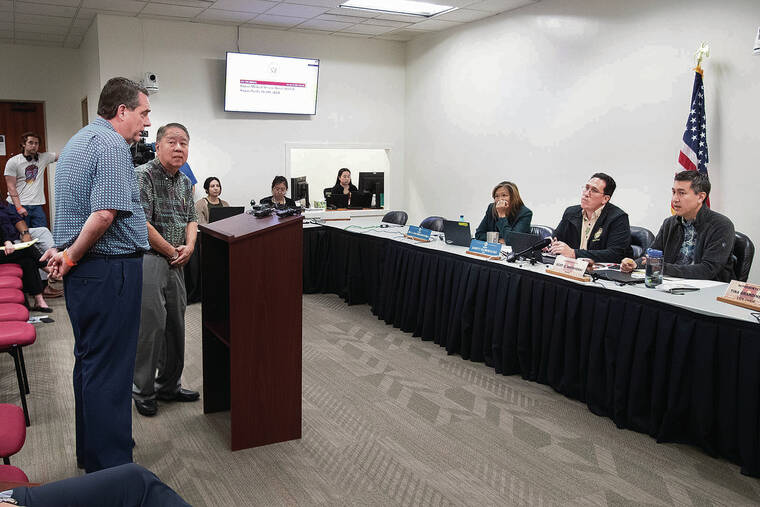
State lawmakers and stakeholders expressed myriad concerns over the proposed partnership between Hawaii’s largest health insurer and a major health care system.
They also had dozens of questions Tuesday during a three-hour joint briefing at the state Capitol regarding the impacts of Hawaii’s largest health insurer, Hawaii Medical Service Association, joining forces with Hawai‘i Pacific Health, as announced last week.
State Rep. Scot Matayoshi said given the drastic ramifications the partnership will have on Hawaii’s health care landscape, he felt the public should be aware of the details.
He invited state regulatory agencies to explain the approvals needed, and other health insurers such as HMAA and UHA Health Insurance, along with major players such as Kaiser Permanente, The Queen’s Health Systems, and Adventist Health Castle to weigh in.
“This may have profound consequences on the health care landscape for Hawaii, especially given the prominence of HMSA and HPH in our medical community” said Matayoshi, chair of the House Committee on Consumer Protection and Commerce. “Whether those effects are good for the consumer or bad for the consumer are kind of yet to be seen. We are still waiting for more details to come out on the proposed partnership.”
While HMSA and HPH continued to say their partnership under a new parent entity, One Health Hawaii, would improve health care over time to benefit consumers, many other health insurers in the state, as well as Queen’s and Adventist expressed concerns or opposed the move due to the potential for unfair competition.
Don’t miss out on what’s happening!
Stay in touch with breaking news, as it happens, conveniently in your email inbox. It’s FREE!
Before the hearing, Matayoshi told the Honolulu Star-Advertiser that a key question is whether the new entity would be able to cherry-pick healthier patients with the ability to pay their premiums while other hospitals would be left with the burden of caring for more vulnerable, sicker patients in the state potentially without the ability to pay.
And even if the network is open, HPH might benefit from a cost advantage due to its partnership with HMSA, steering patients away from competitors.
Legislators also wanted clarification on the structure of the partnership, how it would financially affect other hospitals or physicians working outside HPH, which operates four hospitals, including the Kapi‘olani Medical Center for Women & Children and Pali Momi, Straub Benioff, and Kauai Medical centers.
They questioned the move’s impact on patients and whether it was, indeed, a merger, and who would be making key decisions.
Is it a merger?
From a legal standpoint, it is not a merger, according to Ray Vara, president and CEO of HPH who, along with Mark Mugiishi, CEO of HMSA, on Tuesday continued to assert that no one would be left behind as their partnership would remain an open system.
The message has been emphasized through a newly launched website, healthierhawaiitogether.com, and TV campaigns.
HMSA members would continue to see their own doctors, with the same coverage and options, but with better coordination, the two nonprofits said. HPH patients also would be able to keep their own doctors and insurance, with better coordination behind the scenes for a less-complicated experience.
They emphasized that HPH and HMSA will remain separate entities and operate independently, with their own boards under the umbrella of One Health Hawaii, and that this was a necessary step toward long-term sustainability.
“Every health system in the state, I believe, lost money last year,” said Vara. “Both of our major insurance companies lost money last year. It is an unsustainable system as it exists, and a challenge to continue, as community members endure what have been double-digit-plus increases in the cost of health care during the course of the year. And our intent is to bend that cost curve.”
The savings would come from shared administrative costs, for instance, and the elimination of duplication. When asked, Vara said no layoffs were planned.
Overall, Vara said he expects savings to amount to more than $2 billion over 10 years that could be reinvested into the community, including lower insurance rate increases, specialized care and workforce development.
One Health Hawaii will become a 501(c)(3) nonprofit, according to Mugiishi, with its own board. The greatest benefit for consumers, he said, would be the alignment of incentives between HMSA and HPH.
Additionally, every provider, including Queen’s and Castle, would be invited to join this “value-based system,” he said.
“We welcome all of them because in that way, we actually take the ecosystem of health care delivery in Hawaii and make it better for the person,” he said. “And when I say a consumer, that’s broadly speaking — it means individual people, small businesses, and large employers.”
Vocal opposition
But numerous players in the health care market opposed the partnership.
Jason Chang, president and CEO of The Queen’s Health Systems, said there are some “very real, dangerous, unintended consequences from such a major realignment of health care in Hawaii.”
He warned that “if the commercials sound too good to be true, I urge you to believe that they are too good to be true.”
Participation in an open model under One Health Hawaii for Queen’s means playing by new rules, which would result in reducing its own revenue and limiting its own services.
“And financially, it benefits One Health Hawaii, not any of the others that participate,” he said.
“Keep in mind that HPH does not provide services like behavioral health care, transplants, trauma, advanced stroke, some of the very advanced cancer care, but what they can do is shift to healthier patients, patients that don’t cost HMSA as much money,” he said. “And if I take care of the healthier patients, of course, my cost would be lower, and I look like the lower-cost provider, too. But that’s not comprehensive care. That’s not investing in the services that the state needs.”
Paul Kaiser, president of Hawaii Western Management Group, speaking on behalf of HMAA, said it also opposed the partnership.
He said based on history, economic principles and public financial disclosures, the transaction “presents a substantial and foreseeable risk of increased health care costs with the clearest, direct financial beneficiaries being senior executors and government insiders — not patients or purchasers of health care.”
The partnership removes a critical safeguard, he said, which is the separation between a dominant insurer and dominant provider that “preserves arm-length negotiations and competing incentives.”
Chang warned that down the line, should One Health Hawaii be short of its goals, its business decisions could include reducing the number of Medicare patients covered.
“I highly encourage you to scrutinize this proposed merger,” he said. “Take time to uncover all of the facts. The urgency that you hear is artificial. There is no urgency. Stakes are really too great, and the risk of opening a Pandora’s box is that it can’t be undone.”
The proposed partnership faces a number of regulatory hurdles at the state and federal level, as well as review by the state attorney general and insurance commissioner.
Vara said HPH had not yet made any regulatory filings at the state or federal levels, but looked forward to going through the process. Earlier, he said the integration could take between six to 18 months to finalize.
Matayoshi said Tuesday’s briefing is likely the first of several more to come as more details on the structure of the HMSA-HPH partnership emerge.