
SALT LAKE CITY — Utah’s new North Capitol building feels modern yet familiar from the moment one enters.
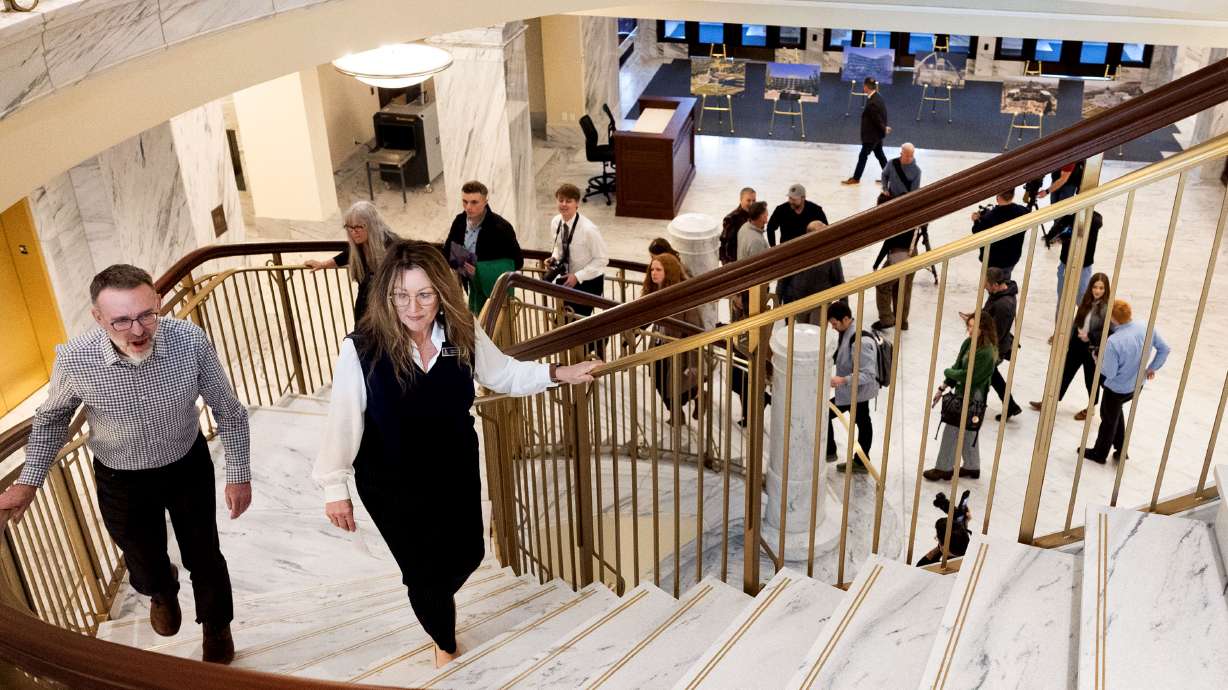
A large LED screen hangs on the wall in the atrium, but its interior is modeled in a way to reflect the interior of the Utah Capitol and the other two buildings in the surrounding complex. Elements of the older buildings can be found throughout the new one, all the way down to the type of marble used, says Mike Despain, project director at Okland Construction.
“This whole building take a lot of inspiration from what’s already on campus,” he adds, as he stands at the bottom of a spiral case underneath a massive 25-foot-wide by 25-foot-long Utah-themed stained glass laylight.
Utah is set to hold a ribbon-cutting event on Friday to celebrate its completion, before it formally opens to the public on Tuesday. Other parts of the building, including the Museum of Utah, will open later this year.
A ‘one of a kind’ building
The North Capitol project launched in 2022, starting with the demolition of the old state office building, built in 1960. The previous building didn’t meet seismic standards and had other concerns, but state officials said it felt out of place next to the three other buildings on the campus.
Yet, what started as a $165 million project eventually grew to $320 million. This was partially because of inflation and the increased building costs in the construction sector; however, the state also wanted something much more than a space for parking and offices, said Andy Marr, director of the Utah Division of Facilities Construction and Management.
State officials ultimately blended the need for more state office space with the Utah Historical Society’s desire for new storage for its vast and precious state artifacts collection, which was previously stored in the basement of the Rio Grande Depot. The project added museum space, so Utah residents and visitors could see the unique items tucked away in storage.
They also saw it as a unique opportunity to blend everything into the rest of Capitol Hill, which led to additional appropriations from the Utah Legislature in recent years. The final price tag includes everything from the demolition of the old building to everything contained in the new building, Marr explains.
The North Capitol Building in Salt Lake City is pictured on Wednesday. (Photo: Laura Seitz, Deseret News)
State offices are found within parts of the large basement, which contains over 40,000 square feet of space, as well as parts of the second floor and all of the third and fourth floors of the building.
A museum is located on the first floor, along with education spaces on the second floor for children who tour the museum in the future. A modern space for storing historic collections takes up a chunk of the basement, away from the public.
Members of the media tour a conference center of the North Capitol Building in Salt Lake City on Wednesday. (Photo: Laura Seitz, Deseret News)
The project includes an underground parking garage, as well as other elements that will be open to the public. These include a conference room capable of holding more than 700 people, new seating areas overlooking the Utah Capitol and new walkways on the east and west ends of the building.
The laylight capping the building features natural elements and images meant to represent all 29 counties in the state.
Utah scenery is depicted on the laylight of the North Capitol Building in Salt Lake City on Wednesday. (Photo: Laura Seitz, Deseret News)
It’s a big budget, but Marr says the building is meant to last, showcasing Utah for generations to come.
“We talk about this building in very specific terms because we will never build this building again,” he said. “We don’t have anything else to compare it to. … It really is one of a kind.”
The building meets state high-performance standards in sustainability. It contains a state-of-the-art base isolation system to protect it and everything that will be stored inside from major earthquakes, too.
Eighty-nine base isolators essentially suspend the building in the air while the ground below shakes, protecting the building and the valuable contents inside it from severe damage, said Jerod Johnson, the project’s structural engineer, as he crouched within the space to explain the system.
“We’re talking about an 80% reduction of seismic accelerations that will no longer go into the building,” he said. “That makes a huge difference.”
Only a handful of buildings in the state have this technology, including the Utah Capitol to the south, which was installed during a major renovation about two decades ago. Installing the technology in a new build is much easier than a seismic retrofit, he adds.
What’s still to come
Visitors won’t see the museum next week, but a museum store is slated to open in a few weeks, said Tim Glenn, director of the Museum of Utah. It will sell Utah-themed art and retail items, as well as some food, largely from local businesses.
State historians recently finished building mounts for the hundreds of artifacts that will be displayed when it opens in late June, he told KSL. The state has already determined more than 950 items that will be displayed, based on years of public feedback from across the state.
It will include a replica of the iconic golden spike, as well as the cowboy outfit worn by Michael J. Fox in a scene of “Back to the Future III” filmed at Monument Valley and the iconic hot rod Mormon Meteor III, which the state acquired last year.
Other artifacts from the state’s historic archives and arts collections are expected to move into storage throughout the year, finally giving them a modern space to preserve them, as well as anything else added to the collection over time.
“This is the space where Utah’s fine art and history preservation will be for the next 100 years,” he said. “All of the state’s treasures will be here.”
The Key Takeaways for this article were generated with the assistance of large language models and reviewed by our editorial team. The article, itself, is solely human-written.