
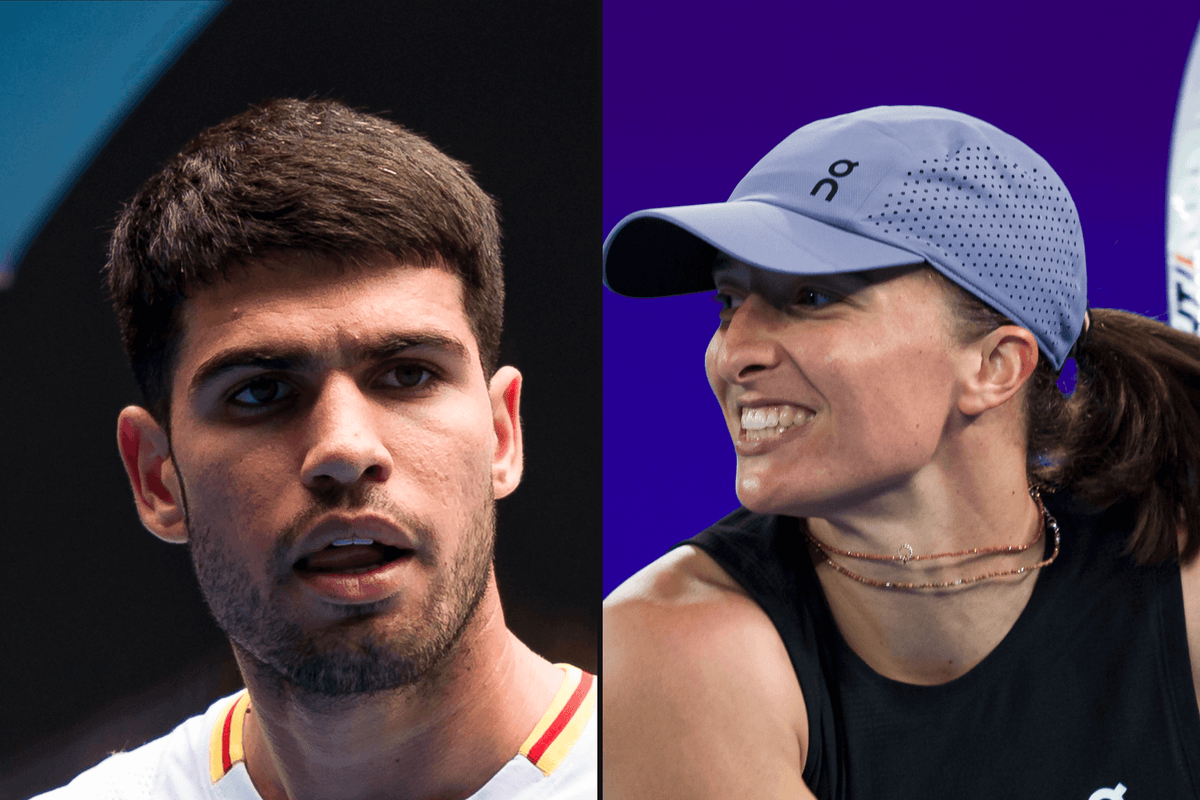
The Australian Open begins Sunday in Melbourne, and the draws for the men’s and women’s singles have thrown up some blockbuster first-round matches.
The Athletic’s Matthew Futterman and James Hansen analyze an intriguing draw, as well as offering some of their picks for the best matches of the opening days.
A boost for Carlos Alcaraz’s career Grand Slam hopes?
Alcaraz, who is bidding to become the youngest man to win all four majors, is a favorite for every Grand Slam he plays alongside Jannik Sinner. Now that he and Sinner have a stranglehold on the world No. 1 and No. 2 rankings, with a 6,395-point gap between Sinner and Alexander Zverev at No. 3, it is getting ever harder to unseat them — and Alcaraz could likely not have built himself a better draw for what would be a milestone title. Zverev is in his half, but faces a rocky road to get to the semifinals. He opens against dangerous Canadian Gabriel Diallo, and could face Alexei Popyrin on a partisan Rod Laver Arena in the second round.
The highest seed other than Zverev in Alcaraz’s section is Félix Auger-Aliassime, the No. 7.
Defending champion Sinner gets Novak Djokovic in his half, and faces a potentially irksome third-round match against João Fonseca, but those are the only major-looking threats in his half.
The reality of men’s draws for the past year is that much of it feels like a warmup for the two players who are dominating the tour. No one would bet against a similar dynamic recurring in Melbourne in the next fortnight.
And a challenge for Iga Świątek’s?
Forgive Świątek if her draw feels a bit triggering, given its reminiscence to her U.S. Open run, which also featured Anna Kalinskaya and Amanda Anisimova, and it featuring Anisimova and Elena Rybakina, both of whom took her down at the WTA Tour Finals in November.
Świątek, like Alcaraz, has a shot at the career Grand Slam this fortnight after her Wimbledon title last year. Unlike Alcaraz, her draw has thrown up foes who have beaten or troubled her in the recent past. She knows which players cause her discomfort. She might see a few of them in the second week, with even more pressure on the line than a regular major brings.
Novak Djokovic stays on an even keel?
Djokovic had a terrible 2025. The 24-time Grand Slam champion didn’t make a single major final.
Djokovic had a pretty incredible 2025. The 24-time Grand Slam champion made all four major semifinals. Not bad for a guy in the last quarter of his 30s.
And after the Australian Open draw Thursday, that glass half-full and half-empty scenario seems destined to continue. Who, really is going to bother Djokovic before a potential semifinal doomsday showdown with Jannik Sinner? He opens with Pedro Martinez, and his quarter of the draw is filled with players he’s had his way with basically forever, including Taylor Fritz, Hubert Hurkacz and Lorenzo Musetti.
There’s a potential hiccup against Jakub Menšík in the fourth round. Menšík, the Czech Djokovic protégé, beat Djokovic in the Miami Open final last year. But Menšík has yet to have a high-quality Grand Slam performance. Djokovic would be the favorite in that match, and rightly so.
Just as last year, not much looks to be a problem, except what awaits him at the deep end.
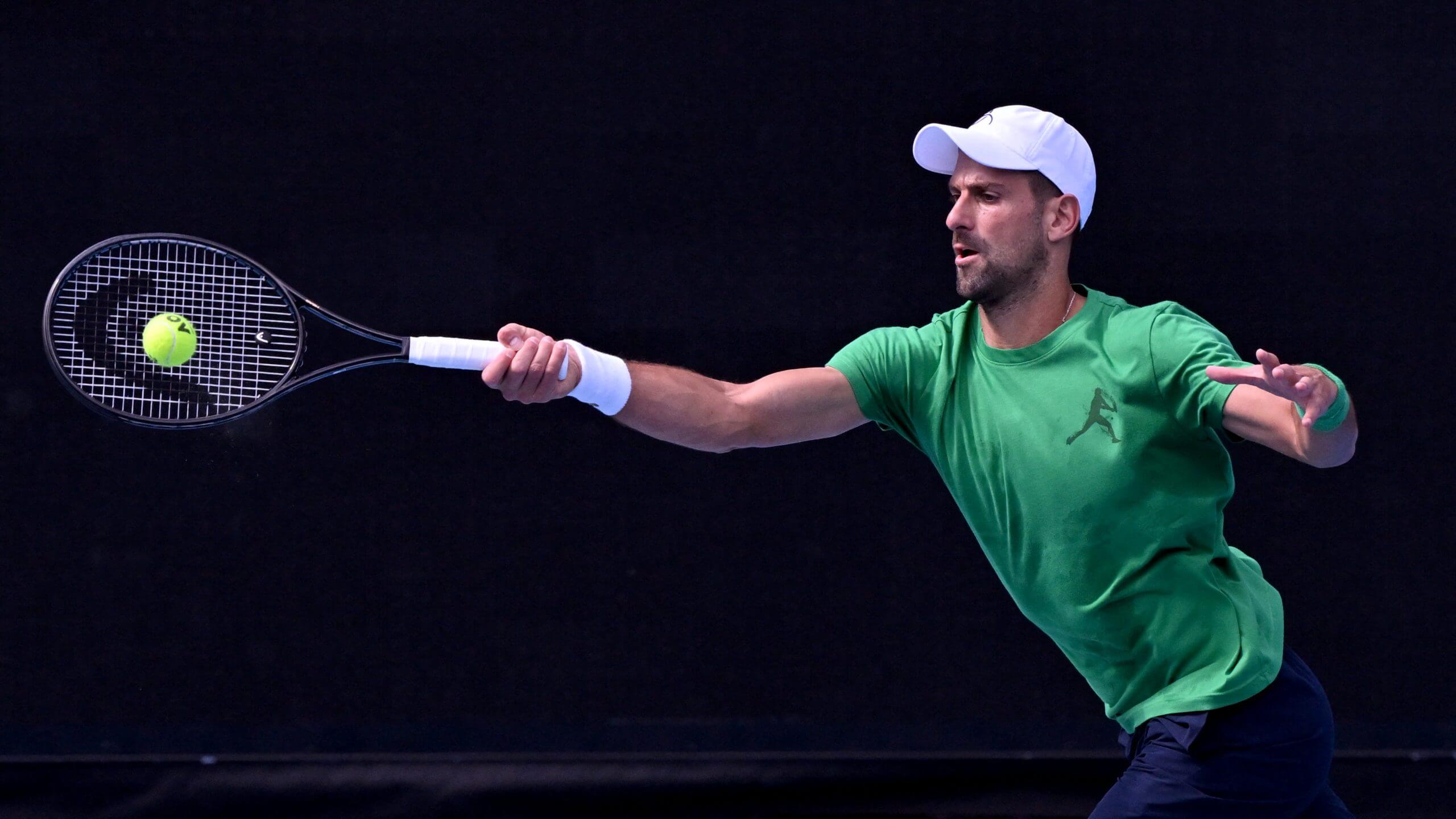
Novak Djokovic warms up for the Australian Open, which begins Jan. 18. (William West / AFP via Getty Images)
What to make of a women’s favorite who only seems to falter in finals?
A player with a sort of reverse quandary to that of Djokovic is world No. 1 and two-time Australian Open champion Aryna Sabalenka. It’s pretty hard to make an argument against the world No. 1’s hard-court consistency, and Thursday’s draw made it that much harder.
She simply does not lose a lot of matches in this country. She won the Brisbane title Sunday, to make it 34 wins in 36. Coco Gauff, a recent nemesis, is the highest seed on Sabalenka’s side of the draw. On a hard court, especially in Australia, Sabalenka would still have to be the favorite.
There doesn’t appear to be a lot of other danger on Sabalenka’s road to the final, but that is precisely the point, given she is 4-3 when she gets to major finals and lost two of three last year. The field is crowded with contenders, from Gauff and Świątek to Anisimova and Rybakina, but their best chance against Sabalenka might be waiting until the very last hurdle to strike — and Gauff can’t get that opportunity this time around.
Matt Futterman’s matches to watch:
Victoria Mboko (17) vs. Emerson Jones (WC)
Hailey Baptiste vs. Marketa Vondroušová (32)
Alexander Bublik (10) vs. Jenson Brooksby
Ben Shelton (8) vs. Ugo Humbert
And of evolving Americans who are works in progress?
Gauff is a mystifying player these days, capable of great highs and ugly lows which can announce themselves with no prior warning.
She can beat anyone. She can lose to anyone. Her serve is a work in progress. Her forehand remains shaky.
The popcorn match in Gauff’s early rounds is a possible second-round meeting with Venus Williams, the legend of the sport and the idol of Gauff, who the younger American beat in straight sets in Melbourne in 2020. After that, there is plenty of danger, but Gauff’s real focus the past few months is on trying to get to a place where she stops beating herself. With Karolína Muchová and Mirra Andreeva lurking among others, she will hope that Melbourne is the city in which it happens — and more importantly, sticks.
For Ben Shelton, returning from a shoulder injury, a first-round match against fellow left-hander and clean striker Ugo Humbert could be challenging for the joint.
The highly talented Frenchman, unlike most of his compatriots, is at his best on hard courts rather than on the slow red clay.
Shelton, a semifinalist here last year, has a lot of points to defend and plenty to prove — that the shoulder injury that forced him out of the U.S. Open last year didn’t change everything for a player who has built his game around a booming serve that regularly approaches 150 mph, or used to.
Do qualifiers hold the key?
Every Grand Slam draw is incomplete for a few hours, because they take place while the final round of qualifying is still going. This year, across both the men’s and women’s draws, the quality of some of them is so high that seeds with a pending player next to their names — or waiting for them in the second round — will be hoping for a favorable one.
Someone like Spain’s Rafael Jodar, who was the star of the ATP Next Gen Finals without winning it, could land as a possible second-round opponent for Alcaraz or Sinner. Nikola Bartůňková, the devastatingly talented 19-year-old Czech, could appear next to Świątek. This is the case everywhere, but especially in the men’s draw, the zone outside the top 100 is stacked with tough, rising talents who have made a big impression on the ATP Challenger Tour and are waiting for their chance to step up.
One of them got unlucky Thursday, once the draw was out. Belgium’s Alexander Blockx appeared to be cruising past Jason Kubler of Australia, but injured his upper back late in the second set and could not finish the third. And the two most exciting matchups did not feature boldface names. Jodar will play Rei Sakamoto of Japan, a fellow qualifier who plowed through his draw, while 2017 U.S. Open champion Sloane Stephens and qualifier will face an old rival in Karolína Plíšková, who is returning from a foot injury.
James Hansen’s matches to watch:
Tereza Valentová vs. Maya Joint (30)
Hubert Hurkacz vs. Zizou Bergs
Leylah Fernandez (22) vs. Janice Tjen
Lorenzo Musetti (5) vs. Raphaël Collignon
Australian Open 2026: Women’s singles drawAustralian Open 2026: Men’s singles draw
Which matchups are you looking out for? Let us know in the comments.