
Houses We Love: Every day we feature a remarkable space submitted by our community of architects, designers, builders, and homeowners. Have one to share? Post it here.
Project Details:
Location: Hakusan City, Japan
From the Architect: “Attracted by the spacious site and the surrounding environment with its old townscape at the foot of Mt. Hakusan, one of Japan’s three sacred mountains, a young couple sought a one-story house with a large garden and open living, dining, and kitchen areas. Traditional industries such as sake breweries, soy sauce, miso, and koji remain in the surrounding area, and the site is also surrounded by a group of sake brewery buildings.
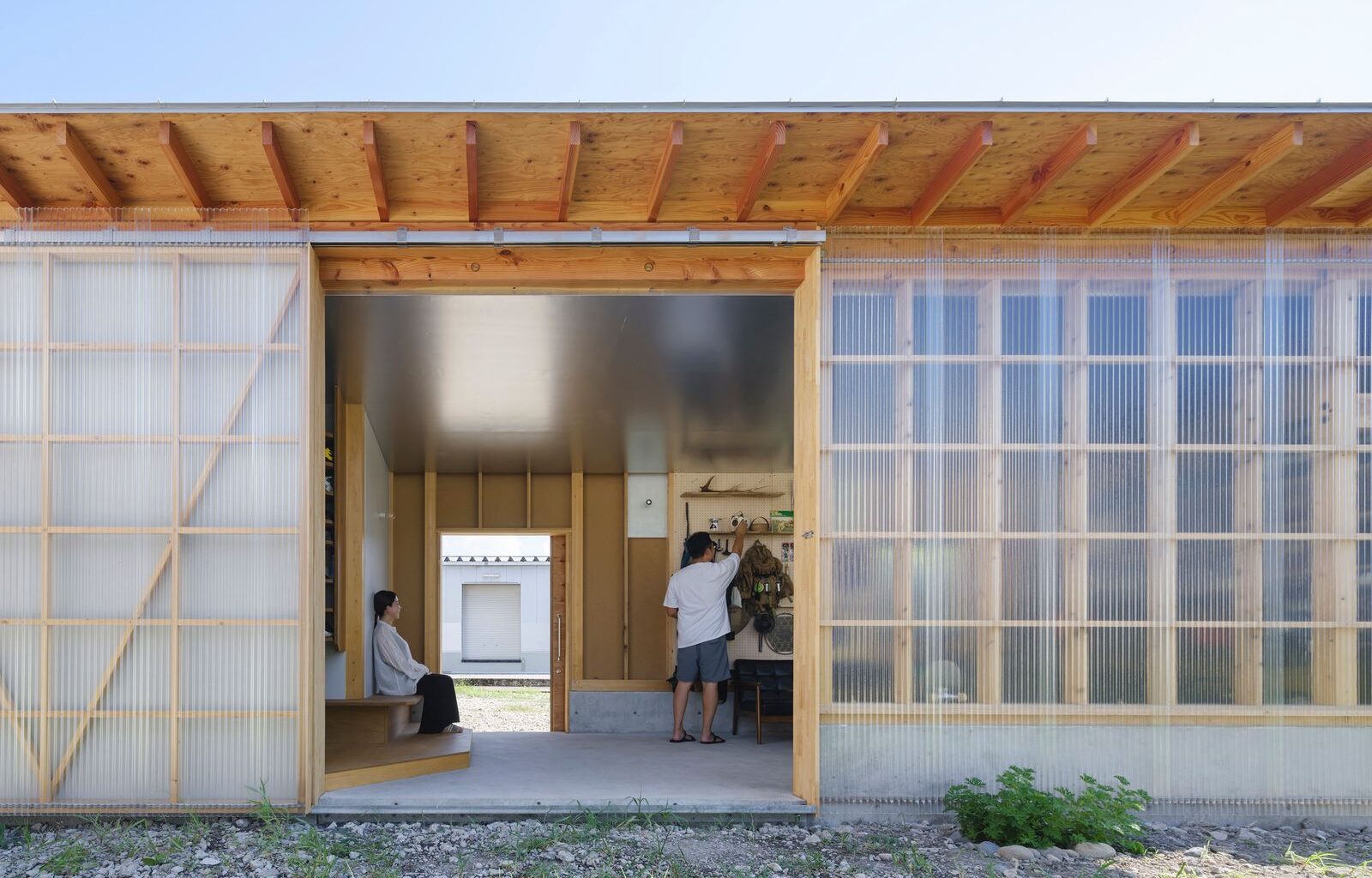
“The adjacent land to the west of the site is vacant and has no fence. The vacant lot, as seen from the site, is surrounded by fields and beyond it are town houses and a view of the mountains. The layout of the building was studied in order to create a visually expansive courtyard that feels as if it’s borrowed landscape. In order to keep some distance from the bustling road in front of the house, the building was placed in an L-shape along the road. Considering the loading and unloading of camping equipment, since the owners love camping, we designed a floor plan that allows a view through the courtyard to the garage like a Japanese traditional gatehouse. Here, horses have been replaced by motorcycles and farming tools by camping equipment. The plan of the house is such that the living room, dining room, and kitchen can be seen through the courtyard.
“The site is surrounded by a mixture of buildings from different periods and typologies, including townhouses with matching eaves, a large sake brewery, and modern office buildings and factories. The lot across the street from the main site is slated to become a residential subdivision and will include a house with a carport. The various buildings that make up the streetscape are a living manifestation of the residents. In this environment, we wondered if it would be possible to create a house that could be interpreted as a building from different eras. The result is a house with a roof shape like an enlarged machiya (Japanese town house), a roof slope and construction similar to that of a warehouse, modern industrial exterior walls and components, and a layout that treats the adjacent vacant lot as its own site. Rather than referring to a single historical building or landscape feature, as was attempted with a prior build, Hokuriku Dwelling No. 1, we sought a form of architecture that would accept and participate in this townscape, which has undergone a mixture of changes over the years.”