
Get your daily dose of health and medicine every weekday with STAT’s free newsletter Morning Rounds. Sign up here.
After getting demolished by the flu last week, I am thrilled to be back in the saddle. Stay healthy, everyone!
Trump’s ‘Great Healthcare Plan’ puts affordability in the spotlight
President Trump announced a suite of policies yesterday that would let the federal government exert more control over pharmaceutical companies, as he faces mounting pressure over the rising costs of health care.
The announcement was heavy on pomp and light on circumstance, so most of the details are rather fuzzy. What we do know is that the most consequential provisions could be proposals to extend lower international drug prices to all Americans, make more prescription drugs available over the counter, and send at least some health insurance subsidies directly to enrollees.
Many of these moves would require action from Congress, which failed to extend enhanced Affordable Care Act subsidies that expired at the end of last year, allowing the premiums of millions of people to more than double. Mehmet Oz, administrator of the Centers for Medicare and Medicaid Services, claimed Trump’s plan would result in savings. Will it? Read more from my STAT colleagues.
Controversial CDC-funded hepatitis B vaccine study in Africa cancelled?
Remember in December, when those controversial Danish researchers got money from the United States to run a study on hepatitis B vaccines in Guinea-Bissau in West Africa? At the time, some experts said such a study was likely “unethical.”
Well, it has been cancelled — possibly. This all started on Thursday morning, when Inside Medicine published the study’s protocol and got quotes from a Centers for Disease Control and Prevention official, who called it “another Tuskegee.”
When reporters asked Africa CDC about the study, an official said it had been cancelled, but apparently officials in Guinea-Bissau and at HHS are suggesting the opposite, that the study will continue. If that weren’t confusing enough, Guinea-Bissau is going through a coup and has replaced all of its top health officials.
If you want more background on the study, check out our coverage from December.
What do Americans think about science?
Americans want the U.S. to be a global leader in the sciences. But a new survey shows stark partisan divides about where the country’s scientific stature is headed and its role globally.
Trust in science increased slightly from 76% of those surveyed in 2024 to 77% in 2025 and scientists remained a trusted profession — findings that surprised one researcher, given President Trump’s “wholesale, massive attacks on science.” But many more Republicans are distrustful of scientists compared with Democrats — a long-established division that grew precipitously during the coronavirus pandemic.
Those insights were gleaned from the Pew Research Center’s annual survey of public opinion on science, which published its latest results on Thursday. Read more from STAT’s Anil Oza.
A healthy dinner for $3?
Welcome to America’s hit new game show: Design That Diet!
The new U.S. dietary guidelines have got some food economists doing just that: Designing different diets to figure out how affordable, as well as healthy, following the new pyramid would actually be.
Trump administration officials have been promoting the new guidelines, which emphasize protein and urge Americans to limit or avoid ultra-processed foods, as healthier and more budget-friendly than previous versions. They have also, as we mentioned above, been pushing to lower costs for Americans.
Is the new food pyramid more affordable and healthy? STAT’s Sarah Todd polled a food economist and registered dietician. Read on for their takes.
The flu vaccine is working
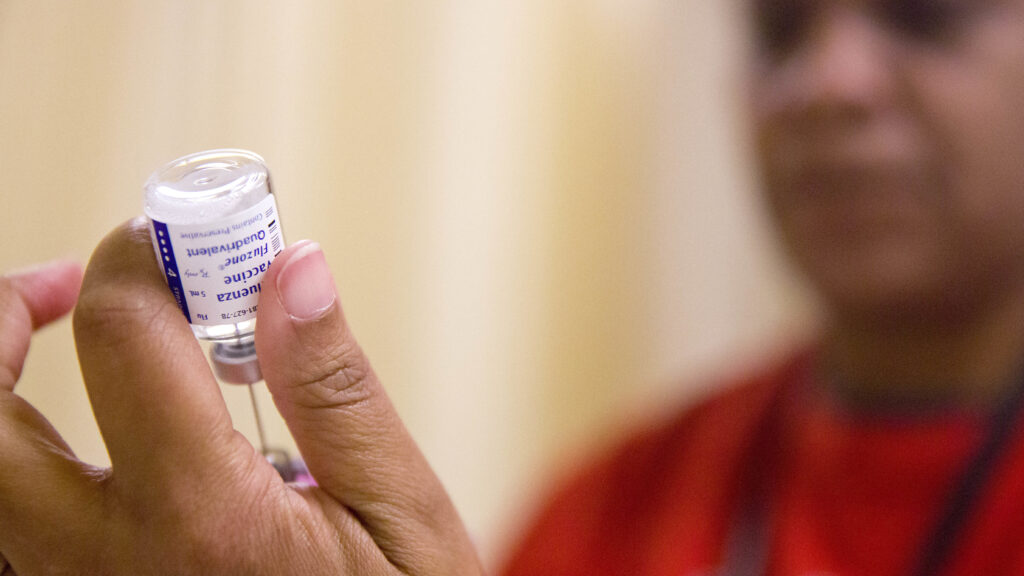
There is yet more evidence that this year’s flu vaccine is offering some protection against the viruses responsible for most of the illness in the U.S. this winter, a family of H3N2 viruses known as subclade K. These viruses emerged too late to be included in the 2025-2026 flu vaccine, and experts worried the mutations they carry might render the shot’s protection against H3N2 minimal at best.
Early research from the United Kingdom and the University of Pennsylvania suggested the flu shot is offering at least some people some help fending off subclade K. And on Thursday, researchers from France and China reported similar findings in the journal Eurosurveillance. Both looked at vaccine effectiveness in preventing laboratory-confirmed influenza infection. The French paper showed that the vaccine was about 36% effective, while the Chinese study showed the vaccine’s effectiveness in preventing laboratory-confirmed H3N2 influenza was roughly 40%. — Helen Branswell
What we’re reading
Massachusetts issues its own vaccine schedule for kids, countering federal recommendations, Boston Globe
Native Americans are dying from pregnancy. They want a voice to stop the trend. KFF Health News
Abortion opponents threaten to withhold midterm support amid rift with Trump, Politico
What happens in space during a medical emergency? BBC
Bring back the black plastic spatula, Slate