
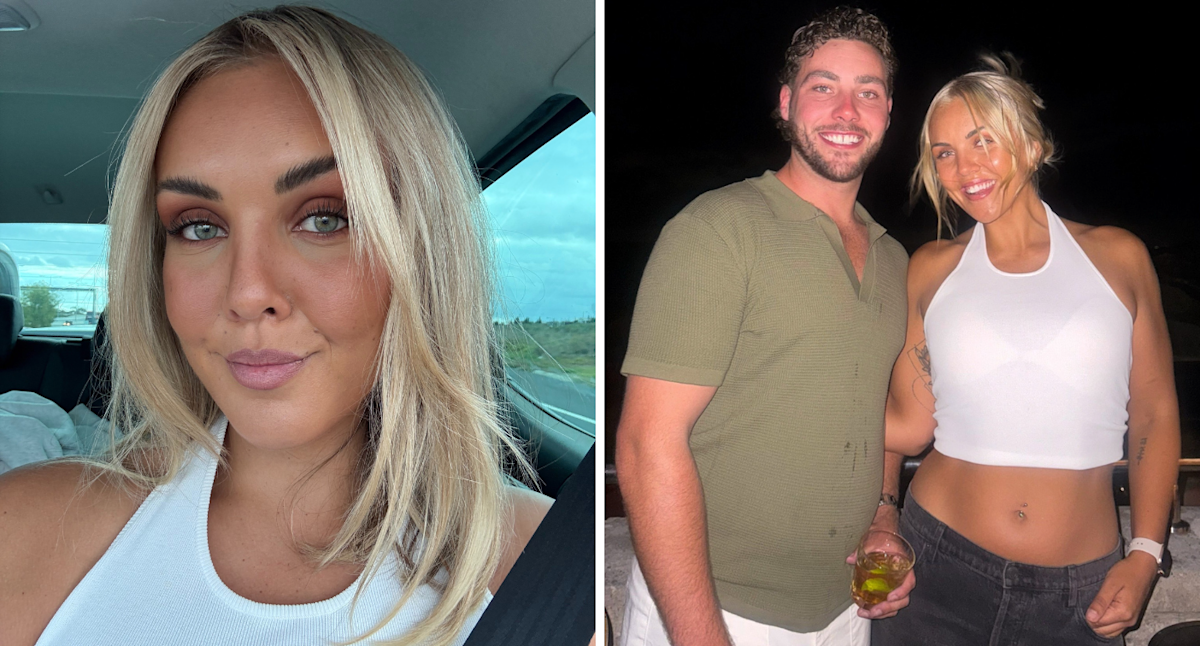
 Kahlia Flett and her boyfriend Bailey are saving for their first home deposit and are hoping to buy a place in Melbourne. (Source: Supplied)
An Aussie who has been saving up for her first home deposit for over a year has shared the money-saving hack that “completely changed the game” for her. Kahlia Flett and her boyfriend are hoping to save up $60,000 to buy their first home in Melbourne.
The 30-year-old and her boyfriend moved back home to help save on rent and have tried a bunch of different savings tactics to try and boost their savings. But there’s one rule that Flett told Yahoo Finance was the first thing that had actually worked.
“If we want to purchase something that is a non-necessary purchase, we can only purchase it if we are prepared to match that amount and put it into our savings,” she explained.
RELATED
Flett gave the example of recently wanting to buy a new pair of shoes for $200. If she wanted to buy that, she would need to put another $200 into savings. So the shoes would end up costing her $400 in total.
Flett said her boyfriend suggested the strategy a few months ago after they spoke to a mortgage broker. She admitted she can be a bit of an “overspender” and “impulsive spender”, so she wished she had implemented the rule sooner.
“For me personally, my issue wasn’t saving, my issue was spending. That sort of fun, discretionary money was where I was running into trouble,” she said.
“Once we spoke to the mortgage broker, we realised we need to go hard for two to three months to get where we want to be and then that’s when this came into effect.”
Do you have a story to share? Contact tamika.seeto@yahooinc.com
Kahlia Flett says the strategy worked for her because she can be an impulsive spender. (Source: Supplied)
The couple has drawn a strict line on what constitutes discretionary purchases.
“We’ve said everything from shopping, so clothes, to even food, so anything that we don’t purchase from either Coles, Woolies or Aldi we’re classifying as non-necessary or a discretionary payment,” she said.
They’ve also capped gifts for upcoming friends’ 30ths at $50, so if they want to contribute more, they also have to match that with savings as well.
Flett said she’s saved under $1,000 extra through the method, with the real savings coming from her not purchasing unnecessarily in the first place.
Flett shared the tip online, saying it “rewired” her brain and had “completely changed our housing saving game”. She was flooded with comments from others keen to try out the hack.
“I love this hack, thank you!” one person said.
“Obsessed with this,” another said.
“I did this while saving for a trip!!” a third added.
Flett said what works for other people will really depend on their own personal circumstances and spending habits.
“It’s all about finding what works for you. It’s not a one-size-fits-all approach. I know personally what works for friends or family, absolutely did not work for me,” she said.
Flett said the couple had previously tried to cut back on socialising, like going out for dinner, shopping and holidays, but she found this “cold turkey” approach didn’t work for her or last very long.
“Ironically, I actually found that I would end up splurging more,” she said.
The couple have now tried to strike more of a happy medium where they will still catch up with friends, but opt for free activities like going for walks or cheaper options like grabbing a coffee. They’ve also swapped overseas holidays for road trips.
“It’s definitely been a bit of a process and a bit of trial and error,” she said.
Get the latest Yahoo Finance news – follow us on Facebook, LinkedIn and Instagram.