
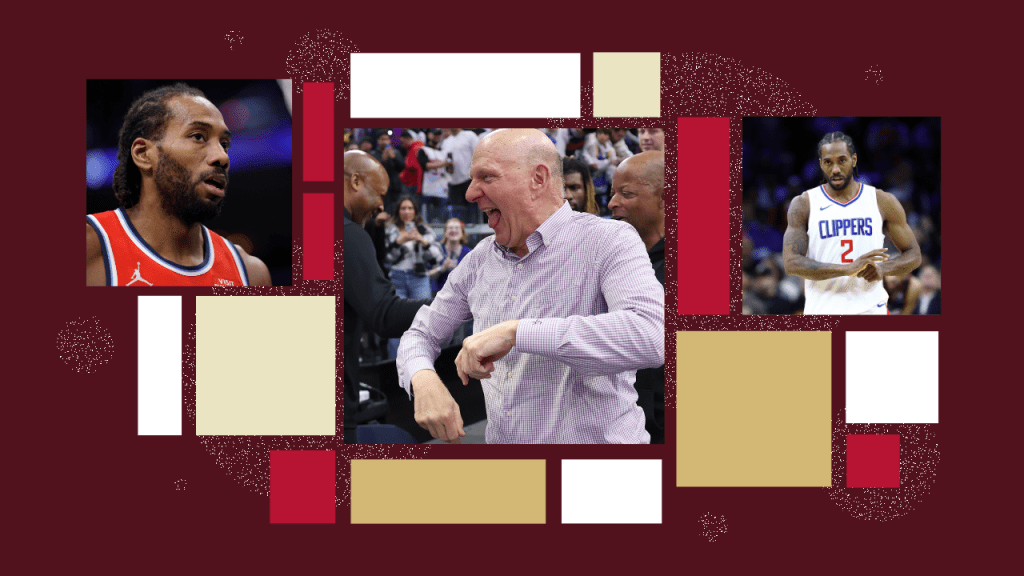
Los Angeles Clippers owner Steve Ballmer says the accusation he invested in Aspiration (now called Catona) as part of a scheme to funnel additional money to star player Kawhi Leonard through a no-show endorsement deal is “salacious” and “false.”
Ballmer’s assertion is contained in a demurrer filed earlier this week by his attorney, Daniel Petrocelli of O’Melveny & Myers. While NBA commissioner Adam Silver isn’t the stated audience of the filing—Los Angeles County Superior Court Judge Tony L. Richardson will rule on the motion—the NBA will certainly consider the brief as it investigates Ballmer and the Clippers for alleged salary cap circumvention.
The motion is in response to Aspiration investors suing Ballmer in the aftermath of company co-founder Joseph Sandberg inducing them to invest their money in what turned out to be a fraudulent enterprise. Last year, Sandberg pleaded guilty to wire fraud and Aspiration filed for bankruptcy.
The investors sued Catona’s board members for fraud and related misdeeds and later added Ballmer, the multibillionaire former Microsoft executive, as a defendant. This is a move Petrocelli, who successfully represented Fred Goldman in the 1997 wrongful death case against O.J. Simpson, says reflected the investors’ “search of deep pockets to fund a recovery” and their “zeal to recover assets swindled by Sandberg from anybody with the means to pay.”
One alleged problem in the lawsuit, Petrocelli insists, is that it relies heavily on assertions made by podcaster and journalist Pablo Torre last September. Torre accused Ballmer of conspiring with Aspiration to circumvent the NBA salary cap, with Aspiration—at one time a Clippers sponsor—signing Leonard (through Leonard’s KL2 Aspire LLC) to a four-year, $28 million endorsement deal.
Leonard allegedly didn’t have to perform services to earn the money, with the deal ridiculed as a deceptive instrument. Ballmer and the Clippers deny the allegation.
Petrocelli says the complaint against his client tracks “almost verbatim the commentary in Torre’s podcast” without providing additional specifics, insights or context. The complaint is depicted as failing to offer alleged facts that Ballmer “was even generally aware, much less had the required specific knowledge, that Sandberg was stealing money from victims (including Ballmer himself) by using doctored financial statements, generating phony customers and revenue for Catona’s enterprise sustainability business, or using false and inflated financials.”
That approach is problematic, Petrocelli insists, because proving fraud is uniquely challenging. Under California law, fraud must be pled with particularity, meaning there must be specifics and details in the complaint; generalizations, inferences and supposition don’t cut it.
“While conjecture and unsupported assumptions may be appropriate in the world of Torre’s podcast, they have no place in a sworn legal pleading,” Petrocelli wrote.
The alleged lack of specifics is portrayed as especially important in a case where Ballmer was financially harmed by Sandberg. Court records indicate that Aspiration owes the Clippers and KL2 Aspire $30.1 million and $7 million, respectively. Petrocelli highlights that in the criminal prosecution of Sandberg, the Securities and Exchange Commission and Department of Justice “treated Ballmer as a prime victim of Sandberg’s fraud.”
Timing is another supposed problem in the theory of liability leveled against Ballmer. As the demurrer tells it, most of the plaintiffs had already invested in Aspiration by the time Ballmer became involved with the company in late 2021. Petrocelli contends the plaintiffs can’t credibly argue they were influenced by Ballmer when their association predated his, and was allegedly based on their reliance on Sandberg’s assurances.
It’s worth noting that Ballmer’s not committing fraud under California law would not necessarily preclude him from being part of a salary-cap circumvention plot. The two topics are connected, but distinct. Ballmer might not have committed any fraud as to Aspiration investors, but (at least in theory) he still could have been part of an arrangement to pay Leonard extra. To be clear, Ballmer and the Clippers deny that allegation.
Petrocelli further suggests it is revealing and suspicious that while both the plaintiffs and Torre describe the Aspiration-Leonard endorsement contract as a sham and vehicle to salary-cap circumvention, neither of them has shown the entire contract.
“Notably,” Petrocelli writes, the plaintiffs “attach over 90 pages of exhibits” to their complaint “but made the tactical decision to exclude the endorsement deal that lies at the heart of their theory.”
Petrocelli also blasts Torre for “making a salacious—and false—claim” while “tellingly” not revealing the entire contract. Instead, Petrocelli maintains, Torre highlighted “only certain provisions.”
Petrocelli contends it “is impossible to tell from those cherry-picked screenshots which terms Torre chose to withhold, and whether there are express terms that undermine the allegations in his podcast and the [complaint].”
While Petrocelli is critical of Torre for not sharing the entire endorsement contract, keep in mind that Torre is not an officer of the court. He is a journalist and podcaster reporting a story and using the material most relevant to his goals as a reporter and host. Torre is under no obligation to share additional material, some of which might be irrelevant, duplicative, or disruptive of storytelling. Torre might also have obtained the contract with the explicit understanding that he could only share certain portions.
As to why Ballmer would want the Clippers to become associated with Aspiration, Petrocelli insists it’s because Aspiration claimed to have a commitment to environmental sustainability, and Ballmer “shared” that passion. The match was also allegedly appropriate because the Intuit Dome, where the Clippers play home games, is a “climate friendly arena.”
The investors in Donald R. Karr et al. v. Joseph Sandberg et al. will have the chance to try to rebut the motion. Judge Richardson will hold a hearing to consider the motion on March 9 in Los Angeles.
There is no required timetable on the NBA’s investigation. As explained by Sportico, the league possesses wide discretion in assessing if there was an understanding between the Clippers and Aspiration to evade the cap. The outcome of the controversy could have far-reaching legal implications for the business relationship between teams and sponsors when those sponsors wish to sign teams’ players to endorsement deals.