
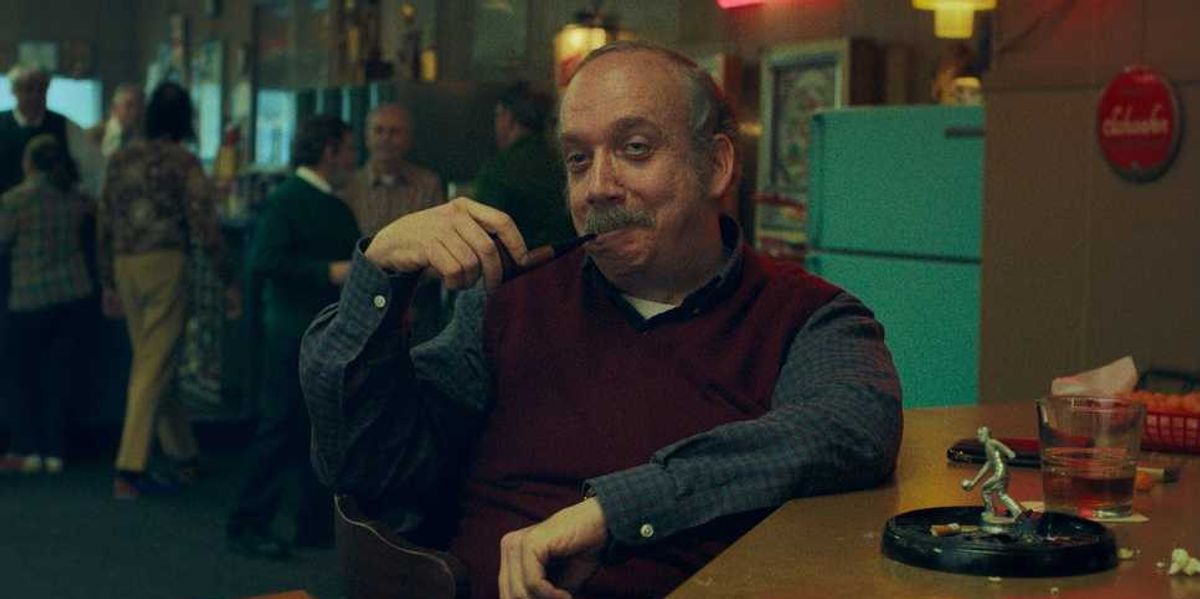
You might’ve assumed The Holdovers was shot on celluloid.
From the opening frames, the 2023 Best Picture nominee has that unmistakable warmth of early ’70s cinema. It looks amazing, with its slight grain and vivid colors.
But as Frame Voyager broke down in one of their videos, director Alexander Payne and cinematographer Eigil Bryld pulled this off entirely on digital.
Shooting on an ARRI Alexa Mini, Bryld said they wanted the movie to “look like it was a movie found in the cans in someone’s garage” decades after being shot.
Colorist Joe Gawler told Filmmaker Magazine went even further, saying they wanted the film to look like a “questionable release print.”
They approached film emulation not by using surface-level illusions. To get their look, they had to manipulate the four fundamental pillars of film emulation—color response, grain, halation, and gate weave.
If you’re thinking about film emulation (and trust, we get it, because the film look is beautiful), start by learning these basics.
– YouTube www.youtube.com
Color
Film stock is celluloid coated with light-sensitive emulsion. The chemicals in the stock are what give it color. Different stocks create different color signatures.
Early 1970s film stock, which was dominated by Kodak’s Eastman Color Negative II (5247), gave pictures warmer, more saturated colors with deep shadows, fine grain, and lower dynamic range. Bryld and Gawler created custom LUTs to replicate this digitally.
Bryld told Cinematography World that modern film stocks evolved significantly after digital intermediate workflows became standard.
“We shot tests on both digital and film, we even tried 16mm, but we didn’t pursue it in the end as Kodak said that, due to COVID-era logistical issues, they couldn’t guarantee us the amounts of stock we needed. And we realized that if we decide to shoot on film, we’d still have to build in a lot of the artifacts of the early ‘70s stocks in post. We would basically have to de-grain the image, then add grain again, etc., which was quite discouraging, so we abandoned the idea.”
To match the period aesthetic, they had to reverse-engineer those older characteristics. Per Filmmaker Magazine, the team also shot at ISO 1280, two-thirds of a stop over the Alexa’s native rating, pushing them to shoot more like they would have with film stock.
When you’re learning cinematography fundamentals, understanding how different capture mediums respond to light is a great place to start.
– YouTube www.youtube.com
Grain
Film grain makes an image look very slightly “fuzzy.” It’s the physical structure of silver halide crystals suspended in a stock’s emulsion. Each frame shifts and moves. But digital sensors produce uniform, predictable noise that looks nothing like film grain.
For The Holdovers, the production employed LiveGrain, a software that generates algorithmic grain responding to the luminance and chrominance properties of each frame.
According to Filmmaker Magazine, Gawler had previously used LiveGrain for Kelly Reichardt’s First Cow.
Different film stocks exhibit varying grain characteristics. Faster stocks (higher ISO) show more pronounced grain, while slower stocks appear finer. The grain structure also varies between color channels.
Tools like FilmConvert offer presets for various stocks, but the Holdovers custom-tuned their grain to match specific references from early 1970s cinematography. This attention to detail separates convincing emulation from something that just looks “film-ish.”
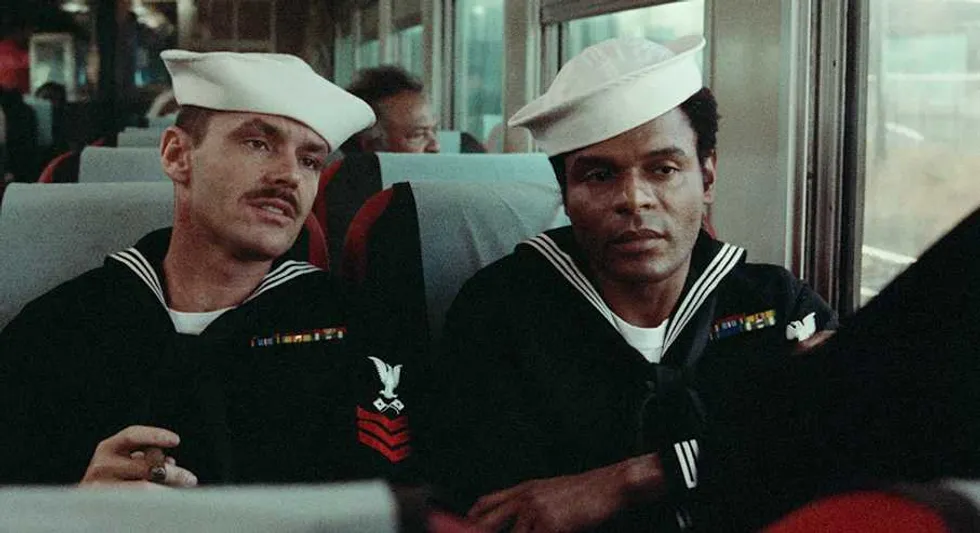 The Last Detail Credit: Columbia Pictures
Halation
Halation gives you reddish-orange halos in footage, especially around highlights. It happens when light penetrates through the stock’s emulsion layers and reflects off the film base. It bleeds back into the red layer.
Dehancer explains, “Light reflected from the inner surfaces of the camera is usually filtered out from the high-frequency components (blue and green spectrum) and backlights mostly the ‘red’ emulsion layer, which is also the closest to the inner surface of the camera.”
This happens in-camera, not in post, so it’s something you can (usually) only achieve when shooting on film. Digital sensors just can’t do this in the same way.
So for The Holdovers, production added halation digitally in post.
While some might use simple glow effects or slap on a filter, sophisticated emulation requires understanding the physics of halation. The effect should bloom from your highlights naturally.
Start studying what halation looks like. Different film stocks show varying amounts of halation depending on their anti-halation layer effectiveness.
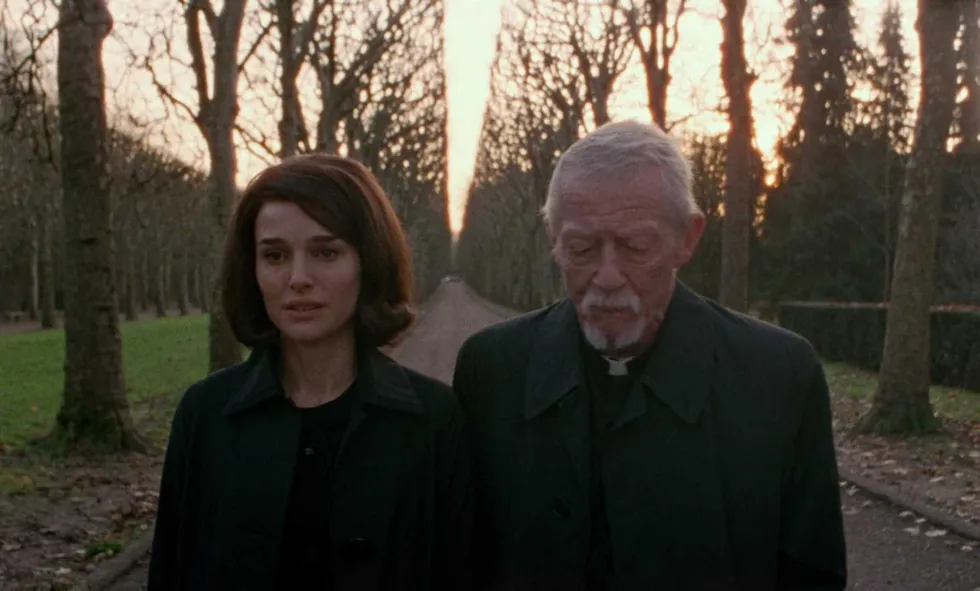 Jackie Credit: Fox Searchlight Pictures
Gate Weave
Gate weave refers to the slight mechanical movement of film as it travels through a camera’s film gate (the rectangular opening where film gets exposed). It’s basically a jitter on the image.
“We added a little subtle gate weave throughout the show,” Gawler told Filmmaker Magazine.
The Holdovers team motion-tracked actual 35mm film and applied that data to their digital footage. Dehancer describes it as “breathing life” into digital images.
FX Elements looked at gate weave from Hollywood films across different decades, finding that 1930s footage shows large jumps while 1970s footage exhibits subtler movements. The Holdovers targeted this minute, 1970s level.
Summing It All Up
There are other things the team did to get that 1970s feel beyond emulation. They used snap zooms, slow cross-fades, and smart needle drops. Even the blocking of scenes and character performances call back to the era.
As The Hollywood Reporter wrote, Bryld thought carefully about the meaning of 1970s cinematography—the freedom and experimentation of that era—rather than just copying its aesthetics.
“I was thinking, ‘What is it that I really love about that era?'” Bryld said. “There’s a sense of a spirit of the ’70s movies—breaking away from your studios. And all the DPs of the period that I really admired would push the film stock, or they would do handheld or whatever. And then I started thinking, ‘That’s really what I should be going for.'”
Understanding cinematography fundamentals is great, but you should know not just how cameras work but how different capture mediums interpret reality. What do your choices reflect in the story? What are you actually saying or referencing when you want to add grain or gate weave?
Film emulation tools continue improving, but knowing why film looks the way it does helps you use those tools effectively rather than just slapping on LUTs.
So get planning on your next project!