
A remarkable video captured a pair of ultra-rare lynx kittens bounding through Voyageurs National Park in Minnesota.
For the first time in years these endangered cats were spotted in September on the Kabetogama Peninsula, per the Voyageurs Wolf Project.
The brown and white kittens with black spotted underbellies pranced behind what seemingly was an adult lynx.
Their oversized front paws and lengthy legs tugged on viewers’ heartstrings, as this sighting is sparking hopes of a population resurgence in the Greater Voyageurs Ecosystem.
This cat breed has been spotted in the park for decades, every now and then. However, there has never been evidence of kittens, according to the Voyageurs Wolf Project.
Researchers concluded that most lynx that were sporadically spotted were transitory and alone, simply passing through the area.
‘It’s just not a common thing,’ project lead for the Voyageurs Wolf Project Tom Gable told Star Tribune.
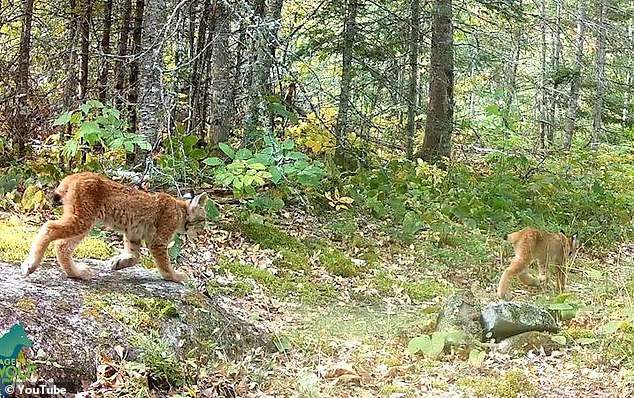
The brown and white kittens with black spotted underbellies pranced behind what seemingly was an adult lynx
The Voyageurs Wolf Project, funded by the state’s Environment and Natural Resources Trust Fund, studies wolves and their role in the ecosystem, as well as tracking other rare wildlife.
The footage, captured in September 2025, finally came to light recently as researchers sifted through months of video from roughly 400 outdoor trail cameras.
The Minnesota Department of Natural Resources estimates that there are only 100 to 300 lynx in the state.
The kitten sighting is encouraging, as it suggests the endangered population is attempting to reproduce and expand.
Many studies over the years have estimated lynx populations in the park, attempting to record sightings and numbers, but they found that lynx were either absent or only passing through.
The last national park research study, conducted in 2015, concluded that ‘it does not appear that there are currently resident lynx.’
Studying these scarce cats in Voyageurs was challenging in the past because modern trail camera technology unavailable.
Today, however, it is a valuable tool for observing and understanding wildlife in the national park.
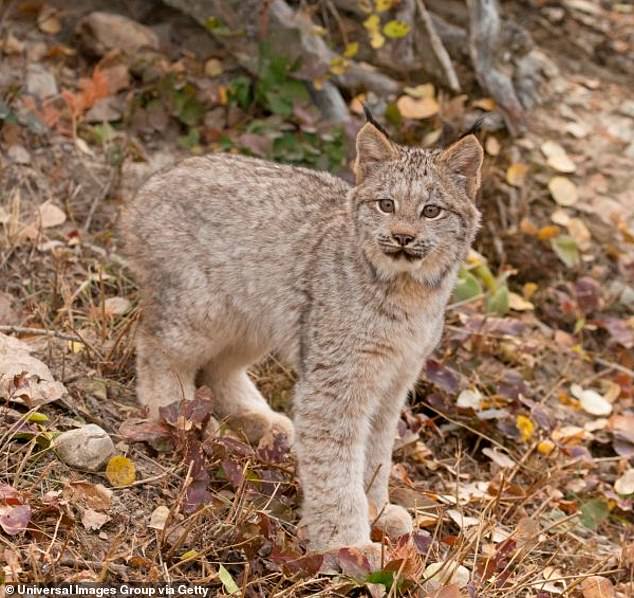
Canadian Lynx (Lynx canadensis) cub standing at entrance to den under fallen tree
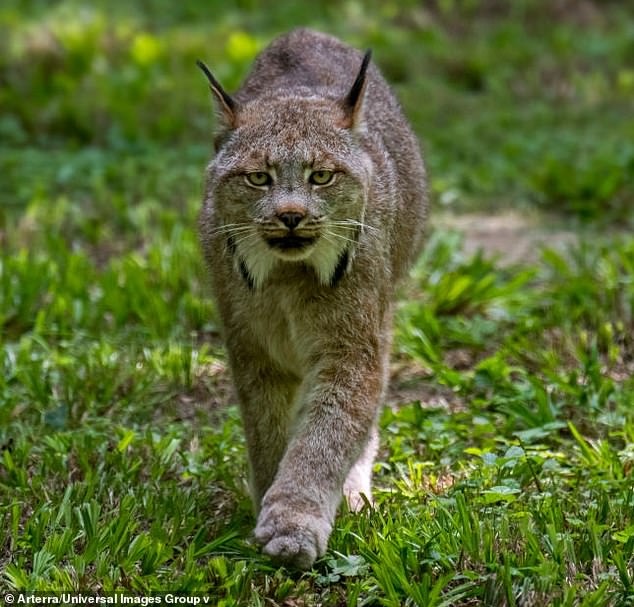
Canada lynx (Lynx canadensis), medium-sized North American felid that ranges across Alaska, Canada and northern United States
Wolf and lynx populations have become less predictable, which is common for cyclical species, a group of animals whose populations naturally go up and down, Research Biologist John Erb told the outlet.
Because the state’s winters have warmed, lynx habitat isn’t as suitable as it once was, and other predators have been able to move into their territory, Erb explained.
Regardless, lynx are still here on camera—and hopefully, they’re here to stay.
Share or comment on this article:
Ultra-rare lynx kittens spotted in national park sparking hopes of a population resurgence