
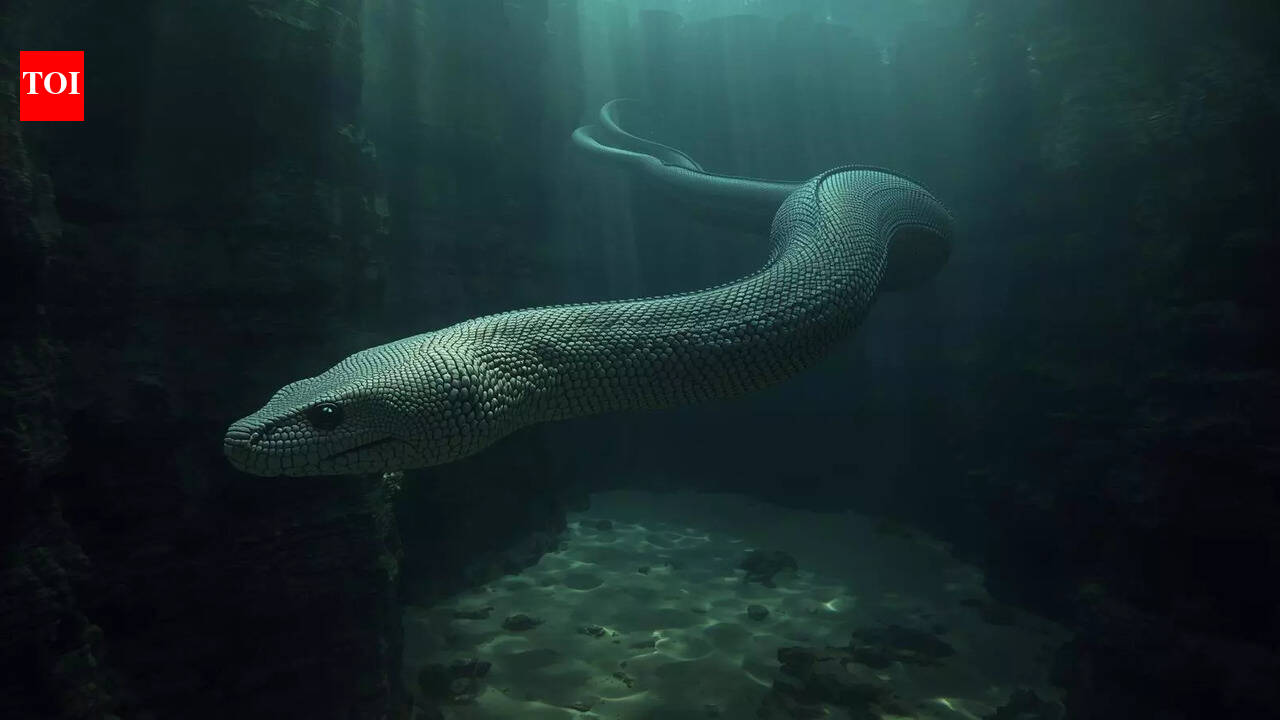
 The concept of enormous animals has historically been associated mostly with terrestrial dinosaurs. Oceans conceal their own rich past, but they feel different and quieter. Sometimes, in ways that are difficult to imagine now, fossils provide clues about species that formerly inhabited warm oceans. One such species is made up of scattered bones rather than a whole skeleton, yet those remnants are difficult to overlook. They come from a kind of sea snake that existed for millions of years before people. It did not coexist with coral reefs or whales as they exist today. Rather, it travelled through shallow, extinct old oceans. Scientists’ perceptions of early marine ecosystems and the boundaries of reptile evolution in the ocean are altered simply by its vastness.
Palaeophis colossaeus: World’s largest sea snake that lived 56 million years ago
Palaeophis colossaeus is the name given to the largest sea snake known to science. It lived during the Eocene epoch, roughly between 56 and 34 million years ago. The animal is known only from fossilised vertebrae, but those bones are unusually large. Based on their proportions, researchers estimate the snake may have grown between 8 and just over 12 metres long. That places it far beyond any living sea snake today. A 2018 scientific study named “Large palaeophiid and nigerophiid snakes from Paleogene Trans-Saharan Seaway deposits of Mali” described the vertebrae as larger than those of any known modern snake species, marine or terrestrial. Even without a skull or full body, the scale of the bones suggests an animal built for dominance rather than survival at the margins.
This giant sea snake lived near Africa
Evidence points to a warm, shallow marine environment that once covered parts of North Africa. This region is known as the Trans-Saharan Seaway, which existed when global temperatures were higher than today. Areas that are now desert were once coastal waters rich in life. The presence of such a large sea snake suggests these seas were warmer than modern tropical oceans. Large reptiles depend on heat to regulate their bodies, and sustained size on this scale would not have been possible in cooler conditions. The environment likely supported a wide range of fish, sharks, and other marine reptiles, creating space for a predator of unusual size.
This snake might have eaten sharks for survival
No direct evidence shows what Palaeophis colossaeus preyed on, but size offers some clues. A snake measuring more than 10 metres would have needed large meals. Researchers have suggested that if its skull was highly flexible, like many modern snakes, it could have swallowed very large prey. This may have included sizeable fish, sharks, or crocodile-like reptiles called dyrosaurids. The idea is not dramatic speculation so much as basic biology. Big predators usually target big animals. Even so, scientists remain cautious, since only vertebrae have been found and behaviour is harder to reconstruct than bones.
How does it compare to snakes today?
Modern sea snakes are far smaller and less imposing. The longest-living species, the yellow sea snake, reaches around 3 metres at most. Even the largest snake ever known, Titanoboa, which lived on land, was only slightly longer than Palaeophis colossaeus. That animal is also extinct. What remains today are scaled-down versions adapted to cooler seas and different food chains. The giant sea snake belongs to a time when oceans worked differently. Its disappearance does not come with a neat ending. It simply faded as climates shifted, seas retreated, and the world rearranged itself around smaller forms.