
While WNBA players are dispersed around the country and the world in off-season domestic leagues, including Unrivaled and forthcoming Athletes Unlimited, in addition to international leagues in Europe, China, and Australia, a small group of advocates held up signs expressing their frustration with the situation at hand.
Last Friday, a call to action took place in front of the NBA store in New York City.
“Tell [WNBA Commissioner] Cathy Engelbert and [NBA Commissioner] Adam Silver to get this CBA DONE,” a sign read. “Without the players, there is NO WNBA.”
A giant inflatable rat — which has been a common symbol for unions and workers’ rights for more than 40 years in New York City — sat on the sidewalk of Fifth Avenue, greeting the passersby.
Since the demonstration last Friday and the subsequent expiration of the previous collective bargaining agreement (CBA) later that evening, both the league and the Women’s National Basketball Players Association (WNBPA) have been relatively quiet.
Both sides agreed to a moratorium the following Monday, an administrative legal action to put a temporary halt to the free agency period, which under the current status quo period would have already begun. A moratorium was also enacted during the previous cycle to ratify the most recent CBA. Over six years ago, both sides signed it right before the new year. This is outlined in Article V, Section 15 of the 2020 CBA.
The main disagreements between both sides have been over how revenue should be shared and what benefits the WNBA should provide. There are also questions that both sides face regarding how the WNBA continues on the path to becoming a sustainable mainstream entertainment property.
To have a greater understanding of the current status quo period, let’s explain what each side has proposed.
Two very different ways of allocating money
The highest two priorities on the list of the WNBPA from the very early days of the negotiations have been receiving a massive salary increase and being able to earn money as the business grows. This concept is widely known as revenue sharing.
For example, players in the NBA earn basketball-related income (BRI), a revenue metric that gives players a share of the money made from gate receipts, broadcasting deals, merchandise, sponsorships, and concessions.
There currently isn’t a formal metric like BRI for WNBA players. Revenue sharing between the league and the players in the most recent WNBA CBA was predicated on a trigger system. If the league was able to hit certain revenue benchmarks, then that would trigger for the players to have a share in the business in addition to the money they earn from their salaries on the salary cap.
These triggers weren’t activated because this CBA was signed before the COVID-19 pandemic, which limited the number of fans at games for almost three seasons, setting the WNBA’s business a couple of steps back before it could take a much more substantial leap forward.
But now, the players want a more formal metric of money that’s tied to the business following the booming ratings, dynamic star power, and massive media rights deals that the WNBA has acquired in the past few years.
Both sides understand the need for revenue sharing in the salary structure but have gone about getting there in two very different ways. A common phrase that has been written about the disagreements in money allocation between both sides is that the league and the players are very “far apart” on these items. But how can that be quantified and explained further?
The WNBA’s Proposal
The WNBA has proposed a system that shares with the players after the costs of expenses are deducted from the total amount of revenue. This is also known as a net revenue system. Let’s approximate what this might look like based on reports about the league’s total revenue in 2025, along with the approximate percentage that the league is looking to deduct.
Reports have alluded to the WNBA’s total revenue for the 2025 season being at least around $300 million. And a source familiar with the negotiations has confirmed to NBC Sports that the deduction rate is close to 80 percent. Why does the WNBA need to deduct money?
This is for operating costs, which include arena rent, charter flights, making sure players stay in five-star hotels, and growing coaching and medical staff. This could also include updating officiating infrastructure, something that became a particular hot-button issue during the 2025 playoffs.
Let’s use a hypothetical. If the WNBA’s total revenue for 2026 is $350 million, then the league would take off $280 million to cover its expenses. That would leave a new pot for the players to benefit from of $70 million. The league has proposed that the players would get 70 percent of that $70 million pot of money. That would bring the players’ share to $49 million, which amounts to 14 percent of the league’s total revenue.
Multiple sources familiar with the negotiations confirmed to NBC Sports that NBA players receive 40 percent of the league’s total revenue, while they receive between 49 percent and 51 percent of the BRI. The NBA, too, deducts money, but it’s through an escrow system — a legal arrangement where money is held and only released once conditions of the CBA are met — instead.
Part of the WNBA’s argument for deducting such a high amount from the total revenue the league brings in relative to the NBA is the fact that the WNBA’s revenue is so much smaller than the NBA’s. If the WNBA’s approximate total revenue in 2025 was $300 million and the NBA’s could hit $14.3 billion during its current 2025–26 season, then the WNBA’s total revenue is just a hair over two percent of the NBA’s.
That’s a massive difference in the amount of money that the WNBA has access to in order to uphold professional standards like charter flights, proper hotels, and expanded team staffers on both the basketball and business sides.
The league would handle revenue sharing as an installment that’s paid to players after their salary that’s in accordance with the salary cap. According to a source familiar with the negotiations, the top salary a player could earn in the first year of the deal via the cap would be $1 million without the revenue share installment. With the revenue share installment, that number increases to $1.3 million.
The WNBPA’s Proposal
The players, however, believe that deducting such a huge percentage of the total amount of revenue puts the players in a position where they are impacted directly by the league’s expenses. There isn’t a formal cap for how much money coaches and other league and team employees are paid.
The WNBPA’s proposal is a lot simpler and, as a result, yields the players more money. To be clear, their share isn’t just for salaries but also includes the benefits that the WNBPA expects the WNBA and its teams to provide, which include health care, child care, and parental leave.
The WNBPA has proposed that players get a share that’s 30 percent of the league’s total revenue. What would that look like using the hypothetical numbers from above?
The players propose getting 30 percent of $350 million in total revenue, which would yield them $105 million for salaries and benefits. The league would receive 70 percent of the total revenue, which is $245 million.
So how far apart are both sides?
Using the numbers from above, there’s around a $56 million difference between the two sides and what they both want.
The league is offering to give the players around $49 million, while the players are asking for more like $105 million. The WNBPA’s proposal allows the league to have $245 million; meanwhile, under the league’s deduction-first policy, the league would receive $301 million. Again, that’s around a $56 million difference.
But the WNBPA takes issue with the fact that the league will be receiving approximately $925 million in expansion fees, presumably over long-term installments, for each of the six expansion teams beginning with the Golden State Valkyries and ending with the rest of the teams that will be in the league by 2030.
The players association understands that expansion fees won’t be part of their share, but the union remains confused as to why that money won’t also be used to assist with the league’s operating costs in addition to the money the league will also get from its multiple media rights deals, which could earn the league over $200 million a year for the next 11 years.
That is why there is a lot of skepticism on the WNBPA’s side in response to the report from ESPN’s Alexa Phillippou that the union’s proposed salary cap of $10.5 million would result in $700 million in league losses over the course of the CBA.
A Concern with both proposals
As of this writing, the WNBA’s latest salary cap proposal is a $5 million salary cap in the first year of the deal to accompany a $1.3 million max salary and an average salary of $530,000. These numbers include revenue sharing, although revenue sharing will be added on following the salary that’s part of the salary cap.
Phillippou also reported that both salary cap proposals from the union and the league will lead to the max salary representing 20 percent of the total salary cap, an increase from the most recent CBA, where the top salary represented 16.5 percent of the previous salary cap.
What’s the issue there? For the second straight CBA, the league’s middle class, or group of veterans who aren’t top players but also aren’t on rookie-scale contracts, will be squeezed out. What has resulted are either top-heavy teams without much middle-class depth or top players who have had to take discounts so that the team could be more competitive.
According to these current proposals, that issue will remain and could potentially get even worse. “I’m trusting that the PA and the elite players on the executive committee have actually taken out their calculators and are considering this, which is quite important to 75% of the league,” a player agent told Phillippou.
Aces guard Dana Evans, a key part of the team’s 2025 championship run, explained the importance of valuing the middle class to The IX Basketball’s Howard Megdal recently in Miami while competing in Unrivaled.
“We want to reward our stars and not just let them have to settle all the time,” she said. “But I think it’s so important, percentage-wise, because players like me that are in that middle range, in their fifth to sixth year, it’s not going to be much money left for those players, so we have to make sure it’s equal all across while still making sure our stars are well taken care of.”
A deal won’t get done without compromise
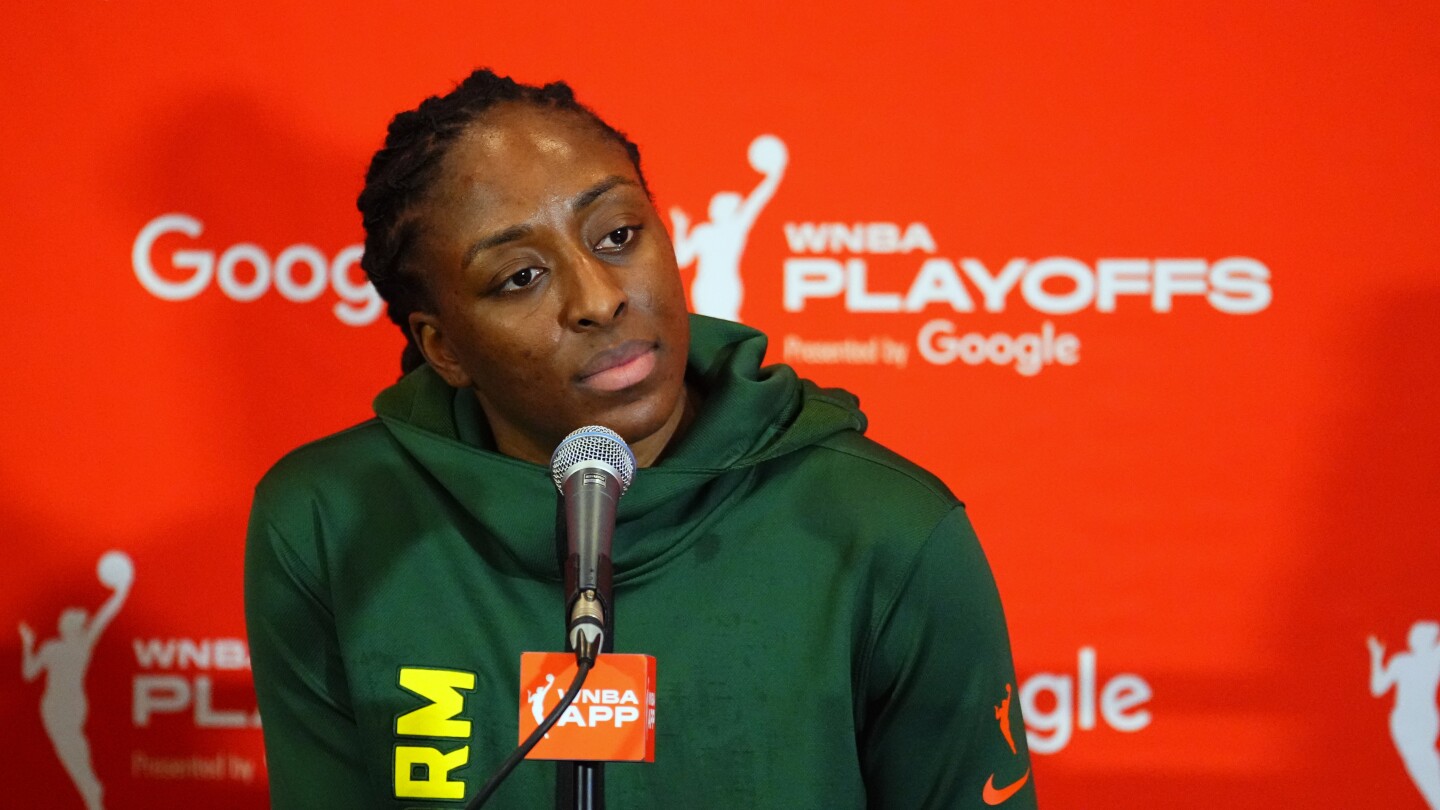
Amid so much well-documented discord between the WNBA and the WNBPA, there are some areas where both sides have agreed in principle. WNBPA Vice President Napheesa Collier told ESPN’s Katie Barnes that those areas included maternity and child care benefits, along with codifying the league’s charter flight program.
But there is another area of agreement that has to do with changes to the rosters. The players union proposed a system where teams would be able to sign developmental players who could appear in at most 10 games per season and would be paid on a prorated minimum salary. A source familiar with the negotiations would be shocked if there isn’t a change to the current roster structure, which often sees teams struggling to develop talent while also remaining competitive. As a result, there would be less reliance on hardship and replacement contracts, seen by many around the league as an overly complicated and outdated system.
In order for this deal to get done, though, more areas of agreement are going to need to be reached, and that means compromise. Toward the end of the 2025 calendar year, both sides agreed on two extensions to the 2020 CBA, mostly due to the fact that the WNBA had upped the ante in their salary proposals and added in a true revenue-share component.
As of now, the WNBPA has been headstrong about its position, as union President Nneka Ogwumike made it clear to ESPN’s Barnes last week that the players “aren’t moving on” their main priorities.
These deep-seated tensions are systemic and aren’t either side’s fault. Nobel Prize-winning economist Claudia Goldin, who has worked with the WNBPA, explained that in an opinion column for The New York Times this past June.
She pointed toward the reason that the 2025 average WNBA salary was such a tiny fraction of the average salaries that are made in the NBA. It came out to 1/80, or less than an actual percent.
“The most likely explanation is that the WNBA is not receiving the full value it contributes to the combined NBA and WNBA enterprise revenue,” she wrote. “NBA owners claim that they lose money on the WNBA, yet the recent willingness of investors to pay high sums for WNBA expansion teams suggests the opposite. In the leagues’ joint venture, management is not giving the WNBA enough credit for the attention and money its players attract.”
Is it the fault of the WNBA that its NBA owners, who don’t own teams but collectively own 42 percent of the WNBA, have been icing it out of revenue it could use to operate at a more professional level?
Is it also the fault of the players who have been taking less for so long in a league that struggled to acquire capital for a long time through the resources that men’s leagues often take for granted (i.e., corporate sponsorships and consistent media coverage)?
That’s what’s at the heart of the frustration on both sides and why consensus remains at a premium.