
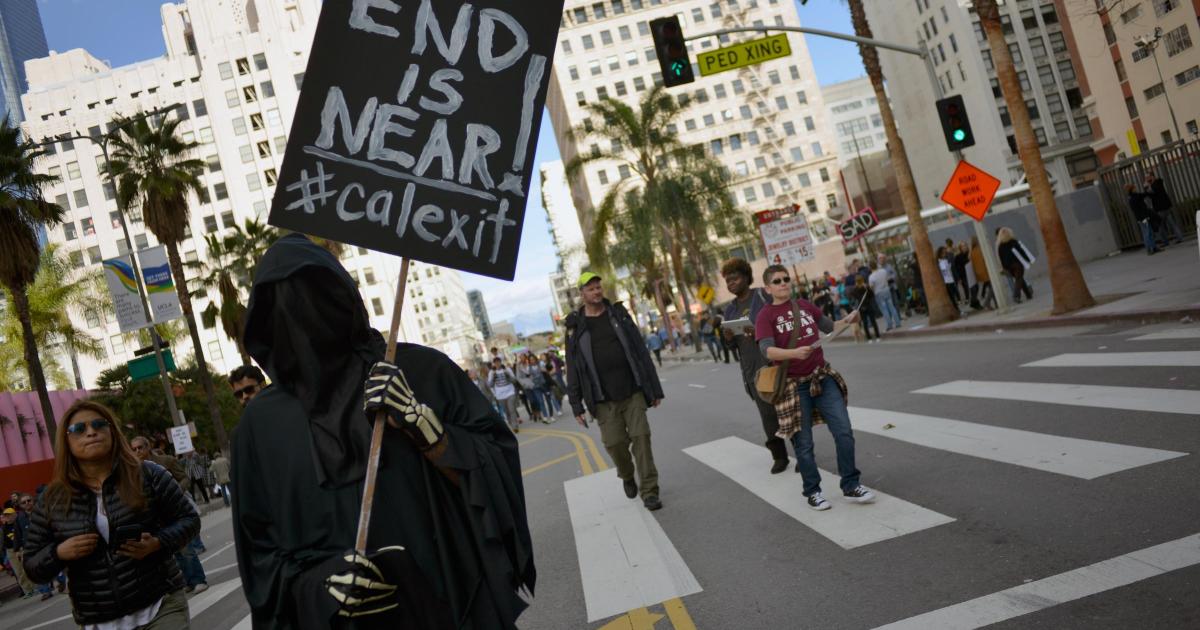
It was an interesting choice of words amid tensions between the US’s most populous and richest state and the Donald Trump administration.
Current governor Gavin Newsom – who is widely tipped to run at the next US election – promised to lead the resistance to Trump’s conservative agenda immediately after he won a second term.
READ MORE: Society of Editors slams Scottish Labour over made-up quote in fake magazine
There have been notable bust-ups since, including last summer over Trump’s deployment of the National Guard to crack down on protests against mass deportations.
It has only served to highlight the political gap between the traditionally liberal California and the current US government.
But it has also coincided with increased support for Californian independence – in the form of more powers or even full secession – according to polling last year.
The YouGov survey in June 2025 found that 44% of Californian adults would vote for the state to leave the United States and become a fully independent nation, which the Independent California Institute (ICI) – who commissioned the poll – said is a “record high poll result for secession.”
But could it actually happen?
THE picture for Californian secession isn’t fully clear, with significant legal barriers as secession would likely require a constitutional amendment approved by Congress and states.
But Coyote Codornices Marin, the executive director of ICI – which is a think tank that researches and advocates for the idea of California independence – told the Sunday National that increased independence is already happening in many ways.
“We are seeing the start of building the groundwork that could be part of becoming a new country or could be part of becoming more autonomous within the United States,” they told the Sunday National.
“Like we’re already talking about backfilling money for federal programs that were cut by Republicans at the congressional level and money that’s been just straight up withheld by the Trump administration. We still want the same level of social services. We want government to work, and California’s getting the idea that that’s just not going to happen at the federal level, we have to do it ourselves.”
Donald Trump is a largely unpopular figure in California (Image: Kevin Lamarque, REUTERS)
Marin added: “So California basically, if we just had all the tax dollars we paid to Washington, instead they went to the state government, for us, things would be exactly the same.
“We’d just be paying for whatever level of services we have now. There’s no added value in passing our tax dollars through the federal government.”
They went on: “The other thing is with the Trump administration, many of the things that have been good about the United States have gone away. We used to have a federal court system that made good decisions. We used to have free trade with other countries, for example.”
Marin then said that if the United States continues on its current course, they do believe that California will be a country at some point.”
Professor Benjamin J Cohen wrote a book discussing California’s potential independence which was published in 2025.
Called “Dream States: A Lurking Nightmare For World Order”, the professor at the University of California, Santa Barbara, warned of rising fragmentation that could lead to violent clashes and potentially challenge US unity by 2035.
Right now, though, he described the appetite for Californian independence to be in more of an “ebb” rather than a “flow”.
“It’s a low grade, by which I mean not highly visible, attitude among a number of Californians. Difficult to say how many, as well as some in the neighbouring state of Oregon, who are unhappy about the limited representation that they have at the national level, that is to say at the federal level,” he told the Sunday National.
“From time to time, the sentiment boils up in one form or another. At the moment, it’s at a low end; there isn’t much discussion. If the Trump administration continues on the path that it’s chosen for the first year of Trump’s second term, I wouldn’t be at all surprised if we begin to hear more about secession.”
Cohen added: “There is a lot of discussion of resistance to federal edicts of one kind or another, and I have a feeling that our present governor, who’s turned out after this year, I have no doubt that he’s going to run a strong campaign for the Democratic nomination two years from now, precisely because of his willingness to resist, and that’s the point at which I would imagine there might be some revival.”
He added, however, that at the grassroots level, there is relatively little going on – although there is a campaigning group called Calexit and a small political party by the name of the California National Party.
“I think it’s fair to say that the number of people who take the idea of secession seriously, who are willing to go out and campaign for secession in California, that number of such people is pretty small,” Cohen said.
“But I really do believe that in the next two years, if things continue as they have for the past year, there will be some strengthening of interest in the idea of secession.
“You have something like the fifth-largest economy in the world within the borders of California and 40 million people who have very limited representation at the national level, federal level, and given the kind of discontent that’s bubbling up over the last year, it’s not difficult to believe that at some point this could lead to a serious revival of interest in secession.”