
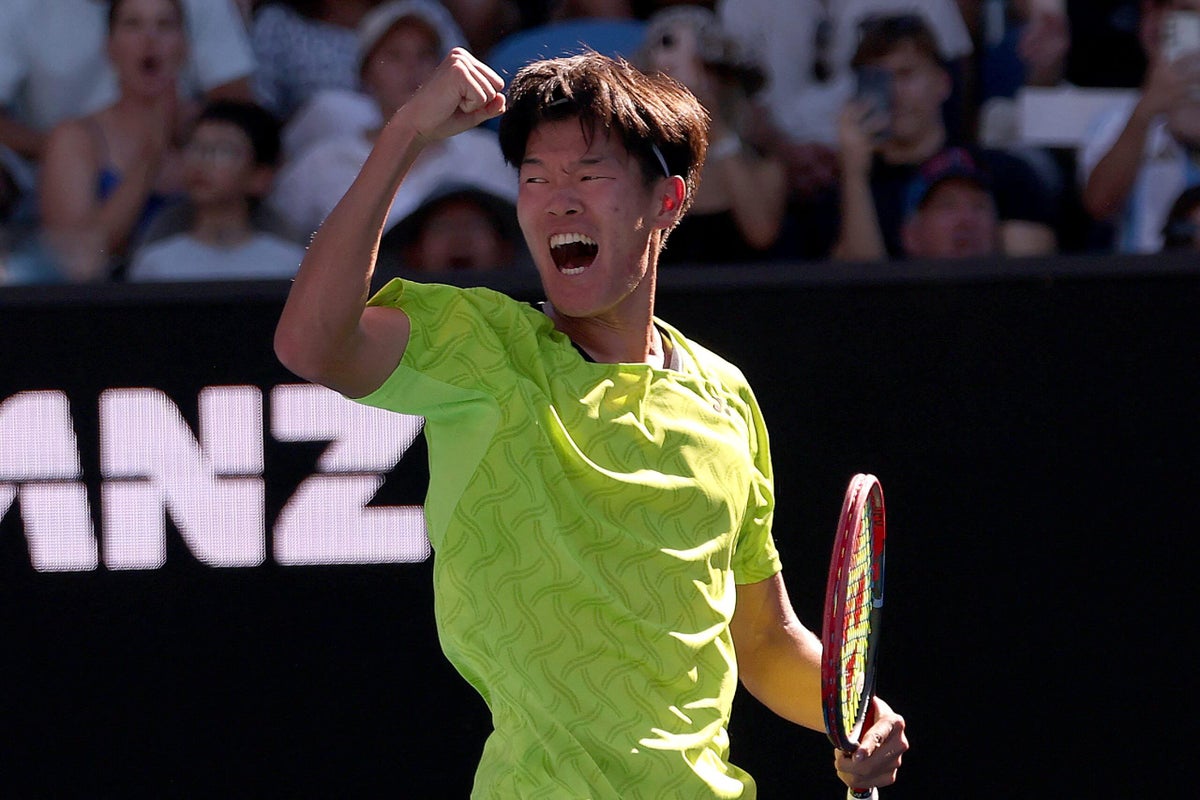
MELBOURNE, Australia — Michael Zheng is having quite a winter break from college sports and life in chilly New York City.
A senior psychology major and two-time NCAA champion at Columbia University, Zheng won three matches in Australian Open qualifying, then upset compatriot Sebastian Korda in the first round on Sunday in five sets, 6-4, 6-4, 3-6, 6-7(0), 6-3.
“Definitely was not easy out here,” Zheng said on court when it was over, after writing “Go Lions” on a camera lens to take his college team about as far around the world as it could go.
Korda, a quarterfinalist here three years ago who has been plagued with injuries the past two seasons, came out cold. Zheng came out hot, staying solid and patient in every rally and burning for the lines when required. He sprinted to a two-set lead.
“Michael doing well today,” his college coach, Howard Endelman, texted midway through from 10,000 miles away in the middle of the New York night.
Korda came alive in the third set, but Zheng kept his cool on a warm, breezy afternoon. When Korda played a tentative point and sent a ball long on a chance to serve for the fourth set, Zheng locked in and whipped a forehand winner to seal the game.
Three games later, Korda was battling for survival in a fourth-set tiebreak. He whipped through it 7-0.
On to the fifth set they went. Korda had never come back from 0-2 sets down to win before. Zheng had never played a main-draw Grand Slam match before.
“A lot of the pressure is on him, so I’m just going to try to put that pressure, make the return, and try to start the point on the offense,” Zheng said in his news conference. “That was kind of the mentality going into the fifth.”
In the fifth game, with the crowd chanting “Let’s go Michael!” for someone a lot of them had probably never heard of before that day, Zheng got his chance. On break point, he took a big rip at Korda’s serve, crushing it deep into the court. Korda short-hopped it back long.
Zheng then staved off a break point at 3-2, and then another at 4-3, inducing errors from Korda when he needed them. He ripped a backhand pass on the run from outside the tram lines, with Korda looking like he was about to get another chance.
Another backhand rip down the line got him two points from the match. Korda double-faulted twice and Zheng had the win.
Collegiate champions, who are used to playing on hot, hard courts in front of rowdy crowds, have done well at the Australian Open before. In 2023, Ben Shelton, fresh off the NCAA title, made the quarterfinals on the first trip of his life outside the U.S.
“I think the NCAAs definitely prepared me for moments like these,” Zheng said.
“I feel like when you are playing for college, you’re playing for something bigger than yourself. So there’s a lot of people supporting you. You really want to win for yourself, but also for your school. I actually felt more nervous I think going into the finals of NCAAs than this match, surprisingly.”
Zheng couldn’t be more different than Shelton, though. Shelton, the son of a former pro who grew up in Florida, is 6-foot-four and has the shoulders of a football player. He arrived on the tour with a 140 mph serve.
Zheng, a child of information technology executives, grew up in northern New Jersey, hardly a tennis hotbed. He is a shade over six feet and rail-thin, a steady and patient baseliner who spins in first serves in the low triple digits, then looks for an opportunity to unleash a whipping forehand through the court.
In a news conference Sunday, Frances Tiafoe said Zheng must be “damn near a genius.”
“He’s telling me, ‘Yeah, school starts in a week.’ The guy qualified, and now he’s beating Korda. It doesn’t make any sense. He’s playing the NCAAs. The guy is … It’s crazy.
“But he shows how good college tennis is going, right? Korda has been one of the best Americans for a long time. He comes in here and beats him. It’s like, ‘Whoa, that’s crazy.’ I saw they were in the fifth. I didn’t know he won.
S“hout-out him. Shout-out Columbia, man. Hopefully he stays in college and doesn’t continue to take out all the Americans. Stay in college for as long as you want, bro.”
The rest of the college world probably wants him to leave. In 2024, Zheng became the first Columbia Lion to win a college singles championship in more than a century. In November, he became the first NCAA champion to successfully defend his titles since Steve Johnson in 2011-12.
Zheng thought about turning professional after winning his first title, but he wanted to finish his psychology degree, while combining collegiate play with some professional tournaments. Then he won again and said basically the same thing – that he planned to finish his degree at Columbia this spring and try to help the team with the team title in May.
He said it again on Sunday. He’s got 15 credits to go. He promised himself and his parents he’d finish, which means whenever he loses in Melbourne he will head back to a campus dormitory where he shares a suite with five other roommates: A teammate Columbia golfer, and three non-athletes he became friends with during his first years at school.
Things can change in a hurry in tennis, though, especially since he earned about $100,000 by qualifying for the main draw and another $50,000 for the win over Korda. It’s possible he can’t accept that money as a college player, except for covering his tennis-related expenses, but there may be some wiggle room since he is a second-semester senior.
He said he’d have to check that with his coach.
“I don’t want to get into trouble,” Zheng said.
That’s a matter for another day. For now, he’s got to get ready for a second-round match at the Australian Open with Corentin Moutet of France.
When it was over, Endelman had plenty more praise. “Very proud of Michael. Such special courage. When you do that much work when nobody is watching, you give yourself a chance.
“We play South Carolina in 8 hours, and Mike is in Melbourne!!”
Columbia men’s tennis has been a top college program for quite some time
Columbia’s rise to a consistent top-20 program coincides with current head coach Howard Endelman’s 2010 arrival as an assistant.
Endelman, who was a former player with the program in the 1980s, joined his former head coach, Bid Goswami, after working on Wall Street. He had previously coached the women’s team, but a desire to return to mentoring young tennis players brought him back into the fold.
Before Endelman’s arrival, Columbia was a consistent Ivy League power, but hadn’t had the level of national success that it has in recent years, reaching back-to-back Elite 8’s. When Goswami retired in 2019 after 37 years with the school, Endelman took over as head coach. Zheng, who reached the 2022 Wimbledon boys’ singles final, was one of Endelman’s first prized recruits.
Halfway across the world in New York, the Lions, No. 10 in the Intercollegiate Tennis Association rankings and fresh off a season-opening win over Bucknell University, are preparing to face No. 18 South Carolina. Whether or not they will be able to replicate the success of the past two seasons will depend on if Zheng plays this year. — Chris Lopez