
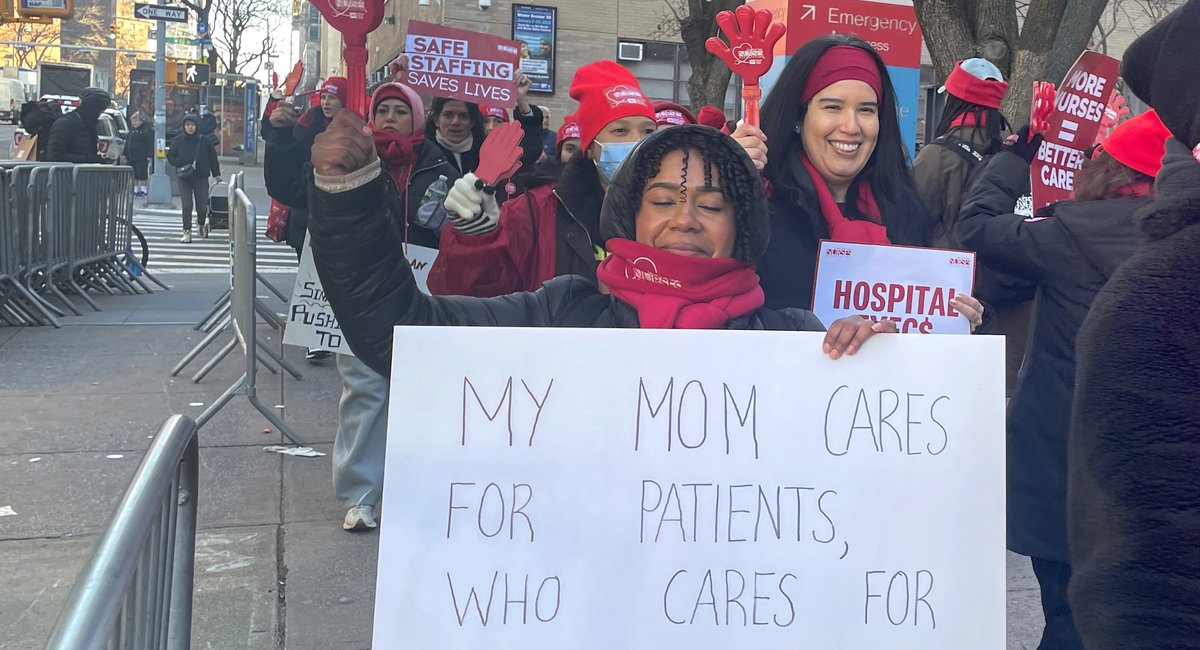
What happens when nurses go on strike?
New Yorkers were figuring this out in real time last week after nearly 15,000 nurses at three major hospital systems walked off the job Monday.
But researchers who have studied this issue going back decades in New York say the answer to that question is abundantly clear, based on an analysis of mountains of data.
Significantly more patients die during nurse strikes, according to a leading study that looked at data tied to strikes over a 20-year period in New York state. And more patients were readmitted to hospitals because of inadequate care, according to the findings.
“ Nurses matter,” Jonathan Gruber, an MIT economist and coauthor of the study, told Gothamist. “And nurses that know the system and know the patients matter, and the displacement that happens when nurses go on strike, it’s consequential for patient health.”
Gruber said collective bargaining can lead to long-term benefits, not just for nurses but for patients, in terms of the quality and efficiency of care. But other experts are pessimistic, given the many forces wreaking havoc on health care in the United States.
Nurses belonging to the union New York State Nurses Association walked off the job after negotiations stalled with Mount Sinai Health System, NewYork-Presbyterian and Montefiore Medical Center. Talks resumed Thursday at NewYork-Presbyterian and on Friday with the other hospital centers. Their contracts expired Dec. 31.
Here’s what researchers say about prior strikes, and why at least some of them are concerned that regardless of how this strike ends, the state of health care will only get worse.
How do nurses’ strikes affect public health?
Strikes cause mortality rates at hospitals to rise by 19.4%, according to research by Gruber and fellow economist Samuel A. Kleiner. Their findings, published in a 2010 paper, “Do Strikes Kill? Evidence from New York State,” examined data over the course of a 20-year period, 1984 to 2004. Gruber said he was confident the findings still hold up.
“Overall, our findings suggest that strikes lead to lower quality of medical care in hospitals,” according to their findings, adding that impacts are especially severe for patients who require intensive care. Moreover, the “outcomes are no better for patients admitted to striking hospitals who employ replacement workers.”
The authors estimated that 138 more patients died because of the strikes than would have in the absence of strikes. They also found that 30-day readmission rates at hospitals went up by 6.5%.
What do nurses and the hospitals say about care during nurses’ walk outs?
Asked whether patient care declines when nurses strike, a spokesperson for Montefiore pointed to a Jan. 12 email sent to all staff by Philip Ozuah, the president and CEO of Montefiore Einstein.
“Patients are being cared for in a calm, compassionate, and collegial atmosphere,” Ozuah wrote. “Our Montefiore Einstein colleagues have rallied as a team to ensure the continued provision of the highest quality of care for all who seek us out at their most vulnerable. We have not canceled even one patient’s access to care.”
The New York State Nurses Association issued its own response.
“Every patient deserves to have a qualified nurse at the bedside, and every preventable hospital death is a tragedy,” NYSNA President Nancy Hagans said in a statement.
“That is why nurses fight so hard for safe staffing in our hospitals,” Hagans said. “The hundreds of millions of dollars these wealthy hospitals are throwing away on temporary traveler nurses who don’t know our patients or our communities could have gone toward improving patient care.”
What about the personal toll on nurses?
For nurses, the decision to strike can be costly in the immediate term, said labor economist James Parrott, senior fellow at the Center for New York City Affairs at the New School.
The median wage of registered nurses in New York is $121,000, according to data from the state department of labor.
“Their ability to take care of their families and to keep food on the table and to run their households is seriously jeopardized over this,” Parrott said. “Going on strike is not something that workers enter into lightly.”
Other experts said the impacts extend beyond nurses, to others who work within the health care system. Bruce Y. Lee, a professor at the CUNY Graduate School of Public Health & Health Policy, said the strike would force other employees to shoulder more of the workload, and could cause some of them to experience burnout, depending on the duration of the strike.
“ This is exacerbating existing problems,” Lee said. “We’re really at a crisis stage when it comes to health care professionals, and this is just highlighting that.”
Is there an upside to these job actions?
Gruber, the Ford Professor of Economics and chair of MIT’s economics department, said that collective bargaining better allowed nurses to secure what they’re rightfully owed, in terms of wages and benefits, and consequently made it possible for the health care system to attract the best talent, paying dividends to the public over the longer term.
“There is this trade off,” Gruber said, “where you want to get nurses paid to the point where it’s beneficial for patients, but the strike is a costly mechanism to get there.”
Gruber and Kleiner said in their research that new contracts generally result in improvements in hospital productivity and quality.
But questions remain about how long those gains are sustained.
“It’s likely to be a Band-Aid,” Carri Chan, the Cain Brothers and Company Professor of Healthcare Management at Columbia Business School, said of whatever agreements are struck. “ A lot of the things that both sides are struggling with are going to keep arising.”
Chan said she expected that nurses would continue to feel “ overworked and underappreciated,” and that hospitals would be financially challenged.
“ More hospitals are closing every year than are opening because they cannot stay financially viable,” Chan said. “It’s in many ways a no-win situation.”
What other economic threats are out there?
Chan said matters were only likely to get worse because of “political headwinds.” These include the fate of the Affordable Care Act subsidies, which are currently the subject of intense discussions among federal elected officials – with no resolution insight. The loss of such assistance is expected to push millions onto the rolls of the uninsured.
“If there’s an increase in uninsured,” Chan said, “they’re going to be providing care to people who can’t even pay.”