
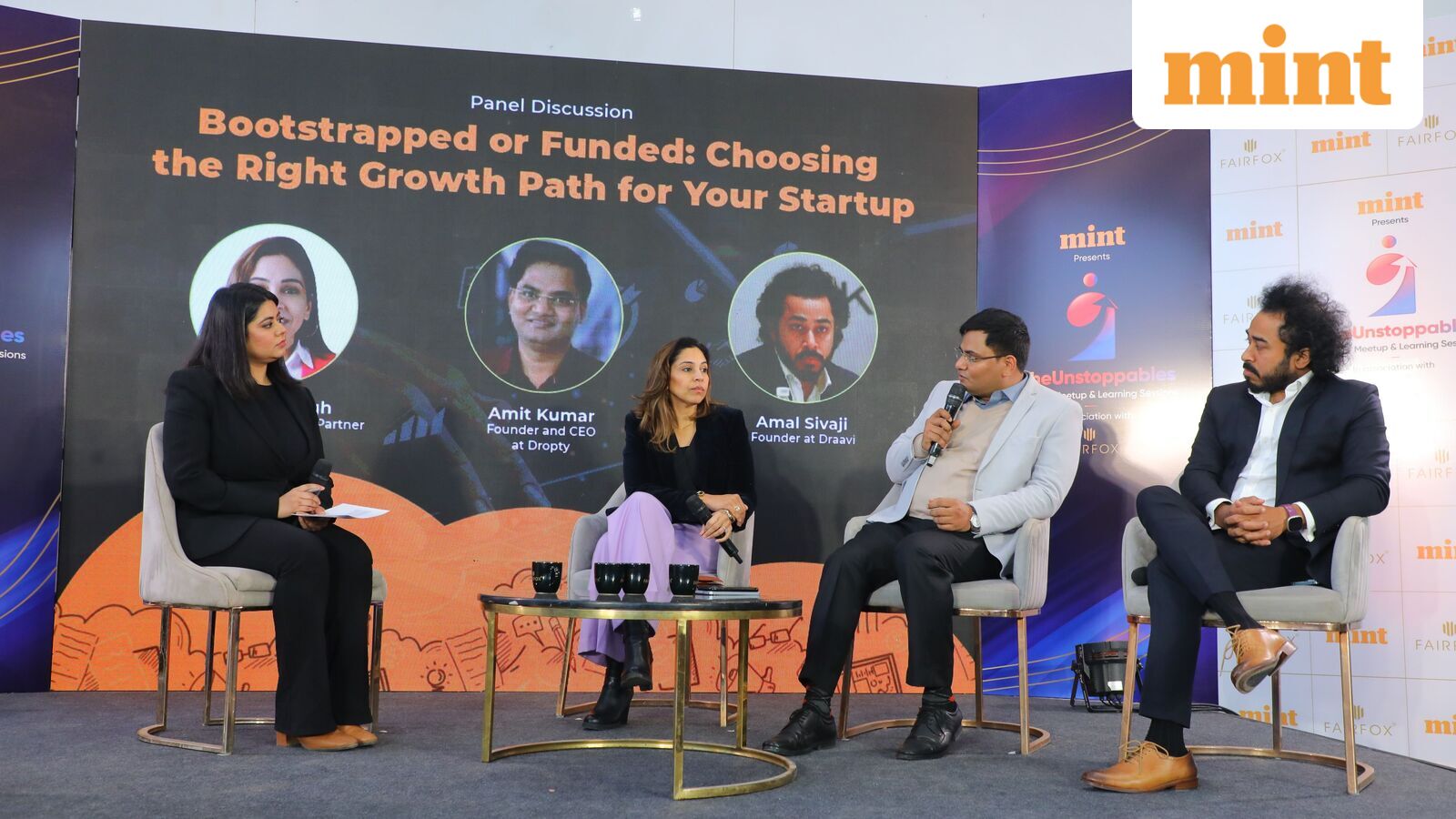
The Indian start-up ecosystem is currently witnessing a transformative phase where the definition of success is shifting from capital raised to sustainable growth. To explore this evolution, Mint, in association with Fairfox EON, recently hosted the second edition of ‘The Unstoppables,’ a Founders’ Meetup and Learning Series on Friday.
Named after the unstoppable founders driving India’s innovation economy, the series aims to consolidate the extensive knowledge within the ecosystem. The goal is simple – to make high-level insights available to those currently building and scaling their start-ups in a ever evolving environment.
Making a choice between bootstrapped or funded
The event kicked off with a high-impact panel discussion titled ‘Bootstrapped or Funded: Choosing the right growth path for your start-up.’ The session sought to decode the critical moments when a founder must decide if, when, and why to raise capital.
Moderated by Aayesha Varma from Hindustan Times, the panel featured diverse perspectives from industry veterans: Anisha Singh, Founder and Managing Partner at She Capital; Amit Kumar, Founder and CEO at Dropty; and Amal Sivaji, Founder at Draavi.
Through real-world perspectives, the discussion covered the delicate trade-offs between maintaining absolute control through bootstrapping and accelerating growth through external funding.
The hybrid approach and persistence
Anisha Singh, who has seen the ecosystem from both the founder’s and the investor’s lens, noted that the lines between bootstrapping and funding are becoming increasingly blurred. She suggested that sequencing, which means proving the model before seeking capital, is becoming a popular strategy in the current funding environment.
Sharing advice for a bootstrapped founder who is trying to scale, Anisha Singh said: “It’s not about fundraising or bootstrapping. Given the environment, which is a bit hard, I am seeing that bootstrapped founders sequence it out and then go out and raise money. If you really believe in what you are doing, a no is not a definite no.”
The reality of Indian venture capital
The conversation then shifted to the specific challenges of the Indian market. Amit Kumar highlighted the differences between the investment cultures of the West and India, noting that Indian investors often have extremely high expectations for immediate and big returns.
Amit Kumar felt that it is simpler to raise funds in a market like the US, unlike in India. “In the Indian scenario, every investor looks for a 10X return. It will not be possible in the future,” he said, suggesting that both founders and investors may need to realign their expectations toward long-term sustainability.
The one way ticket of external capital
The discussion also took the focus on when founders should avoid raising money. The panel warned against the FOMO (fear of missing out) culture, where founders raise funds simply because their peers are doing so.
Amal Sivaji emphasised that entering the venture capital cycle is a commitment that fundamentally changes the DNA of a company. “You need a clear reason to raise as against just that everybody else is raising.. there are compelling market reasons, product stage reasons. Once you start fundraising, you can’t go back. It is a one-way ticket,” Sivaji cautioned. He also spoke about how early stage founders can build a strong fundraising runway and approach pre-seed and seed fundraising with confidence.
Looking at strategic assets beyond the balance sheet
While the panel focused on financial capital, the event also touched upon the importance of physical infrastructure in a start-up’s journey. Bhupesh Nagarkoti, Senior VP – Sales & Strategy, Fairfox IT Infra shared insights into the residential and commercial landscape of the Delhi NCR area.
Nagarkoti highlighted a significant mindset shift among modern entrepreneurs. She spoke about Fairfox’s projects and how founders are now viewing office spaces not merely as a monthly expense, but as a strategic asset. In the race for quality human resources, a well-designed workspace serves as a critical tool to attract and retain the right talent.
Founder’s Roadmap
The Unstoppables session served as a reminder that there is no one-size-fits-all roadmap for a start-up. Whether a founder chooses the grit of bootstrapping or the high-octane fuel of venture capital, the decision must be driven by product readiness and market demand rather than external pressure. As the Indian start-up story matures, these learning sessions continue to provide the blueprint for the next generation of resilient builders.
Note to Readers: This edition of Mint’s The Unstoppables workshop for early stage founders is presented in partnership with Fairfox EON.