
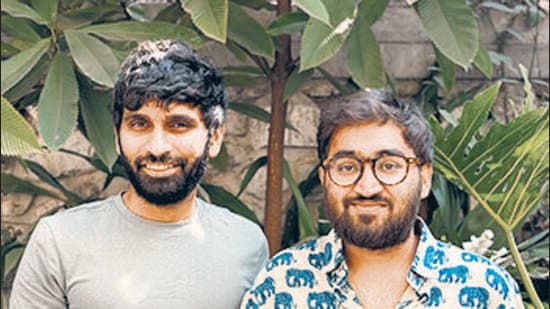
For Aditya Rai and Advaith Inamke, entrepreneurship just fell into their laps. There was no look-out for a need gap, no chasing different ideas. It was simply a deep love for food that led to the founding of the Nomad Food Project in 2018.
 Co-founders Advaith Inamke (L) and Aditya Rai. (HT PHOTO)
The duo was studying at Mumbai’s Institute of Hotel Management and were together in their final year to work on a research project. Says Aditya, “At first, we thought of doing research on IVF meat that you could derive from the stem cells of a cow. But then our professor told us that it was tricky. So we then thought of bacon.” They chose bacon for many reasons, but chiefly because they both loved it. Says Aditya, “We thought that while our country has a huge array of condiments, there are a zillion pickles and achaars, but there was no condiment with bacon as they have in the West. Our idea was to use bacon to create condiments with bacon that had an Indian flavour.”
They took their bacon bourbon relish around to chefs and food connoisseurs for tasting. Says Aditya, “They loved it. In fact, some restaurant chefs even asked us to sell our bacon bourbon relish by the kilo.” But they were unfazed by the keen interest their new product got. In fact, when they had to present their work to the panel of judges at college, they too were very impressed. Says Aditya, “They told us that we could actually build a business around our product and not leave it as a research project.”
Despite the advice of the panellists at college and the orders placed by some restaurant chefs, the duo still wasn’t ready to jump into setting up their own business. Says Aditya, “Like every other kid, our goal was to take up a job.” So in 2017, they both started their careers with a job – Aditya worked as a cook in a European-style kitchen in Delhi and Advaith as a salesman with a wine company.
But the rigours of the job got to them within a year. That was the time when they were offered a consultancy to run the kitchen of an ayurvedic resort in Pune.
Initial steps
Says Aditya, “What our panellists told us in college stayed with us. So I told Advaith that I was going to give our bacon condiments a try. It was during Navratri, and Delhi had a popular flea market where I paid ₹35,000 for a table and set to work. We had our recipes, but we now had to tweak them for bulk production. I made five products: bacon bourbon relish, bacon stout jam, churritzo jam and had two vegetarian items given that it was Navratri- mango chilli jam and pineapple chilli jam. I made 100 jars of each and, with great expectations, went to the event with my jars.
“Unfortunately, the first two days it rained, so no one could sell anything. But on the third and last day, which was a Sunday, I sat with my 500 jars and every single jar of our bacon condiments was sold!” Despite it being Navratri, this sale told them one thing clearly – people want bacon condiments with an Indian flavour, the way they made it.
Meanwhile, Advaith had developed a network of people in the hospitality industry, and he managed to get them a consultancy to run the kitchen of an ayurvedic resort in Pune. Aditya moved to Pune, and the duo asked the owner if they could use his kitchen to cook their bacon condiments. He agreed, and so in 2018, the two started making and selling the bacon products that they manufactured at the resort kitchen.
“We would take one day of the week to cook our bacon relish, jam, etc. Make about 400 jars every week. Meanwhile, Advaith had built a digital presence for Nomad Food Project on shopify and they started getting orders. Initially, for a month or two, the orders came in slowly, but after that, the jars were going off the digital shelf quickly. Says Aditya, “Shopify helped us build our website, and Advaith did the social media marketing, so we were very frugal. In fact, shopify also gave us insights on what product is a fast selling one, and we could make adjustments accordingly. We never had unsold inventory.”
Soon, they hired more staff to help them with their cooking. “We got a guy who had studied just up to the eighth standard but was a quick learner and very diligent. He was our first hire and today is head of operations.”
Spreading their wings
Simultaneously, whilst running the ayurvedic kitchen, the duo participated in flea markets in Pune, Mumbai, Kerala and Bengaluru. Despite this, the Nomad Food Project was a sidekick while they focused on the consultancy. But fate had other plans. In 2020 Covid struck, and the world shut down. They realised that their own startup needed more attention, and with the resort shut down, they could actually focus more deeply. So they quit that job and hired a flat in Bhugaon that would serve as their kitchen, and Aditya hired a small flat below the kitchen. Now they were full time focussed on their startup.
To market
Says Aditya, “We had no plan, we simply went with the flow. We made our products, got orders from our website, and sold them. We hired a kitchen space and kept on doing the same thing. Doing what we thought was right. Sell online and via flea market events.” But no business can stay static. So they registered on Amazon.
Says Aditya, “Whatever money we earned from our business, we pumped back. About ₹80,000 from our earnings. We hired an agency to do our social media marketing, and sales grew to ₹50 lakhs revenue. We were decently profitable and were not burning cash.
As the business focus was on marketing and advertising, Aditya felt it was time to expand their offering. He created the bacon thecha that became a big hit in the industry. In 2021, they started selling on Amazon.
At that time, they got an offer to be featured on Shark Tank. Says Aditya, “We had to fill in some 20 pages of questionnaire, and finally we were called to the studio. We knew nothing about how TV shows work, and to our pleasant surprise, at the end of the show, the judges themselves offered to invest in our business.”
Up until then, they were doing what they felt was right, and now they had an infusion of ₹40 lakh from four of the Sharks – Namita Thapar, Vinita Singh, Ashneel Grover and Ghazal Alagh. Says Aditya, “We used up the cash to buy machinery. We got machinery for jar filling, sealing, capping and labelling. Hired six people for marketing and started doing multiple flea markets in different cities.”
The big mistake
With money in their pockets, it was natural that they increased their marketing budgets. “All this spending helped, and in 2022, we breached the ₹1 crore mark. Our run rate would keep going, but we miscalculated. We were doing many more flea markets, and the expenses were not the same. What cost us ₹ 35,000 in 2018 is now ₹ 60,000. Where one has very small margins. We were doing it for brand visibility, but soon our funds started drying up. We had money to run our business, but not for marketing that was helping us drive numbers.”
Being frugal wins
After the heavy spending post-investment by the Sharks, the duo decided to go back to the early days when their spends were more controlled. Says Aditya, “Instead of running 10 advertisements on Meta, we now run two or three. We cut back on our staff and had to let go of four of our six people. After hitting ₹1 crore, our numbers fell to ₹90 lakh and now have regained ₹1.5 crore.”
Future plans
While their products were positioned as premium, they now realise that they will have to add a mass product to their line. Says Advait, “We will develop a sub-brand under Nomad Food Project that will be priced in the ₹200 range. With multiple products, we can reach a wider audience. We are also planning to export to the UK, the US and Australia. As we have the US FDA approval. We did export to Singapore, but they have now banned pork from India. But we are looking at the Western countries. Meanwhile, we plan to keep doing events across the country along with advertisements.” They may have started as reluctant entrepreneurs, but now are sharpening their strategy skills to keep up the growth momentum.