
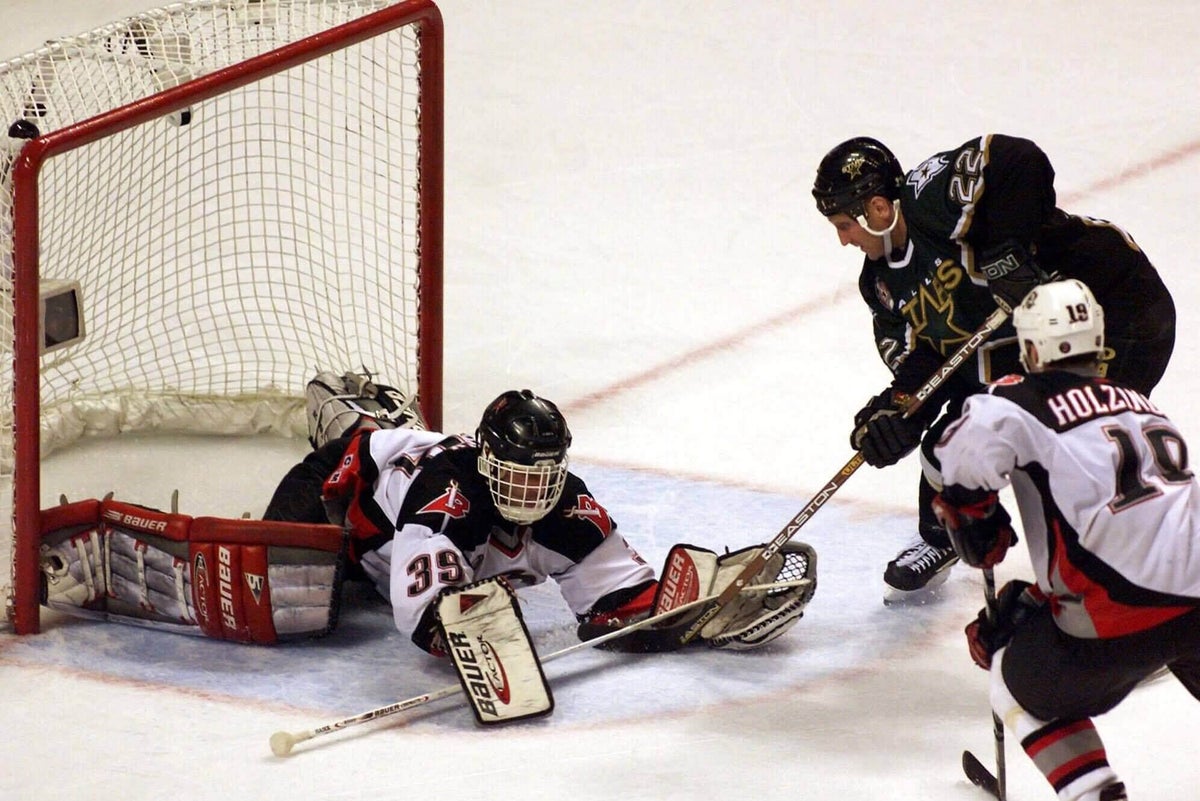
BUFFALO, N.Y. — Buffalo Sabres head coach Lindy Ruff knows better than most what Sean McDermott and the Buffalo Bills are going through.
The Bills’ 33-30 overtime loss to the Denver Broncos in the divisional round on Saturday was the latest heartbreaking end to a Buffalo sports season. And it is also the latest Buffalo sports loss with an officiating controversy. Bills receiver Brandin Cooks initially appeared to catch the ball, and then, as he went to the ground, Broncos defensive back Ja’Quan McMillian ripped the ball from his hands. The play was ruled an interception. McDermott called timeout, hoping to get a better explanation and implore the officials to take a closer look at the play. A completed pass would have put the Bills in range for a game-winning field goal. Instead, the Broncos went down the field and made a game-winning field goal.
Ruff was feeling the emotions other Buffalonians were feeling in the aftermath of the game. But he also could empathize with McDermott as a coach. During the 1999 Stanley Cup Final, Ruff was coaching the Sabres when their season ended due to a Brett Hull goal in triple-overtime of Game 6. As the Dallas Stars were celebrating their championship, Ruff had a closer look at the goal and realized Hull’s foot was in the crease before he swiped the puck in. Ruff was irate, pleading with NHL commissioner Gary Bettman to review the goal.
“I wanted Bettman to answer why there was no review,” Ruff told reporters after the 1999 game. “He almost turned his back on me. There was no answer. There was no review. It was as if he knew it was tainted.
“This was the worst-case scenario. This was the worst nightmare.”
After the series, Sabres fans gathered at city hall to thank the team for the season. Ruff stepped up to a microphone and offered two words: “No goal.” That sent the crowd into a frenzy. It has lived on as one of the biggest what-ifs in Buffalo sports history.
After Saturday’s loss to Denver, McDermott delivered an impassioned rant against the call on that overtime pass to Cooks.
“It’s hard for me to — and I’ve had a chance to look at it — it’s hard for me to understand why it was ruled the way it was ruled,” McDermott said after the game. “If it is ruled that way, then why wasn’t it slowed down, just to make sure that we have this right. That would have made a lot of sense to me. To make sure that we have this thing right, because that’s a pivotal play in the game. We have the ball at the (20-yard line) and maybe kicking a game-winning field goal right there.
“ … But I’m saying it because I’m standing up for Buffalo, dammit. I’m standing up for us. What went on — that is not how it should go down, in my estimation. These guys spent three hours out there, playing football, pouring their guts out. To not even say, ‘Hey, let’s just slow this thing down.’ That’s why I’m bothered.”
Ruff couldn’t help but think of his own experience nearly 27 years ago.
“The play that Sean was talking about is eerily like our ‘No Goal’ in ’99,” Ruff said after Sabres practice on Sunday. “You know, what’s the rule? We’ve had that debate. I totally get it. If I looked at the football game against the Jags and it took two or three minutes to decide whether the clock expired, why wouldn’t it take two or three minutes to decide whether this guy was down on the ground with the ball and had been touched and is that a catch? Why was that definitive so fast? I don’t know enough about it to even be standing here commenting, but like most Buffalo fans, it just felt like you had been stabbed in the gut with a knife. That’s what it felt like to me.”
After Saturday’s game, referee Carl Cheffers spoke with a pool reporter and explained, “The receiver has to complete the process of a catch. He was going to the ground as part of the process of the catch, and he lost possession of the ball when he hit the ground. The defender gained possession of it at that point. The defender is the one that completed the process of the catch, so the defender was awarded the ball.”
Cheffers also said the ruling was upheld by a review in New York. That explanation didn’t sit well with McDermott.
“That play is not even close,” McDermott said. “That’s a catch all the way. I sat in my locker and I looked at it probably 20 times, and nobody can convince me that that ball is not caught and in possession of Buffalo. I just have no idea how the NFL handled it, in particular, the way that they did. I think the players and the fans deserve an explanation.”
Ruff knows what McDermott was feeling. The Bills played an imperfect game with four other turnovers in addition to the controversial interception. Like the Sabres in 1999, there were other factors that led to their season ending. But in the immediate aftermath, it’s hard to reconcile with one of those factors being something outside of your control.
“It’s nothing more than just being emotional about the game and how it ended,” Ruff said. “You’re not blaming. You want a better explanation. You feel like maybe there was a better call to make like tie goes to the offensive guy. Tie goes to the runner in baseball. I thought tie went to the offensive guy in football. I might be a biased Bills fan, though. That’s probably the way everybody will take it.”