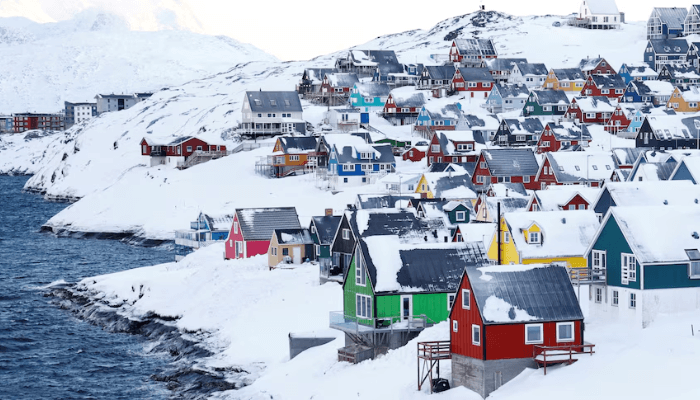
Donald Trump, the United States president, has turned an Arctic island into the centre of a major transatlantic crisis. He insists that America must take control of Greenland for its own security, has not ruled out the use of force, and is threatening European allies with new trade tariffs to press his case.
“If we don’t take Greenland, Russia or China will take Greenland,” Trump said, framing the issue as a race between great powers rather than a diplomatic dispute.
Greenland is a vast, self-governing territory within the Kingdom of Denmark, home to about 56,000 people. It moved from colonial rule in 1953 to home rule in 1979, before gaining wider self-government in 2009. Denmark still controls foreign affairs, defence, and monetary policy, while Greenland runs its internal matters, including education, health, and local governance.
Yet Washington now sees it as one of the most strategically valuable locations on earth.
Concerns about Greenland’s future intensified after the United States launched a military operation in Venezuela in early January and seized President Nicolás Maduro.
Throughout its history, the US has acquired land from other countries multiple times primarily through purchases, treaties, annexations, and cessions.
Read also: Europe sends troops to Greenland as Trump renews claim on Arctic island.
Alaska was purchased from Russia in 1867 for $7.2 million, and Louisiana from France in 1803 for $15 million.
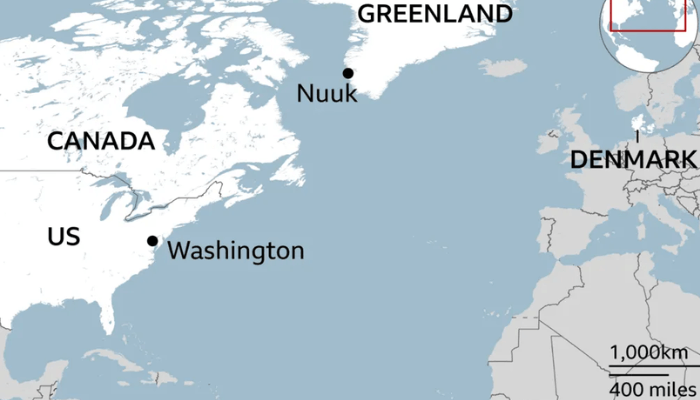 Credit: The BBC
This is why the United States wants it.
A frontline in modern warfare
The island sits between North America and Europe, along the shortest military route between Russia and the United States. Any missile launched from Russia towards America would most likely pass over the Arctic. This turns Greenland into a frontline state in modern defence planning.
Read also: We choose Denmark, Greenland pushes back against Trump
That is why the United States has operated Pituffik Space Base, formerly Thule Air Base, since World War Two. The base is now a key part of America’s missile early warning and space surveillance network.
For US military strategists, losing influence over Greenland would mean weakening one of America’s most important outer defence lines.
The Arctic is opening up
As Arctic ice melts, new shipping routes are opening across the top of the world. These routes can cut weeks off journeys between Asia, Europe, and North America. In the future, they could rival the Suez and Panama canals.
Greenland sits beside these emerging sea lanes. That gives it growing importance in global trade and naval strategy. Control and influence in the Arctic will shape future economic power.
The minerals behind modern technology
Greenland is rich in rare earth minerals such as uranium and iron, amongst others. These are essential for smartphones, electric vehicles, wind turbines, and advanced weapons systems.
Read also: Trump keeps military option open as allies rally behind Denmark over Greenland
China currently dominates the global supply chain. For Washington, relying on a rival power for critical materials is now seen as a national security risk.
Securing alternative sources has become a priority. Greenland offers large, largely untapped reserves located close to American territory. Keeping these resources out of Chinese control is a major strategic aim.
Energy
The island is also believed to hold significant offshore oil and gas reserves. Environmental concerns have slowed exploration, but future energy shortages could change that calculation.
Read also: Trump appoints envoy to Greenland as Denmark, the island leaders push back
Why has the issue become explosive
Greenland and Denmark have both made their position clear. The island is not for sale. Greenland’s leaders say its future can only be decided by its own people, not by foreign powers.
Trump has responded by sharply increasing the pressure.
He has threatened to punish European allies economically unless they support his plan. The US president announced an additional 10 percent tariff on goods from Denmark, Norway, Sweden, France, Germany, the Netherlands, Finland, and Great Britain, countries already facing earlier tariffs imposed in 2025.
The new duties will apply to “all or any goods” from February 1.
In a post on Truth Social, Trump said the tariffs would rise further to 25 percent on June 1 and would remain in place until “such time as a Deal is reached for the Complete and Total purchase of Greenland”.
Both Copenhagen and Nuuk have rejected the demand outright. Denmark insists that Greenland belongs to its people. Greenland’s government has repeated that the island is not for sale under any circumstances.
In a rare show of unity, Greenland’s political leaders, including the opposition, issued a joint statement condemning what they called “the US’s disregard for our country”.
Their message was direct. “We do not want to be Americans, we do not want to be Danes, we want to be Greenlanders. The future of Greenland must be decided by the Greenlandic people.”
Faith Omoboye is a foreign affairs correspondent with background in History and International relations. Her work focuses on African politics, diplomacy, and global governance.